


It’s no secret that there are problems in South Africa. For those in the know, we understand just how bad the situation has gotten. However, there are still many people who do not understand exactly what is going on. So, before I get into the most recent event, I will give a brief summary of the situation.
Before the apartheid was ended, South Africa was a White-minority run government. However, after apartheid was ended, the government became became dominated by blacks. The African National Congress (ANC) freed Nelson Mandela and a universal adult vote saw him elected as South Africa’s president. For many people, they hear this and they believe it’s progress, but South Africa is a devolving state.
The ANC remained in power for the next three decades, having won every national election from 1994-2019. As time went on its vote share declined and other parties became more popular. I will talk about those in just a second.
After apartheid, the South African economy constantly struggled with very high unemployment, persistent poverty, electricity shortages, weak infrastructure, declining industrial competitiveness, and significant government debt. It turned out, having Whites controlling the government and holding the high position jobs was actually what created civilization.
The most visible issue, besides the clear degradation of the environment and infrastructure, has to be the on-going electricity crisis. Eskom, the state-owned electricity utility organization, cannot effectively operate the electrical grid. To the point where South Africa constantly load-sheds—meaning scheduling electrical outages—because they cannot generate a sufficient amount of energy to keep them on-demand. The issue is at its greatest now.
As you can imagine, violent crime also skyrocketed as murder, robbery, assault, and organized crime became common occurrences in the country.
During the Zuma government (2009-2018), South Africa became synonymous with corruption. The term “state capture” came to describe allegations that politically connected businessmen, particularly the Gupta family (Indian, of course), exercised extensive influence over government appointments and state-owned enterprises.
“Kill the Boer”
Earlier I spoke about the ANC declining in power. After apartheid was ended, the ANC pursued land distribution policies. However, they were not successful in tackling the issues that the country was facing. Despite that, their are still some that believe that the Whites are the root of the issue. The ANC not delivering on their promises, facing corruption, and with other parties rising, the ANC made a deal with the Economic Freedom Fighters (EFF).
The EFF is the 3rd largest party in South Africa and a communist party at that. The EFF became internationally recognized for their 2023 rally where they sung a longtime White genocide song, “Kill the Boer.”
A month after the rally where EFF leader Julius Malema sang the White genocide anthem, attacks on White farmers increased throughout the country. In August alone, there were 22 attacks on farms in South Africa and six farmers were killed. AfriForum, an organization that represents Afrikaners (Boers are a subset of this group), reported that in 2022 there were 333 attacks on White farmers. In the same year, 50 farmers were killed in those attacks. Between 2019-2021, AfriForum reported that there were at least 1,310 attacks on farms in South Africa resulting in 163 deaths. This is equivalent to a rate of 437 attacks per year and 54 deaths on average per year.
According to a report, only 5% of the attacks that occurred between 2019 and 2022 were resolved in court, which is 66 of the 1,402 total attacks. In the provinces of Gauteng, Mpumalanga, North West and Northern Cape, no one has ever been found guilty of violence against Boers. The writer’s of the report concluded:
“Weak investigative work, ineffective prosecutions and a clear unwillingness of the government to tackle rural safety and farm attacks in particular are probably the reason for these shocking findings.”
There have also been reports of an attack on a farm in KwalaZulu-Natal province in which attackers imitated Malema and sang the song while raiding the property of Tim and Amanda Platt. According to AfriForum, four armed men entered the couple’s farm where they attacked the Platts. Amanda was beaten several times with blunt weapons, in addition to being stabbed with a spear. Amanda noted that they were singing and shouting “Kill the Boer.” Fortunately, Amanda was able to escape from her attackers and was able to get a gun to protect her and her husband. But not everyone is so fortunate.
Jacques Broodryck, a spokesperson for AfriForum, told Voz Media:
“We find ourselves in a situation where farmers are literally being murdered and tortured. So you can see how a party like the EFF, chanting ‘Kill the Boer, Kill the Farmer’ to thousands of people, certainly doesn’t help. We believe that this is incitement and that it undoubtedly influences the frequency of attacks.”
Expropriation Act 13
In 2024, South Africa enacted Expropriation Act 13, which was signed into law in January of 2025. This new act allows the black dominated government to take White owned properties without any reason and without having to pay any kind of compensation to the White farmers they take the property from—found in Section 12(3).
Because the law says that the land must be taken “for public purpose or public interest,” they use manufactured excuses to take land from its rightful owners.
The act also allows farms to be claimed on the basis of “dispossession” occurring decades before the current owner acquired the property. Meaning that all that some black needs to do is make a claim for the land. So even if land has been in a White person’s family for hundreds of years, blacks have a claim on it. That’s not the worst part of this act.
The government is able to establish “public-purpose/public-interest expropriation” by issuing the White owner a notice of intention, where they have 30 days to submit objections. But these objections are often disregarded. So what would happen if a White farmer was deemed to be a threat to the public?
The act has a clause that allows the government to use urgent means to temporarily take the land if there is a “real and imminent danger to human life or substantial injury or damage to property.” This allows the government to modify normal procedural requirements. If a White farmer was said to be actively threatening people with violence from their property, the government could take emergency measures against the “threat.”
A New Martyr
Last Sunday, a Boer Nationalist, Cornelius Van Dalen, was confronted by police on a farm property he was renting in Robertson, South Africa. Allegedly the police had received a complaint that Van Dalen was taking pot shots at his neighbors car. However, from the video below, we can see that the police didn’t respond in the way that we would assume. In the video below, the police are standing at his gate and they’re speaking to each other in a calm manner. Van Dalen certainly seems annoyed, but he agrees to allow one police officer to enter the compound to check his weapon.
However, you will also note that the neighbor and accuser (who is filming the interaction) is antagonizing Van Dalen in order to make him act in an aggressive manner.
Despite Van Dalen’s best efforts, the police refused to meet him halfway. Instead we have footage of the police obscuring Van Dalen’s property cameras.
In the video below, you will see one of the black officers unholstering his gun in anticipation while two other officers are still speaking with Van Dalen.
It seems that regardless of what Van Dalen wanted, the police had intent to raid the property.
News outlets are now reporting that Van Dalen was already taking shots at police before they had a conversation with him:
“Van Dalen’s death stemmed from an incident on Sunday (16 August) when he fired shots at a neighbour’s car, damaging the vehicle. Van Dalen also fired several shots at the local police and farm owner Karl Smith when they were on their way to attend the scene.”
But, if that were the case, then why would they all be standing outside his gate talking to him like he wasn’t supposedly taking pot shots at the police?
Robertson, South Africa, has massive drug cartel issues. Among many of them is the fact that Van Dalen made the following Facebook post during the standoff with police.
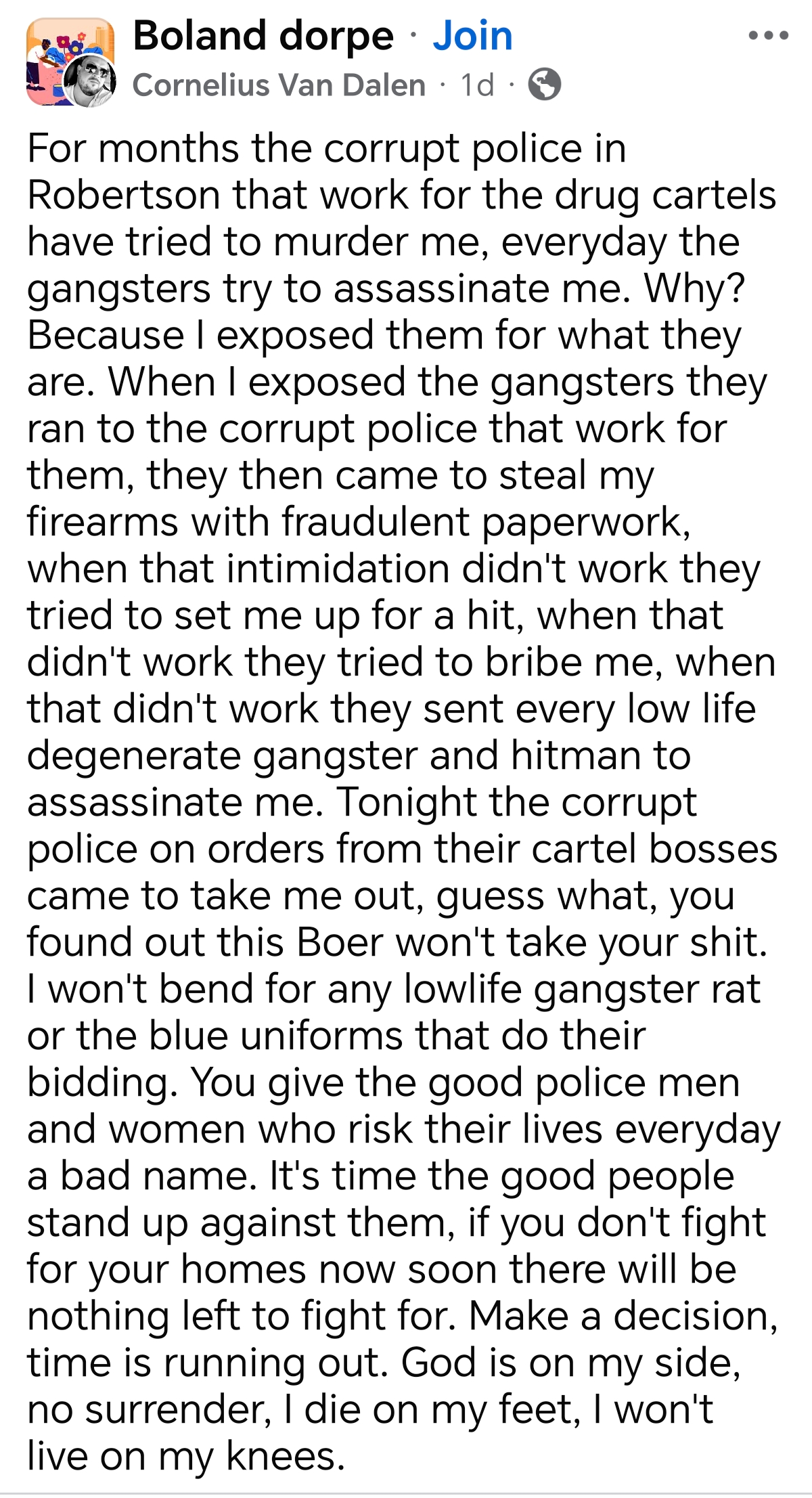
And what we know now is that the Hawks (DPCI), South Africa’s specialized agency for serious organized crime, serious commercial crime, and serious corruption began investigating the scene Saturday. If the allegations didn’t have some truth to them the Hawks wouldn’t investigate.
Robertson, a town of 9,355 (as of 2011), is located in the Western Cape province with a population that is 42% White. It has a massive drug problem. In June of 2022, searched 30 drug premises and 25 residences. They seized roughly R45,000 worth of cannabis, while another suspect was arrested with Mandrax and tik.
In September 2023, Robertson police seized 1,068 Mandrax tablets from a vehicle during a checkpoint.
Robertson has a well established drug problem, but it isn’t a drug center. Instead the drugs are distributed into farming communities like Robertson from Cape Town and Worcester.
Western Cape province also has a massive corruption issue. A Western Cape High Court judgment in 2022 found evidence that stated gang members had infiltrated senior SAPS structures in the province and could obtain sensitive police information. The Western Cape Premier subsequently asked the Police Ombud to investigate alleged SAPS–gang links.
A subsequent GI-TOC investigation has documented allegations of police officers:
passing information about raids to gangs;
diverting investigations away from particular gangsters;
recirculating seized drugs and firearms;
and participating in extortion and fraud.
So, Van Dalen’s allegations have some basis as both police corruption and drug cartels are both documented problems in Robertson.
On Saturday, Boer nationalists got together to hold a memorial for Van Dalen, who has been likened to America’s Robert Matthew.
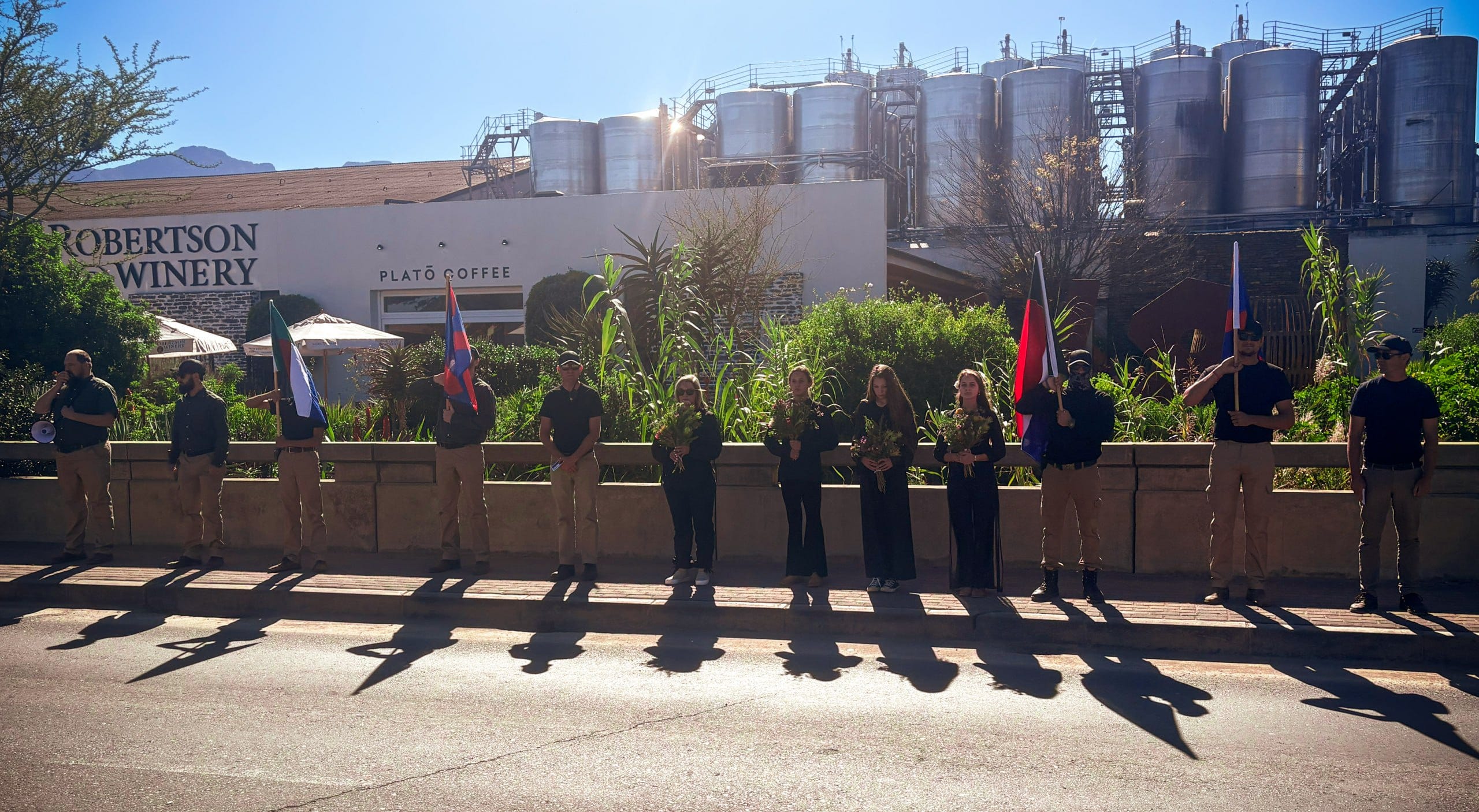
The Telegram message from the memorial post read:
On Saturday, our members in the Western Cape region came together in the town of Robertson to pay respect to a fallen hero. Vryburgers waved the Vierkleur and put up white crosses bearing Cornelius' name around town.
It was Sunday, the 16th of August, when Cornelius van Dalen bravely stood his ground as police started harassing him at the Robertson-area farm house that he rented. The incident eventually led to a standoff much like that of Ruby Ridge in the US, when Cornelius refused to surrender. An image now circulating on social media shows stickers of the Vierkleur flag and the Sonnenrad on Cornelius's vehicle, along with the phrase "Eendracht Maakt Macht", indicating that he was a White Nationalist who also stood for the Boer cause.
In typical fashion, the lying mainstream media immediately started running with the narrative that Cornelius was simply a crazed right-wing extremist who randomly and for no apparent reason open fired on his neighbours and the police.
However, it does not take a lot of research to figure out that there is more to the story and that the corrupt police are covering their own tracks.
As Boers, we live under an occupied government in our own homeland, forced upon us by an occupying police force that practises a two-tier, anti-white justice system. Cornelius stood up to this corrupt system and should be remembered as the hero he was.
The only option for Boers in South Africa is to unify and centralize in one area. They cannot exist if they remain separated in proximity to one another.
There is NOTHING worse than a race traitor, they should all be informed loudly of what they are doing, we must not tolerate traitors in our midst.
Was Cornelius's neighbor white?