


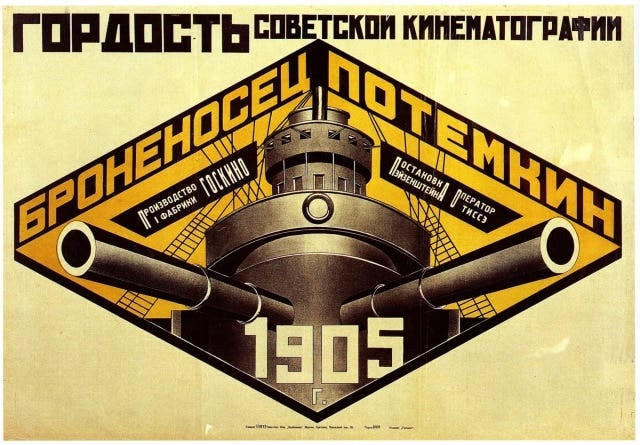
Democracy has always eagerly made use of the soldier’s boot as a symbol of the soldier and of the military state of mind. The many caricatures showing a coarse boot, trampling everything underfoot with ruthless brutality and mercilessly crushing whatever lies beneath its iron-studded sole, are still well known to us all. This image was perhaps most vividly realized in the Soviet-Russian film Battleship Potemkin, released some years ago. In one of its scenes, the entire screen is filled with rows of soldiers’ boots, descending the broad steps leading down to the harbor of Odessa in a terrifyingly uniform rhythm. For a long time, one sees nothing but these boots, rising and stamping down again in perfect unison.
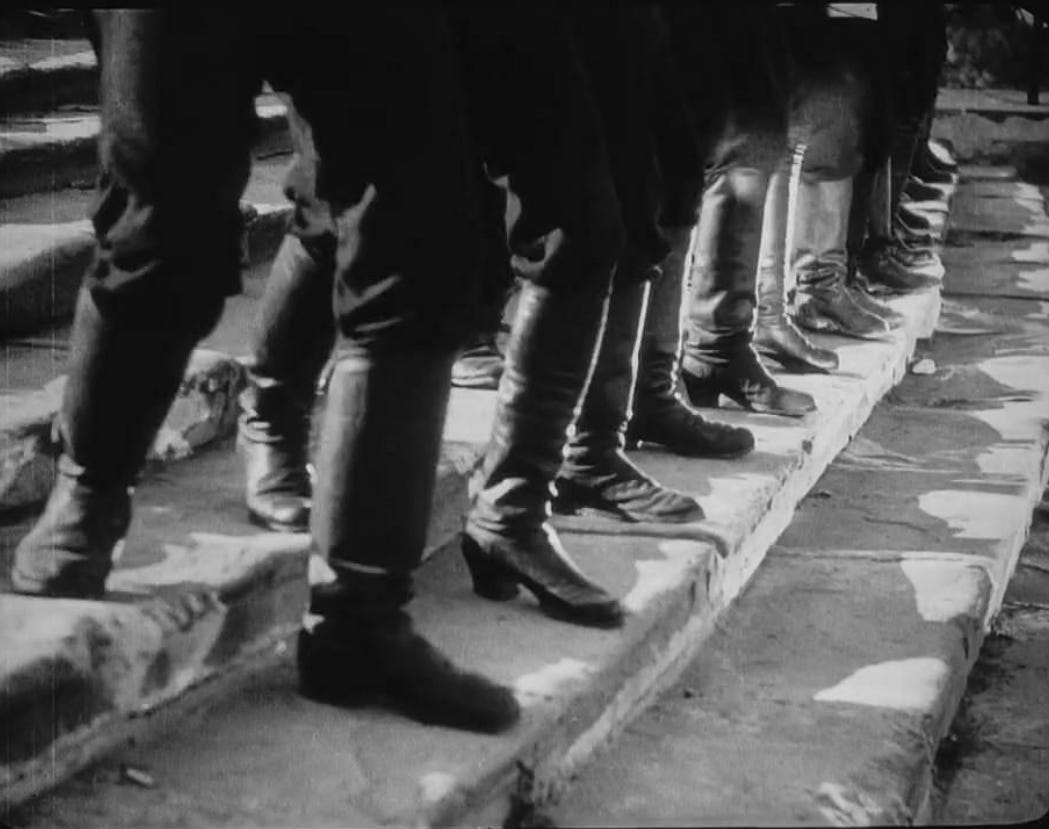
When this image finally disappears, the nerve-wracking cadence continues to echo, and before these symbols of violence and oppression we see the fleeing masses — men, women, and children alike. This scene, from that deeply suggestive film, is so immediate in its effect that for a long time afterward the viewer cannot help but associate soldiers’ boots with violence.
This, of course, was the aim of that democratic caricature: the soldier’s boot crushed everything that made life beautiful, even the most sacred things. Thus, soldierdom and culture were set against one another as two irreconcilable opposites.
How does the SS stand in relation to this?
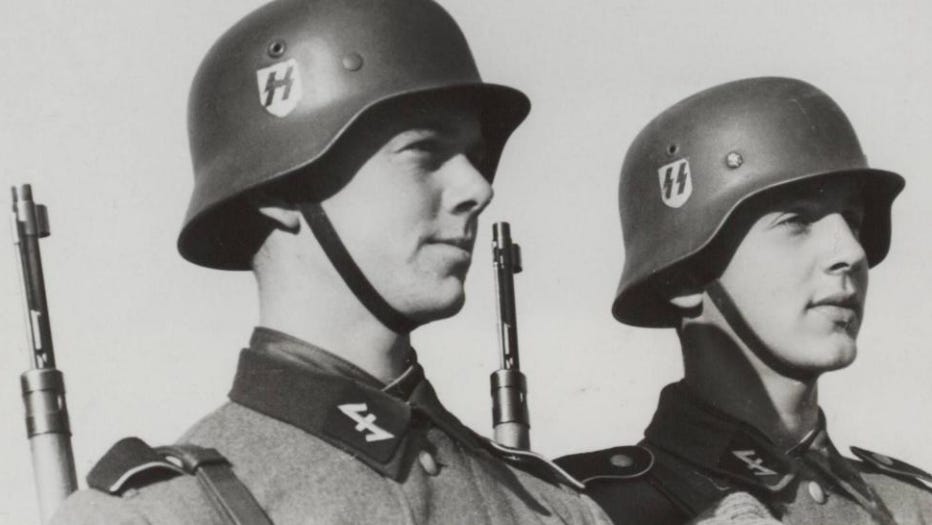
The SS is an organization built upon military foundations; all of us wear the soldier’s boot. Practically all its members stand, in these very moments as the military decision draws ever closer, in the ranks of the Waffen-SS. At the same time, the SS has always stood as a bulwark for the protection and defense of our cultural values and has proven that it does everything within its power to promote art and science. In this regard, we need only point to the scholarly conferences it has held, the exhibitions it has organized, and the archaeological excavations carried out by personal order of the Reichsführer-SS himself. To this end, he also founded the research society Das Ahnenerbe.
Von Clausewitz on War
In our understanding, therefore, there is no opposition between culture and soldierdom. What, then, is the true relationship between these two concepts for us?
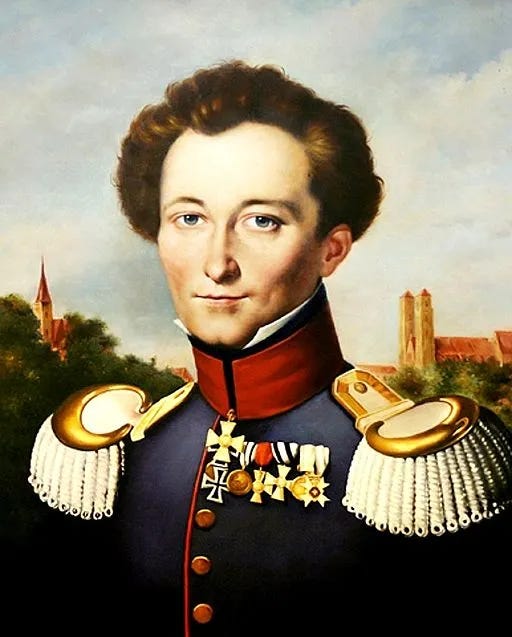
To understand, therefore, what it means to be a soldier, we must first and foremost make clear to ourselves what is meant by war. For it is only war that grants to soldiery its highest consecration. The classical theorist and philosopher of war is General Carl von Clausewitz, who, in his work Vom Kriege (On War), grasped and explained the deeper meaning of war in an unsurpassed manner.
In the first book of that work, Über die Natur des Krieges (On the Nature of War), von Clausewitz gives the following definition:
“War is thus an act of violence intended to compel our opponent to fulfill our will.”
In this formulation, the goal, the means, and the deeper motivating factor of the concept of war are clearly and precisely defined. At first sight, this definition seems fully to justify the opposition drawn by democrats and pacifists. For indeed, the imposition of one’s own will upon another—through acts of violence, no less—appears difficult to reconcile with the prevailing idea of culture. The caricaturist who depicted the soldier’s boot as a symbol of cultural destruction and an instrument hostile to civilization would seem, at first glance, to have been vindicated by the great military philosopher himself.
But matters are not so simple. As so often, appearances deceive. For von Clausewitz was not satisfied with this definition alone; he sought to penetrate more deeply into the essence of war. War, he observed, does not exist in isolation.
The circumstances from which it arises, under which it unfolds, and which are likely to follow its conclusion, all influence it and help to determine its character. In this lies a limitation upon the otherwise entirely correct definition. Clausewitz therefore proceeds further.

“The political purpose,” he writes, “as the original motive of war, will be the measure of it.” With this statement, a new element is introduced into our understanding of war—namely, that of politics. The background of war is political. The will that we seek to impose upon our adversary through war is not an arbitrary will, not mere caprice; it is our political will.
Developing this line of thought, von Clausewitz arrives at his famous conclusion: that war is the continuation of politics by other means, and that we must therefore not regard it as an independent entity, but as a political instrument.
Culture
Following Clausewitz’s reflections, we have now penetrated somewhat deeper into the nature of the concept of “war.” Let us now try to clarify what we mean by the word culture. We speak of cultivated plants, of bringing wild land under cultivation, but likewise of cultural creations, cultural treasures, and cultural nations. The meaning of this term is therefore very broad, and it is not simple to determine the underlying sense common to all these usages.
The word derives from the Latin “colere” — to tend, to care for, to bring to growth and fruition — and is closely related to cultus, meaning worship, religious observance, and the preservation of ancestral traditions.
The concept of culture, therefore, contains two essential meanings: on the one hand, the care and preservation of a people’s inherited spiritual heritage; on the other, the nurturing and unfolding of values that are already latent within it. Thus, cultivated plants are those that have been bred and tended so that their yield and quality are raised to the highest possible level.
Only through cultivation is the uncultivated state overcome, and the original form brought to a higher development.
When we apply this meaning to the life of a people, it follows that culture must always build upon something that precedes it — upon what is original and natural. Culture, in this sense, means the careful development and flowering of a people’s own character and way of life.
It has often been claimed that there exists a fundamental opposition between nature and culture, yet nothing could be less true. Nature and culture are not opposites but continuations of one another: the latter cannot exist without the former. Culture is the intensification, the deepening, the flowering of what is natural.
A phenomenon in social life that does not arise organically from the natural life of the people cannot be called culture, but at most civilization. There thus exists a real contrast not between nature and culture, but between civilization and culture. The very words express this distinction. In the sense we use it, civilization refers to external refinement — the smoothing of manners and appearances, the cultivation of the surface — without any corresponding transformation of the inner life. Culture, by contrast, grows from within, nurturing and developing the best inherent qualities and capacities of a people.
Politics
To be able to speak of culture, however, a second element is necessary. This follows directly from the preceding reflections. There must be a guiding and directing center—one that makes possible and furthers the unfolding of the people’s inherent powers. That this leading element must be most intimately connected with the people, indeed must arise from it, goes without saying.
The cultivation of a people’s life—the giving of leadership and direction to popular currents, the unification of the people’s forces, in short, the advancement of culture—is what we call politics in the true sense of the word.
Here, then, we find the point of contact between the concepts of soldiership and culture, which for the democrat seem mutually exclusive.
Culture is the aim of politics; it is the result of political activity. War is nothing other than a form of politics determined by circumstance—politics expressed in another guise, “politics by other means.”
The ultimate goal of war, therefore, is the same as that of politics: the unfolding, advancement, and safeguarding of a people’s native culture.
War is thus not an end in itself but a means. But politics, too, is not an end in itself, and equally a means.
Seen in this way, there is no opposition between soldiership and culture; rather, they belong together in the closest sense. We are therefore soldiers in the ordinary sense, but also political soldiers, united in one great purpose: the preservation and advancement of our Germanic culture.
The State
The organ that bears political life, and that likewise wages politics by other means—war—is the state. Soldier and statesman alike are the executors of its will: the promotion of their people’s culture.
To be a soldier, therefore, always means to cooperate—albeit by different means than the politician—in the realization of the political ideal, that is, in the furthering of culture. To be a soldier means, therefore, to be a protector of culture.
This line of thought is summarized by the Führer in Mein Kampf as follows:
“It’s therefore the first obligation of any new movement based on a racial worldview, to put forth a clear and logical doctrine of the nature and purpose of the State. The fundamental principle is that the State is not an end in itself, but the means to an end. It’s the pre-condition of a higher form of human civilization, but it’s not the cause. This cause is found exclusively in the existence of a culture-creating race.”
The soldier, in this respect, is likewise an executor of the state’s mission. That he may often do so unconsciously changes nothing of its essence.
The SS, however, must be fully conscious of this. The SS man is a political soldier; he must be completely permeated with the awareness that his being a soldier is not something isolated or self-contained, but that it gains its meaning and purpose through the political ideal: the culture of his people.
The SS man seeks to contribute to the advancement of that culture by all means—even by the means of the soldier, which must often be destructive and are therefore regarded by the superficial democrat as directed against culture itself.
Yet this destruction is no end in itself; no more than war is an end in itself, or politics, or even the state. None of these are ultimate ends, nor ever shall be, so long as National Socialism lives.
All these things are means—means that we, in the SS, consciously employ to bring the innate gifts of our people, given by nature, to their fullest development in the Reich.
Originally published in SS-Vormingsbladen, November 1944
Translated from Dutch by Hameçon
Purchase a copy of Arditi today!

Very insightful work. Thank you.