

Freemasonry: Ideology, Organization and Policy

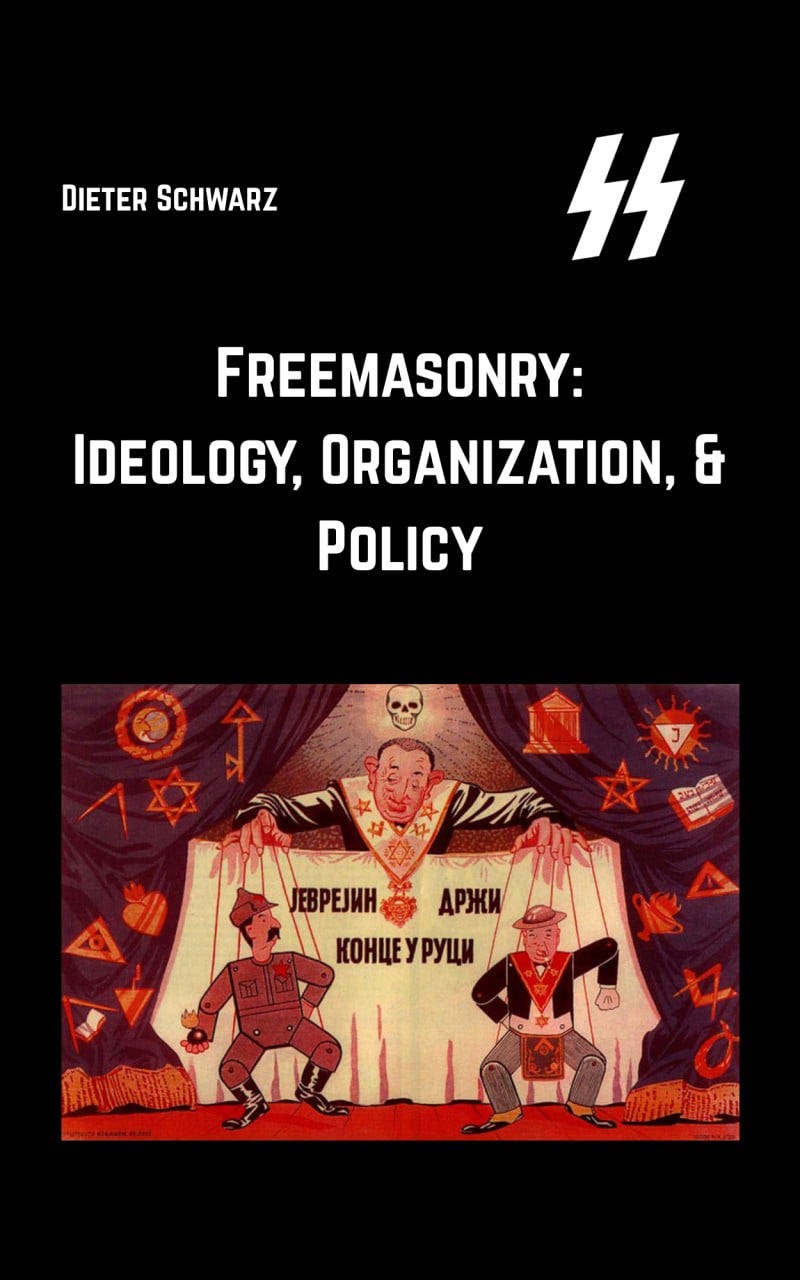
Foreword to the 7th Edition (2025)
The present edition is published at a decisive moment in world history. More than eight decades have passed since the Third Reich first laid bare the hidden hand of Freemasonry, and yet the struggle it warned of continues into our own century. What was once seen as an underground threat has adapted to the modern age, cloaking itself in new forms—digital networks, international finance, and cultural institutions—all serving the same corrosive ends that plagued Europe in centuries past.
This work does not claim to be exhaustive. It is, rather, a guide—an outline drawn from the archives of the 3rd Reich’s security services. Its purpose is to show the enduring hostility of Masonic thought toward the natural order of nations, families, and peoples. The contradictions first revealed in the twentieth century remain irreconcilable today.
History provides its proof. In 1917, Freemasonry stood at the height of its influence. By 1942, it was already crumbling under the weight of its own corruption, its lodges shuttered, its members exposed. Today, in 2025, it seeks rebirth under new disguises. But its hand can still be seen—agitating unrest, fueling resistance, and poisoning the minds of those who would betray their own people for the illusion of “progress” or “liberty.”
For this reason, the task of vigilance cannot end. The collapse of a lodge does not end the loyalty of its initiates. The banning of a symbol does not erase the corruption of thought. Italy long ago provided the warning: even where Freemasonry is outlawed, its adherents endure in secret, waiting for their moment to strike. So too today, in our own cities and nations, enemies of the state are emboldened by those who continue the Masonic spirit in all but name.
This 2025 edition is therefore more than a historical study—it is a call to awareness. May it remind every loyal citizen that the enemy adapts, survives, and resurfaces, and that only through constant vigilance can we secure the spiritual and political health of our community in this new century.
Ardito
Imperator
The New Way
2025
Freemasonry is an ideological form of hostility to National Socialism, the significance of which, in the historical development of the past two centuries, must be deemed comparable to the effects of other supranational organizations, the political churches, world Jewry, and Marxism. In its present form, it must be viewed as the bourgeois-liberal advance troops of World Jewry.
It corrupts the principles of all forms of government based on racial and folkish considerations, enables the Jews to achieve social and political equality, and paves the way for Jewish radicalism through its support for the principles of freedom, equality, and brotherhood, the solidarity of peoples, the League of Nations and pacifism, and the rejection of all racial differences.
With the help of its international connections and entanglements, Freemasonry interferes in the foreign policy relationships of all peoples, and pursues, through governmental leaders, secret foreign and world policies which escape the control of those in government.
Through its personal influences and economic favoritism, Freemasonry ensures that all dominant positions of the public, economic, and cultural life of a people are filled with lodge brethren, who in fact translate the concepts of Freemasonry into action. The National Socialist state has destroyed the organizations of Freemasonry in Germany, and has likewise given rise to similar measures in a number of European states during the present war. But the liberal, Masonic body of thought lives on in the former lodge brethren. In addition, there is still a danger of a renewed penetration of Masonic ideas through the lodge organizations of states in which Freemasons remain free to pursue their objectives without hinderance.
Thus, researching this enemy, and providing a basic education for all racial comrades on the topic of Freemasonry, is not just a matter of expounding upon interesting historical problems; rather, it is an urgent duty of alertness in the struggle against our enemy.
Freemasonry is tightly allied with Jewry, and not just through its organization. Even the symbolism of Freemasonry points to Jewry through its customs, and to Hebrew through its words and signs, as its real origin. The Masonic conceptual universe is a reflection of Jewish near-Eastern images and concepts.
The central point of Old Testament thought is represented by the concept of Yahweh as the Jewish “God.” Initially, the belief in many national deities prevailed among the Jews, for whom Yahweh was still an entirely insignificant desert god, until he sought out a “people” (the nomadic tribe of Israel) with whose help he could set about to dethrone all other gods and achieve world domination. In later Jewry, Yahweh was conceived of first as a High God, then as the One God; but his original nature was strictly retained. To Jewry, the name “Yahweh” implies a programme of world enslavement (see Isaiah chapter 60, etc.).
With the development of the concept of Yahweh, the centralization of the Jewish religious cult was complete. Instead of the original numerous places of sacrifice in Canaan, a single one appeared: first Shiloh (later Jerusalem); then the Royal Tent <Bundeszelt>, and later, the Temple of Solomon were considered the “House of Yahweh.” Just like Yahweh himself, the Temple became a symbol of Jewish plans for world domination (see Ezekiel, chapters 40-48; see also the New Testament, Revelation of St. John, chapter 21).
In the period after the Babylonian Captivity, “Prophetic Jewry” was supplemented by the priestly “Teachings of the Law” (Torah) and the “Books of Wisdom” (Chokmah). “Bourgeois decency” and social order were derive~ through heavy borrowings from neighboring cultures, while Yahweh was given a cosmic characterization as the “World Master Builder.” At the same time, the way was paved for internationalistic attitudes (spreading of Messianic teachings).
The spiritual attitudes of the Syrio-Phoenician “mysteries” merged with Old Testament thought about the time of the birth of Christ. The mysteries assumed a “feeling of sinfulness:” an inwardly torn human being to whom “divine mercy” was to be granted through mystical, that is, secret words, signs, and rituals, thereby achieving “salvation” and personal “eternal bliss.” All “evil” was attributed to the “Devil” (dualism). These concepts, sometimes depicted with great descriptive power, were reflected in the Jewish “Apocrypha” and New Testament texts around the time of the birth of Christ, as well as in the “Gnostic” writings of the following period.
This whole conceptual world was given a new lease on life through the symbolism and teachings of Freemasonry. The legend of Hiram, the symbol of the Temple with its religious strictures, the testing of courage upon acceptance into the lodge, the symbolic death ritual, the secret signs of recognition, embody in a perceptible, visual manner that which is later revealed in their teachings (the shaping of men from a rough stone into a cube, the building of a “Temple of Humanity,” the “Messianic,” “Empire of Peace” and of “World Brotherhood,” the rejection of all natural racial and political barriers in “World Brotherhood”). The symbols and teachings are, however, not uniformly developed based on definite original forms, but exhibit a colorful mixture of ingredients of the widest variety of types (syncretism), which makes it much more difficult to prove their origin in any particular case.
This Near Eastern conceptual world was first communicated to the entire West through the Church, which loyally guarded its Jewish “heritage.” The Arabian influence of Islam beginning in the 7th century, the experiences of the Crusades beginning in the 11th-century, as well as the influence of Jewish philosophers (Ibn-Gebirol, Maimonides, the Cabbalists) beginning in the 12th-century, led to a stronger emphasis on this Jewish-derived conceptual world. Jewish attitudes thus returned to the Western field of vision, whence they had been driven out by German scholasticism.
“Christian Cabbalists” (Pico de Mirandola) acquired particular prestige in the academies and religious associations of the Renaissance.
Scholars occupied themselves primarily with Hebrew texts, in which an eccentric search for “secrets” and bizarre insights may have played a part. These efforts were transmitted to Germany through Johannes Reuchlin and others. Secret societies were formed which attempted to build Jewish fantasies with theological elements into a system through an admixture of alchemy, mathematics, astronomy, and astrology, as well as magic.
Chapter 2
Development of Freemasonry outside Germany in the 18th century
1.) Development from the English working lodges in the 17th and 18th century.
In contrast to the character of Western building site huts and the customs of Western stone-cutters and stone-cutter associations, an orientally-derived picture of history may be observed in the Regius Manuscript of 1390 and the Cooke Manuscript of 1450, two of the oldest manuscripts relating to medieval English construction workers. These documents contain, in corporate lore, an extract, maintained in legendary form, of corporate history and by-laws (statutes) regarding behaviour within the corporation and the fulfillment of comradely duties towards fellow craftsmen. These two oldest documents were followed by several others of similar import. It is significant that the content of this corporate lore was always increasingly based, and in an increasingly detailed manner, upon the Old Testament legendary and conceptual world. It is claimed by Freemasons that these Old Testament foundations were brought into the corporations by “Reverends,” who looked after the spiritual well-being of the English corporations as pastors.
These “Reverends” played still another significant role in the development of Freemasonry. They were the first noncorporate members of the corporate societies, together with the noble patrons of the corporations who had assumed the representation of the guilds before the authorities, and who enjoyed advowsons (Translator’s note: the right to appoint a nominee to a vacant ecclesiastical benefice, involving property rights) through the guilds. Over the course of time, a situation arose in which these patrons and reverends introduced friends and relatives into the guilds, which had in the meantime assumed the name of lodges, as members. This was especially true of the stonecutter lodges.
Thus, as early as the second half of the 17th-century, we find a great proportion of such non-corporate members in various corporate lodges. In these associations, the concept of professional and guild comradeship receded increasingly into the background in favor of sociability. Outwardly, this development was characterized by the fact that these lodges moved their headquarters outside the guild halls and into taverns.
The belief that the contrast between guild masons and accepted, but non-guild members of the lodges, found its expression in the term “Free and Accepted Masons,” is unfounded. This designation was used for all lodge members, even guild member masons.
By the end of the 17th-century, we find the term “Freemason” already generally in use, as shown by several texts from the period and by a student joke at Trinity College in Dublin in 1688. In texts and descriptions from the 17th century, we also see non-guild members in the lodges already practicing a symbolic masonry.
In the year 1717, a new period in the history of Freemasonry began.