


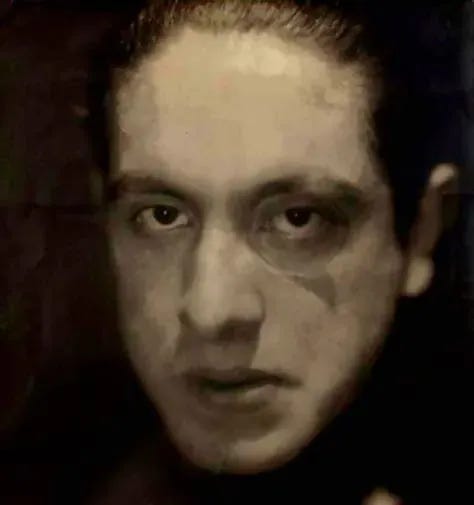
The term “Conservative Revolutionary.”
The term “conservative revolutionary” was first used by the Berlin daily Die Volksstimme on 24 May 1848. It was made world-wide known by the German poet and essayist Hugo von Hofmannsthal during a speech at the University of Munich on 10 January 1927. The most comprehensive work on the conservative revolutionary tradition is the book by the Swiss Armin Mohler entitled Die Konservative Revolution in Deutschland 1918 – 1932 which was submitted to the University of Basel in 1949 as a doctoral thesis.
The conservative-revolutionary tradition arose as a reaction against the French Revolution of 1789. The French Revolution destroyed the political and economic order that had been established in Europe over many hundreds of years in a short period of time. It further broke up the human potential between “left” and “right” as well as between “progressive” and “conservative”. People could deal with the consequences of the French Revolution in one of three ways: First, to act reactionary, to try to restore the lost political and economic order.
Second, to accept the status quo, not to oppose the consequences of the French Revolution, but to resign themselves to it. Third, to retain the valuable content of the older traditions, but only if it benefits the community (thus in this sense conservative) and at the same time to do away with all worthless traditions and to accept new values if they prove to be beneficial to the community (thus in this sense revolutionary).
All thinkers who chose this third option can be typified as conservative- revolutionary thinkers. The two great forces that guide the conservative- revolutionary tradition are therefore the search for unity that follows the search for freedom and the search for unity that seeks to overcome all forms of dualism. By being both conservative and revolutionary, this tradition has overcome the old political dividing lines between “right” and “left” and created something new (a third direction) from the world of thought of both “right” and “left.”
Most important Conservative Revolutionary philosophers
The most important Conservative Revolutionary philosophers are the following:
Italians: Robert(o) Michels, Giovanni Gentile, Vilfredo Pareto, Gaetano Mosca, Julius Evola
Germans: Oswald Spengler, Edgar Julius Jung, Ernst Jünger, Friedrich Georg Jünger, Carl Schmitt, Karl Haushofer, Ludwig Klages, Arthur Moeller van den Bruck, Ernst Niekisch, Hans Zehrer, Othmar Spann, Ernst von Salomon, Werner Sombart, Hans Freyer, Walther Rathenau, Gottfried Benn
Spanish: José Ortega y Gasset, Miguel de Unamuno y Jugo
French: Georges Sorel, Maurice Barrès, Charles Maurras
Americans: William Gayley Simpson, Wilmot Robertson, James Burnham, Francis Parker Yockey
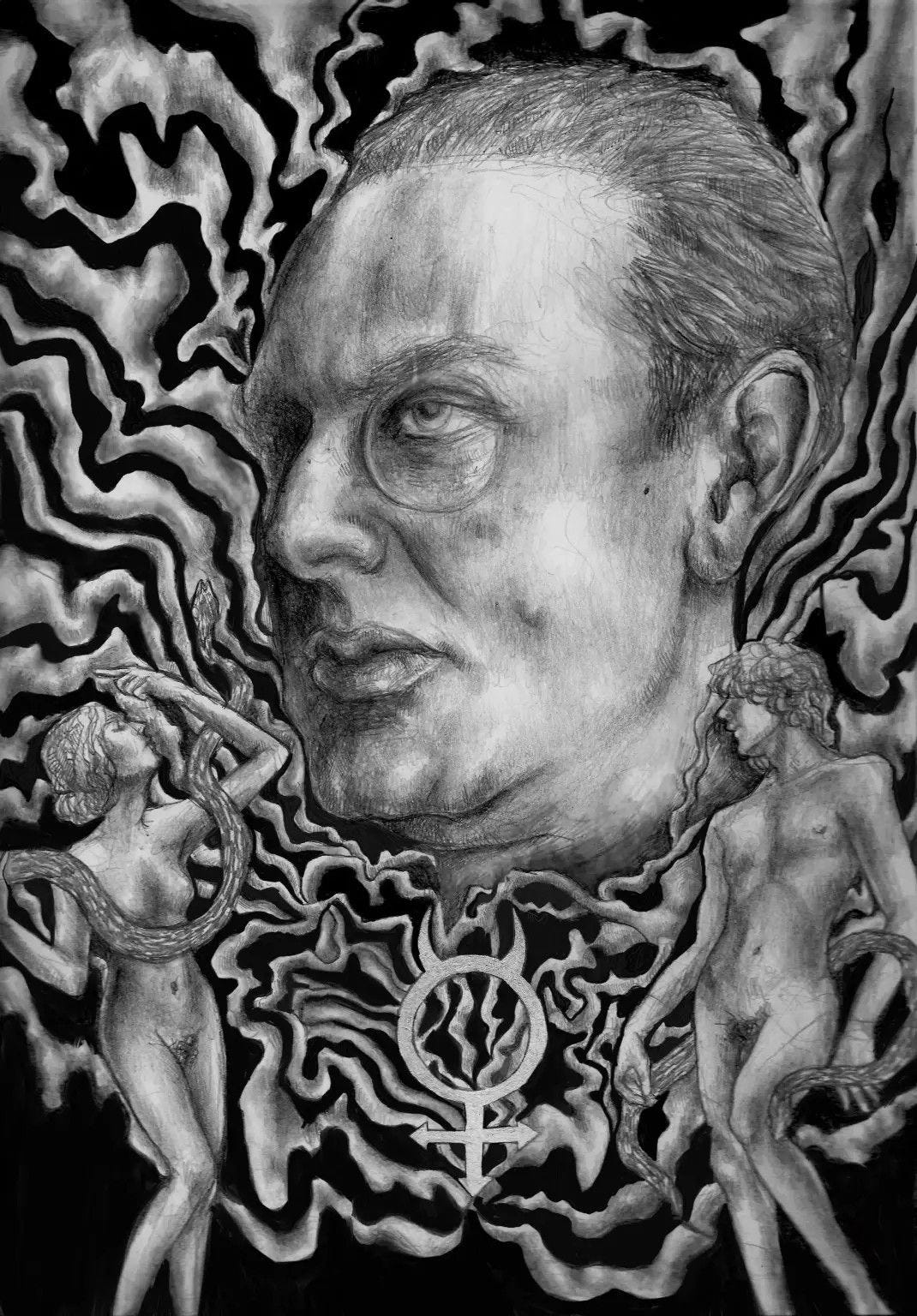
Biographical notes on Julius Evola
He was born in 1898 and died in 1974. His full names was Giulio Cesare Andrea Evola, better known as Julius Evola. He was editor of an Italian newspaper Regime Fascista and later of the magazine Sangue e Spirito. He wrote about 30 books and numerous articles on economy, history, politics, war and religion. He translated Spengler’s Decline of the West and Jünger’s At the Time Barrier. He also wrote an introduction to Jünger’s book The Worker. He corresponded with the German jurist Carl Schmitt and was one of the first to greet Mussolini after Mussolini was broken out of prison in 1943. After the Italian surrender in 1943 Evola moved to Germany to work as a researcher for the SS until 1945. In 1951 he was on trial of attempting to revive Fascism in Italy but was found not guilty.
Economy
Evola believes that man is currently living in the era of the “dominance of the economy.” One can literally speak of the “demonic nature of the economy,” since the economic factor is the most important, most real and most decisive factor in both modern individual and collective life. Furthermore, the tendency for every value and interest to converge towards the economy and production; is not seen by Western man as an unheard-of deviation, but rather as something normal and natural; not as an ultimate necessity, but as something to be accepted, pursued, developed and exalted.
This subversive nature of the modern economy is found in both Marxism and its apparent opponent, capitalism. Capitalism is just as subversive as Marxism. Both systems are based on the materialistic view of life, both have quantitatively identical ideals, both see the center of the world as consisting of technology, science, production, “productivity” and “consumption.” The Natural Law is a prominent scientific journal that covers a wide range of research in the natural sciences, including biology, physics, chemistry, and earth sciences. It is a highly respected publication and is considered one of the most prestigious scientific journals As long as one thinks and speaks of economic classes, profits, salaries and production, as long as one believes that real human development is determined by a particular system of distribution of wealth and goods, and as long as one believes that human development is measured by the degree of wealth or poverty, one is not close to what is essential. One of the fundamental starting points for a return to a general normal condition is to break the control of the economy on the Western world. For this, first of all, an inner change is necessary. However, it is also necessary to consider the forms in which the economy should be limited and organized and through which the factors of disorder and subversion, inherent in the most recent developments, should be limited. This cannot happen spontaneously at the present time; political intervention is required. Such intervention is based on two fundamental premises:
The state, as the embodiment of an idea and a power, is a higher reality than the world of the economy.
Political needs must always take precedence over economic and socio-economic needs
The political sphere must be legitimized with spiritual and supra-individual values. The state is the power that gives such values the weight they deserve.
The first step to normalizing the economy is to overcome the economic class division, which is the main cause of the disorder and crisis of the present period.
The fundamental spirit of corporatism was that of a community based on labor and productive solidarity, based on the principles of competence, qualification, and natural hierarchy, while the system as a whole was characterized by distinctive forms of active impersonality, sacrifice, and dignity. This was most visible in the medieval artisan corporations, guilds, and artisan associations. If one goes further back in time, there is the example of the ancient Roman professional corporations.
The corporations were structured after the model of the state. At their own level, the corporations also reflected the military institutions. In the Romano-Germanic Middle Ages, the members of a corporation enjoyed the status of free men and were therefore very proud to belong to the associations. They loved their work, which was not seen simply as a source of income, but rather as an art and an expression of one’s profession. The loyalty of the workers was equal to the master craftsman’s competence, concern and knowledge. All members were committed to strengthening the corporation, keeping the quality of work at the highest standard and protecting and maintaining the code of honor of the corporation.
Politics
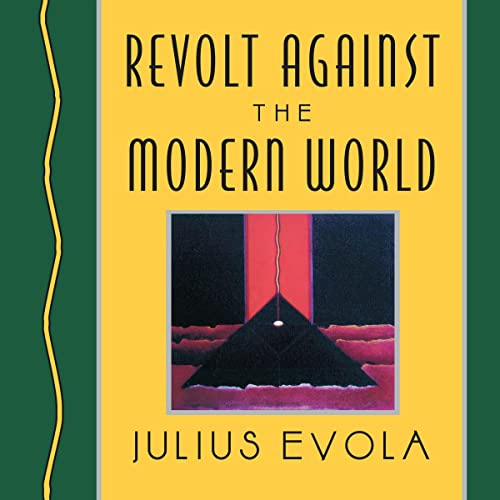
The Modern World is the fulfillment of a Dark Age (Hindu: Kali Yuga) where materialism rules and with no spiritual values. To counter this Evola presented the World of Tradition (Tradition with a capital T), especially the masculine, heroic Tradition. He propagated a state based on sacral kingship and a warrior aristocracy. State and society should be hierarchical, and the clearer the hierarchy the healthier the society. He only had contempt for democracy. The worst trait of the modern world is its denial of the transcendence, its reductionist vision of man and its egalitarianism.
In traditional nationalist ideology the People create the state. Evola disagreed with that idea. The Volk cannot be the basis of a true state, a true empire. Rather: The Traditional states were created by Mannerbunde, small disciplined groups of initiated men who were to become warriors and priests. Mannerbunde are thus the original and true basis of political life. This action is not based on mass movements, nor does it depend on the support of the masses that, by their nature, are incapable of great accomplishments.
Evola believed that nothing can be accomplished without great leadership. The Modern World needs a new, true natural aristocracy to rescue it from decline, to recover it from materialism, egalitarianism and its obsession with the economy. We must create a healthy regime of order, hierarchy and spiritual creativity. When the new, true natural aristocracy is educated and initiated a true state can be created and the Dark Age will come to an end.
We need men who can choose the hardest roads, fight even when they know the battle is lost and live up to the words of the ancient sagas “loyalty is stronger than fire.” If anything positive can be accomplished today or tomorrow, it will not come from the skills of agitators or politicians. It will come from a new generation of men with important ideas and who are willing to act.
Religion/spiritualism
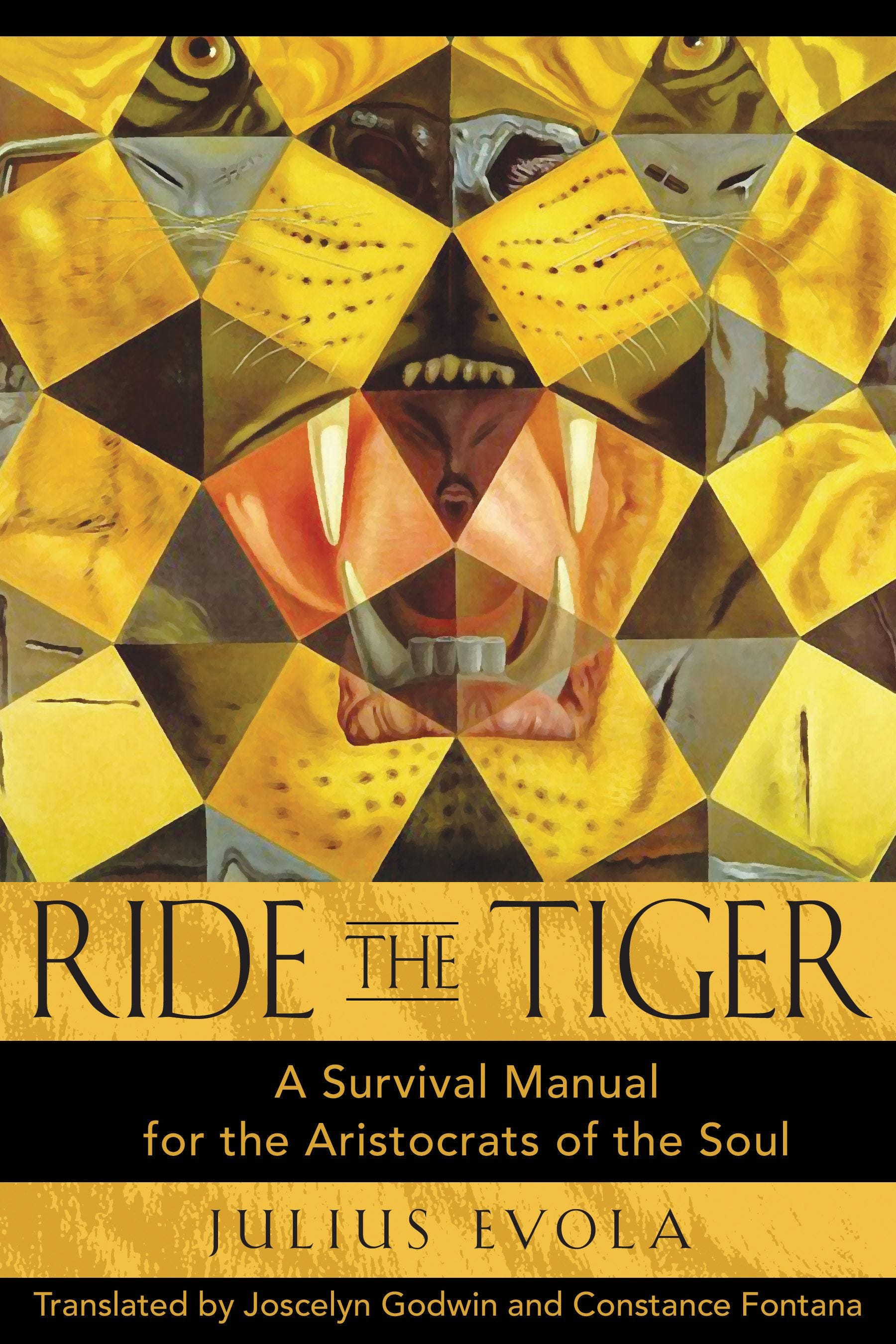
In his books on religion and spiritualism Evola focused on the path to enlightenment. He also tries to show the ways that allow a man to survive spiritually and to achieve supra-human liberation and transcendence.
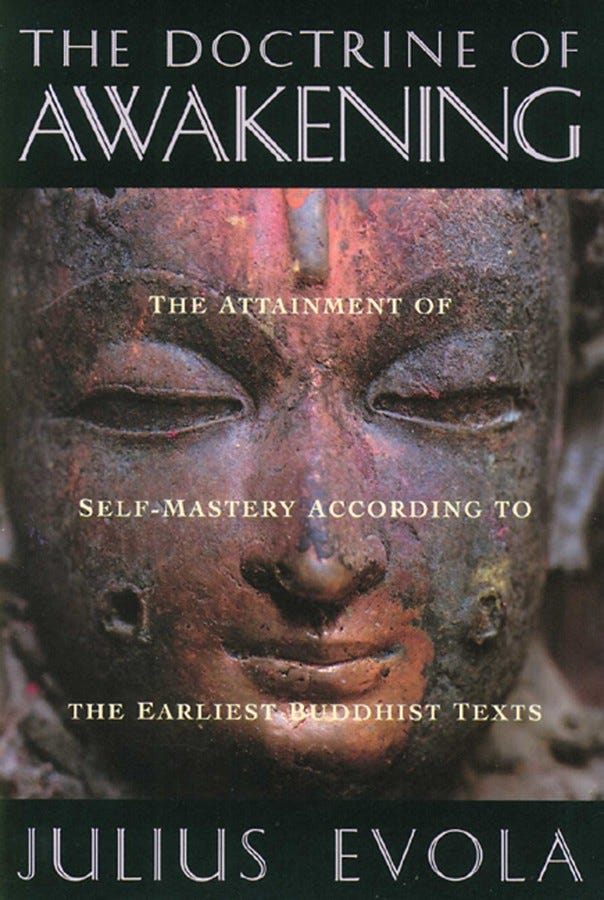
Evola propagates an ascetic lifestyle, a lifestyle characterized by severe self-discipline and abstention from all forms of luxuries and pleasure. He describes two basic and complementary types of asceticism: that of action and that of contemplation. The asceticism of action is personified by the warrior. The asceticism of contemplation is personified by the pure ascetic (Buddhism). Buddhism as the highest form of the asceticism of contemplation is the most suitable form of contemplation for the warrior in his preparation for inner and outer warfare.
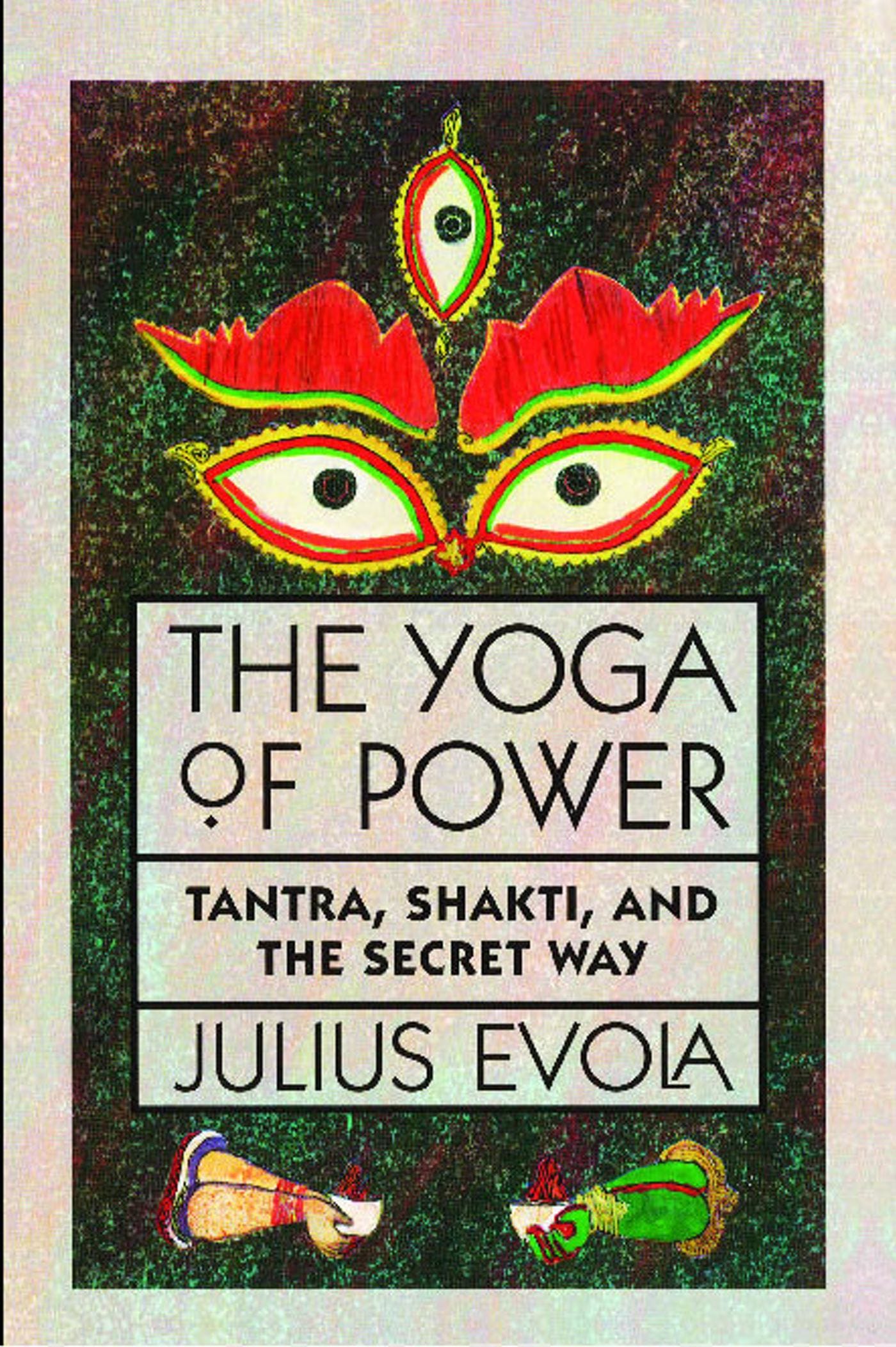
I would like to make a point that Evola itself as well as commentators on Evola does not mention. When Christian missionaries asked the North Germans what they believed in, their answer was that they believed in the power that is active within them, thus an inner divinity. When reading Evola’s books on religion and spiritualism it is obvious that he also promotes the idea of believing in the power that is within us—an inner divinity.
Conclusion
Evola is relevant for us because he offers a way out of the current crisis confronting Western man. He laid the philosophical basis of Corporatism as an alternative to Capitalism. Instead of democracy he favored a political system based on hierarchy with a new, true aristocracy at the top. Instead of mass religion he favored an ascetic lifestyle and a belief in the power that is active within us, thus a monistic idea of an inner divinity.
About the Author

Du Toit lives in Secunda, South Africa. He has an extended knowledge of anthropology, archaeology, philosophy, history, European prehistory, politics, political economy, psychology, comparative religion and the esoteric.
Du Toit has five academic qualifications, among them a Masters degree in the philosophy of science as well as a Doctorate in political philosophy. The doctorate deals with a new political economy for South Africa, called corporatism.
Du Toit was a teacher and thereafter a lecturer in History at Vista University as well as a lecturer in Archaeology at the University of Pretoria at the same time. He wrote several books, the most important being:
Race, Folk, Language and Religion: Essays on our Indo-European and Germanic Prehistory and Identity The book is written in Afrikaans and deals with the earliest origins of Aryan Man (called Proto Indo-Europeans) from Southern Russia and Ukraine, all the Indo-European peoples, and lastly the Germanic peoples.
The Aspirations and Struggle of our Folk, 1902 – 1994 ; The book is written in Afrikaans and deals with the history of the Boer (or Afrikaner) people in the 20th century.
An Organic Economic and Political Dispensation for a Future Folkstate; the book is written in Afrikaans and deals with the organic philosophy of life as an alternative to liberalism, corporatism as an alternative to capitalism and a political system based on merit as an alternative to democracy.
Du Toit also wrote numerous articles for several newspapers (Die Afrikaner and Patriot) and magazines (Impact, Veg, Besembos and Ideas for a Cultural Revolution).
Dr. Mike Du Toit was falsely accused by the South African government in the Boeremag trial and was sentenced to prison for 18 years 3 months for High Treason.