


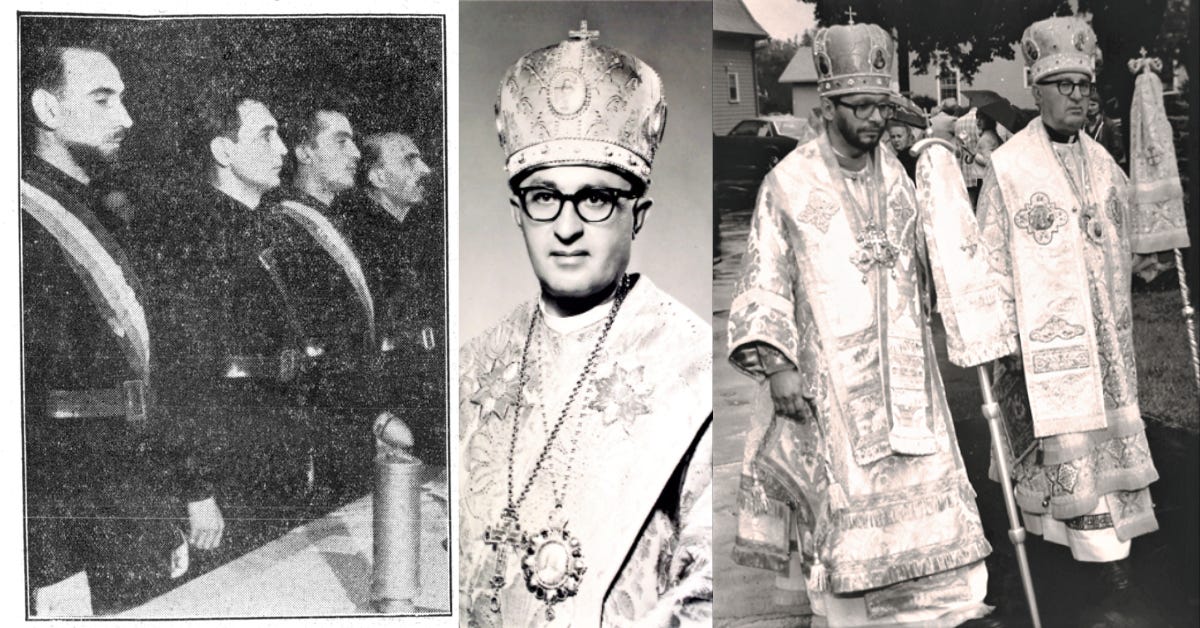
For nationalist movements, there can be no greater endorsement than that of the clergy. In America, this would often take the form of Protestant pastors and perhaps Catholic priests endorsing political movements, but rarely Orthodox priests.
However, that is not because Orthodox priests were historically adverse to endorsing nationalist movements, but that Orthodoxy has been a historical minority amongst the populace. Yet, this is rapidly changing.
For serious political movements, you cannot expect to win if you do not have the blessing of God’s spiritual leaders. Many have tried, but they will always fail—Matt Heimbach’s Traditionalist Worker Party comes to mind.
However, outside of America, there is historical precedence for priests who possess substantial moral authority to endorse and work in nationalist movements. No greater example comes to mind than that of the Legion of the Archangel Michael, one of the largest nationalist movements of the 20th-century.
This article will address the relationship between the Romanian Orthodox clergy and the Legionary movement—commonly referred to as the Iron Guard.
While the relationship was complicated, it was never officially condemned. Patriarchs and bishops disagreed among themselves, many priests opposed the movement, and the Church hierarchy periodically attempted to restrict clerical participation. Nevertheless, a significant minority of priests became members, sympathizers, candidates, organizers, or public supporters of the Legion—with notable Legionaries later becoming canonized.
The historical significance of this episode lies not merely in the fact that priests supported this nationalist movement, but that it demonstrated how a political movement can appeal to existing religious concepts, institutions, social networks, and moral authority while on their journey to establishing symphonia.1
The Legionary Background
The Legion of the Archangel Michael was founded in 1927 by lawyer, Corneliu Zelea Codreanu. However, unlike some earlier Romanian nationalist organizations, such as the National-Christian Defense League which Codreanu took part in, the Legion was founded under the belief that there could not be a separation of faith from that of politics.
The Legion emphasized sacrifice, national regeneration, discipline, national community, Christian morality, and spiritual renewal. And the idea that a people were more than just their race or biology, but that race and biology were important as all of the races are different, as God made so.
This made the priest an unusually important figure in national life, as the village priest did not merely conduct Sunday services. Typically, he could be a teacher, counselor, community leader, organizer of charitable activities, and custodian of local traditions.
A movement seeking national regeneration must naturally meet the Church at the local level.
The Legion understood this social reality. And so, rather than treating religion as a private matter separate from public life, the Legion presented national renewal as requiring corresponding moral renewal of the individual for the benefit of the people.
And while some have attempted to claim that the Romanian Orthodox Church had condemned the Legion for trying to appropriate Orthodoxy, many Orthodox priests saw in the Legionary movement an expression of concerns they already regarded as fundamentally important:
Faith
National solidarity
Moral discipline
Regeneration of Romanian society
The clergy’s participation was not simply the product of political calculation. For the clergy who joined or endorsed the Legionary movement, the question was whether the nation could recover its moral and spiritual foundations after the upheavals of the Great War, political corruption, economic uncertainty, and rapid social change.
And only the Legion offered an answer.
Neam is Inseparable from Christianity
All Romanian nationalism during the interwar period was closely connected to Orthodoxy, but it was the Legion that pointed out that faith is inseparable.
Romania, was not simply a territory inhabited by people who happened to speak Romanian, but it was a historical community formed through language, tradition, ancestry, belief in Christ, and collective memory.
This truth was embodied in the Romanian word neam:
Neam means a people, kindred, lineage, or historical community—in the historical Romanian context it means the people are inseparable from Christ, because theologically, Christ gives the neam its ultimate orientation, moral purpose, and understanding of true history.
However, in ecclesiological terms, being part of a neam is not itself the Church, nor does belonging to a neam replace belonging to Christ and His Church.
So neam is a historical inheritance and Christ gives that inheritance its meaning and its end.
However, all of mankind have their own neam. And neamuri (plural) do not cease to exist in the Kingdom of God. Revelation 21:24-26;
“And the nations of those who are saved shall walk in its light, and the kings of the earth bring their glory and honor into it. Its gates shall not be shut at all by day (there shall be no night there). And they shall bring the glory and the honor of the nations into it.”
In the Bible, the original Greek for nation was ἔθνος (ethnos), meaning a distinct people, not a collection of diverse peoples.
Likewise, Genesis describes humanity being divided into ἔθνη (ethnē), or nations, according to their families, languages, and lands. Gn 10:5, 20, 31–32;
10:5 “From these the coastal nations were separated into their lands, each according to his language, in their tribes and nations.”
10:20 “These were the sons of Ham, according to their tribes, according to their languages, in their countries and in their nations.”
10:31-32 “These were the sons of Shem, according to their tribes, according to their languages, in their countries, according to their nations. These were the tribes of Noah’s sons, according to their genealogy, in their nations; and from these the coastal nations were divided on the earth after the flood.”
In Act 2:4-8;
“And they were all filled with the Holy Spirit and began to speak with other tongues, as the Spirit gave them utterance.2 And there were dwelling in Jerusalem Jews, devout men, from every nation under heaven. And when this sound occurred, the multitude came together, and were confused, because everyone heard them speak in his own language. Then they were all amazed and marveled, saying to one another, ‘Look, are not all these who speak Galileans? And how it is that we hear, each in our own language in which we were born?’”
In modern terms, neam is the closest equivalent to the Biblical ethnos. And we see the greatest example of this in Gn 11:1-9;
“Now the whole earth was one language and one speech. And it came to pass, as they journeyed from the east, they found a plain in the land of Shinar, and dwelt there. Then they said to one another, ‘Come, let us make bricks and bake them with fire.’ They had brick for stone and asphalt for mortar. They also said, ‘Come, let us build ourselves a city and a tower, whose top will reach to heaven; and let us make a name for ourselves, lest we be scattered abroad over the face of the whole earth.’ But the Lord said ‘Indeed, the people are one race and one language, and they begun to do what they said. Now they will not fail to accomplish what they have undertaken.3 Come let Us go down there and confuse their language, so they may not understand one another’s speech.’4 So the Lord scattered them abroad from there over the face of all the earth, and they ceased building the city and the tower.5 Therefore its name is called Babel, because there the Lord confused the languages of all the earth; and from there the Lord God scattered them abroad over the face of all the earth.”
Neam has nothing to do with inferiority or supremacy. However, the Bible does teach that the neamuri are to remain physically separate, but not spiritually separate, as they were united at Pentecost while keeping their particularity.
And because God wishes us to keep our national sovereignty and has commanded us to struggle for self-determination and self-preservation, we must endeavor to preserve our culture, our people, our faith, and our way of life alive.
Why Priests Answered the Legionary Call
The attraction of the Legion to portions of the clergy can be understood through some of the earlies themes that I pointed out.
Moral regeneration
Legionary teachings emphasized discipline, personal sacrifice, courage, service, and rejection of materialism. By incorporating priests to lead these efforts, they could work on treating alcoholism, corruption, sexual immorality, poverty, political opportunism, or the deliberate weakening of traditional social structures.
Service over Electoral Politics
The Legion, like my organization, The New Way (TNW), distinguishes itself from conventional political parties through our emphasis on creating parallel structures.
For example, the Legion created famous work camps that employed young people or gave volunteers the opportunity to construct or repair roads, bridges, buildings, wells, and churches.
During the time of the Legion, a secret police report recorded that out of 128 work camp projects, fifty—39% of all projects—involved religious construction or ecclesiastical property.6
And my organization has already branched out to begin nation-wide clean up services to remove trash and debris from our environment. However, we have also begun to create trade schools and apprenticeships for our people.
For the Legion and TNW, we are fundamentally different from politicians who only pretend to care for the people during elections, deliver speeches, and disappear afterward.
The Formation of the Youth
The Legion being a Christian organization, placed an enormous emphasis on young people. Understandably, priests who think in terms of spiritual formation see the significance of this.
Nationalist movements, like the Legion, should attempt to cultivate discipline through communal living, physical labor, religious observance, study, and ceremonies.
The emphasis on forming character rather than merely obtaining votes is why the Legionary movement is so compelling.
National solidarity
Something that was particularly powerful was the fact that the Legion maintained that Romania had always been a historic Christian nation, and that the survival of Romanian religious and cultural traditions were inseparable from the survival of the Romanian nation.
Nationalists must understand that nationalism is not merely a political program, but that national belonging is a moral obligation.
Priests Taking Positions of Authority in the Legion
The clergy’s involvement in the Legion went far beyond the occasional expression of sympathy. Many priests actively participated in Legionary organizations, while others even become electoral candidates and local organizers.
Fr. Vasile Boldeanu of Putna County and Fr. Nicolae Nițu of Roman are both notable examples of priests becoming Legionary county commanders, giving them positions within the movement's political hierarchy.7 While local organizers include Fr. Gheorghe Doară and Fr. Aurică Nicolescu of Vâlcea were notable Legionary organizers in their communities, where they mobilized people to volunteer in the work camps and other Legionary activities.8
Honorable mention includes Fr. Iustin Pârvu.
Bishop Vartolomeu Stănescu
A significant case was Bishop Vartolomeu Stănescu of Râmnicu Vâlcea. He wasn’t simply a parish priest who sympathized with the movement, but he was a regional patron of the Legion, mobilizing village priests and church resources, while encouraging priests to join. And Legionary commander Radu Gyr regarded him as an important spiritual figure for the movement.9
Stănescu, rather than treating young nationalists as simply another political faction, regarded their activities as having potential social and moral value.
This demonstrated one of the fundamental reasons why the Legion was so important to the Romanian religious society. The Legion did not merely ask priests to vote for it or to convince their flock to vote for it. It presented exactly why the movement was necessary in the moral and material reconstruction of the country.
Metropolitan Nicolae Bălan
Among the most important clerical figures associated with the Legionary movement was Metropolitan Nicolae Bălan of Transylvania.
Bălan possessed a considerable amount of authority within the Romanian Orthodox Church and his relationship with the movement illustrated why clerical endorsement mattered.
Bălan’s support also demonstrates that sympathy for the Legion was not restricted to obscure parish priests and that there were senior members of the hierarchy who believed that aspects of the movement represented a legitimate response to the problems confronting Romania.
Metropolitan Gurie Grosu
Likewise Metropolitan Gurie Grosu of Bessarabia publicly praised Legionary work camps. His support was significant because it demonstrated that the Legionary movement’s emphasis on constructive labor provided a point at which nationalism, youth organization, charitable work, physical labor, and religious life could meet.10
Nationalism must be more than mere rhetoric, as it must become a form of service to your people.
Metropolitan Visarion Puiu of Bukovina
Puiu is another interesting example as he was actively supporting the Legion in the 1930s by financially supporting work camps, organizing Legionary projects, and spreading the Legionary ideology.11
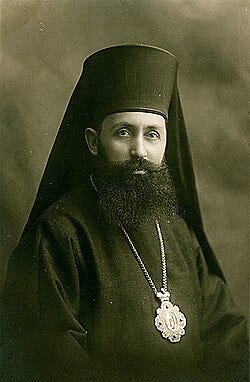
In 1937, he defied government restrictions by holding religious services commemorating Ion Moța and Vasile Marin, Legionary leaders killed fighting in the Spanish Civil War.
After the war he established the Romanian Orthodox Diocese of Western Europe, served as its first hierarch. In 1955, however, Puiu sent Archimandrite Teofil Ionescu on a mission to Canada and the United States to organize Romanian Orthodox communities, and he was the author of the original plan (1926) for establishing a Romanian diocese in the United States, describing himself as its founder.12 This would later give birth to the Romanian Episcopate of America in 1929.
Orthodox Priests in General
The historian Francisco Veiga estimated that approximately 2,000 of Romania’s roughly 10,000 Orthodox priests had joined or worked with the Legion by 1937.13 Meanwhile, Oliver Jens Schmitt estimates that approximately 1/4 of Orthodox priests had joined or supported nationalists movements in general.14
Interestingly, the 1937 election demonstrated the extent of clerical participation. Of the 103 candidates associated with the Legion’s Everything for the Country organization, approximately 33 (or 1/3) were priests.15
Orthodox priests did not regard political participation as inherently incompatible with their vocation. They believed that the priest could serve the nation not only from the altar but also through public life.
Legionaries Later Becoming Authorities in the Church
After the Legionary government fell in 1941, many former Legionaries were subjected to horrific treatment. Especially when the communist government gained power. However, despite the persecution, there were many notable Legionaries who became officials in the Orthodox Church, especially in America. Honorable mention includes Fr. Arsenie Papacioc.
Archbishop Valerian Trifa, head of the Romanian Orthodox Episcopate of America.
One such individual was Valerian Trifa, who had been part of the Legionary government in 1941 and fled Romania after its collapse. However, by 1952 he had become an Orthodox bishop in America. And by 1957, he was running the Romanian Orthodox Episcopate of America. He was also the mentor to the current Archbishop of the Romanian Episcopate of America, Archbishop Nathaniel Popp. Archbishop Valerian never renounced Legionarism.
Fr. Vasile Boldeanu
During the National Legionary State, Boldeanu reached the rank of Legionary commandant and served as deputy to Nicolae Petrașcu, the government’s secretary-general. After the war, he became an Orthodox priest and worked with Metropolitan Puiu’s Romanian Orthodox organization in Paris. In fact, Metropolitan Puiu placed Fr. Boldeanu in charge of the largest Romanian Orthodox congregation there. He never renounced Legionarism.
Fr. Gheorghe Calciu-Dumitreasa
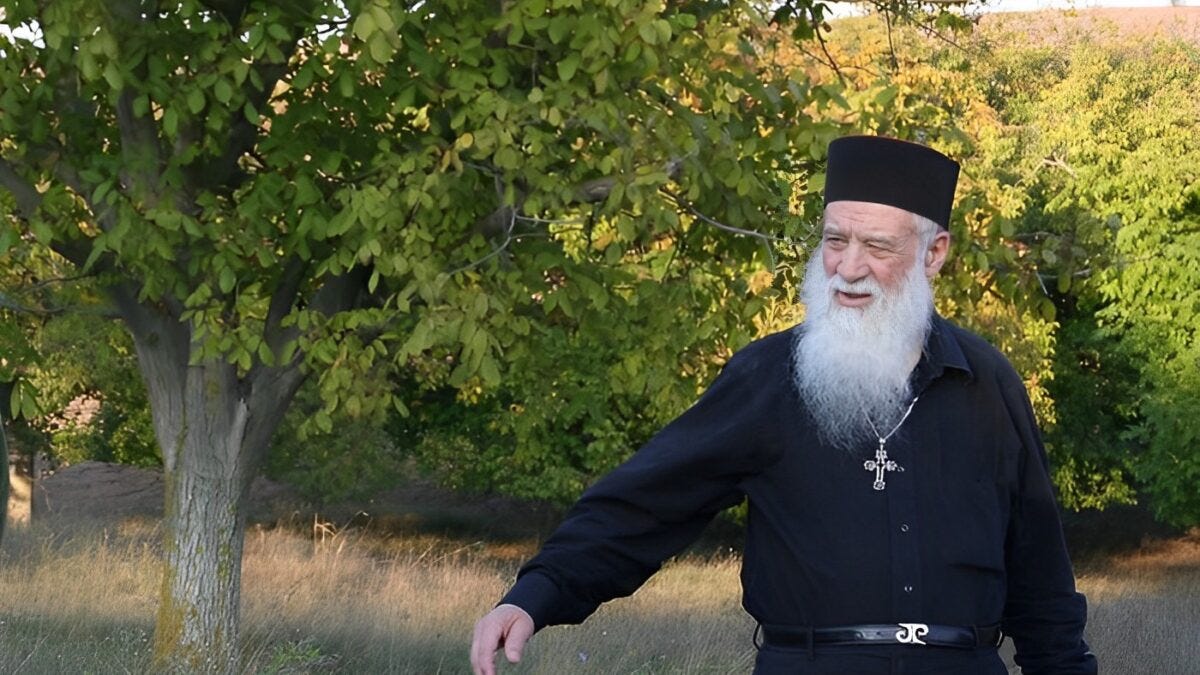
Originally part of the Frățiile de Cruce, a Legionary youth organization, he was arrested both in 1942 and 1948 for Legionary activity. However, after imprisonment, he studied theology and eventually became an Orthodox priest.
It was in 1978 that he became internationally famous for his oppositions to Romania’s communist dictator, Nicolae Ceaușescu, where he openly declared that Romanians had the right to worship their Orthodox faith openly and proudly. He was subsequently sentenced to 10 years in prison. However, he was released from prison due in part to pressure from supporters such as U.S. President Ronald Reagan.
In 1984, he was defrocked by the Romanian Orthodox Church (communist pressure) but became a priest of the Orthodox Church of America’s Romanian Episcopate of America.
Moreover, he continued to glorify the Frățiile de Cruce, suggesting the canonization of Iron Guard leader Corneliu Zelea Codreanu because of being martyred, as well as proposing his view of Legionarism. 16
St. Ilie Lăcătușu
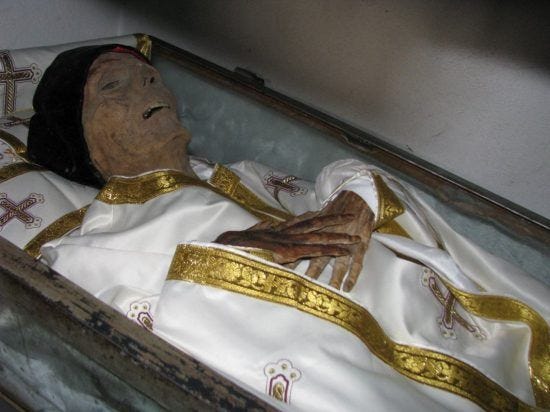
One of the former Legionaries who only disavowed the Legion under communist imprisonment, but not after was Ilie Lăcătușu.
In July 2025, following Legionary-themed manifestations at his relics, it stated that Lăcătușu was canonized for his Christian confession and suffering under communist imprisonment, but not for being part of the Legion.
St. Ilarion Felea
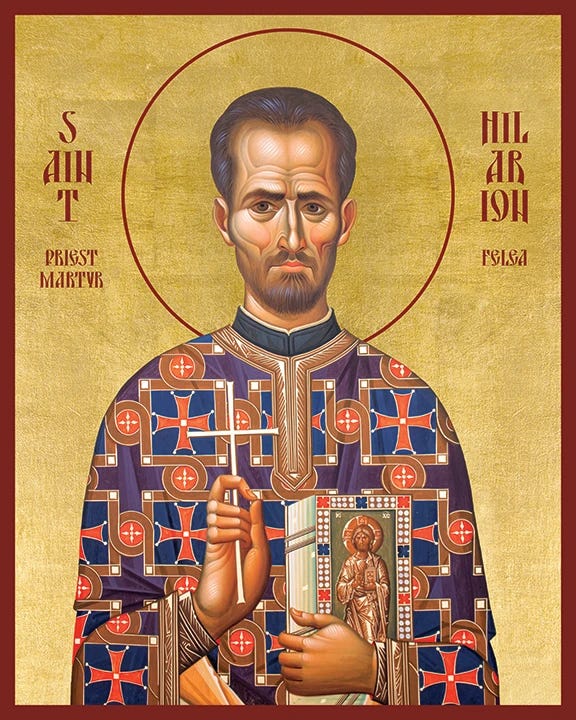
Felea had a documented Legionary association in 1940, later said that the January 1941 rebellion caused him to break with the movement, explicitly rejected renewed Legionary activity in 1948, and denied Legionary connections during his 1949 interrogation. Nevertheless, the Communist security apparatus continued to regard him as a Legionary activist and prosecuted him again in 1958–59 in an alleged Legionary-related conspiracy.
Felea was accused in 1958–59 of participation in an anti-Communist conspiracy that the Securitate interpreted in Legionary terms, and he was convicted in 1959. However, the available evidence does not by itself establish that he had actually resumed Legionary activity after his earlier break with the movement. And he died in prison in 1961.
Religious Meaning of National Service
Nationalism, cannot be understood solely through political categories, but through a repeated process of sacrifice for the nation that provides spiritual meaning.
The ideal nationalist is not merely a political activist, but someone who understands the neam ceremonies, funerals, religious processions, and memorial culture.
A nationalist must become disciplined, courageous, self-sacrificing, faithful to his comrades, devoted to his country, and willing to subordinate personal interests to a higher purpose.
And nationalist movements must commit to outreach in order show that we share the same idea that human beings should sacrifice selfish interests for God, family, community, and neighbor.
This also explains where the fundamental point of contact between nationalism and Christianity is.
Nationalist movements that build churches, help the poor, maintain discipline, attend religious services, and promote devotion to the Lord are very different than political parties that are more concerned with the material over the immaterial, or concerned with the secular over achieving symphonia between the Church and State.
For the nationalist, politics begins with the formation of the person. And a corrupt political system cannot be repaired by replacing one group of politicians with another. The people as a whole must become morally stronger.
Symphonia (Greek: συμφωνία, literally “harmony” or “agreement”) is an Orthodox Christian political-theological concept describing cooperation and mutual respect between the Church and civil authority. The idea comes from Emperor Justinian I’s Novella 6 (AD 535), where he described the priesthood and imperial authority as two great gifts from God, each having its own responsibility, working together for the good of the Christian commonwealth. Essentially, the Church governs spiritual matters; the civil authority governs temporal matters, and both cooperate for the common good.
From the Orthodox Study Bible:
“2:4-8 This is a fulfillment of the prophecy of Joel 3:1 and a divine reversal or recapitulation of the events of the Tower of Babel (Gn 11:1-9). In the account of Babel, pride was shown to possess the awesome power to divide; here, the humble reception of the Holy Spirit is shown to have the overwhelming power to unite, even in diversity. A key lesson of Pentecost is that the people hear the gospel in their own language.”
From the Orthodox Study Bible:
11:6 “Mankind was united as one race and one language. But this unity existed without the Holy Trinity, for man’s true unity is union and communion with the Father, the Son, and the Holy Spirit. The Church is “the race of Christians” (Kairon Service), a ‘holy nation’ (1 Pt 2:9), and glorifies God ‘with … one mouth’ (Rom 15:6). In the Great Litany, the Church prays ‘for the union of all men,’ a union based in the Holy Trinity.”
From the Orthodox Study Bible:
11:7 “The pronouns Us refers to the Holy Trinity. The words go down are a figure of speech, for the Trinity is everywhere present and fills all things. The words ‘came down to see’ (v. 5) are also a figure of speech, for the Trinity is not ignorant of anything. God condescends to our weakness that we might understand something about Him and His works.”
From the Orthodox Study Bible:
11:8 “The Lord divided this false unity for the sake of man’s salvation, that man might seek and find Him (Acts 17:26-28). For they sought to build their unity by making a name for themselves (v. 4). They cared nothing for the name of the Lord God, by which man is saved.”
Raul Cârstocea, “Building a Fascist Romania: Voluntary Work Camps as Mobilisation Strategies of the Legionary Movement in Interwar Romania,” Fascism: Journal of Comparative Fascist Studies 6, no. 2 (2017): 163–195.
Ionuț Biliuță, The Romanian Orthodox Church and the Iron Guard: The Politicization of the Romanian Orthodox Church in the Interwar Period (PhD diss., Central European University, 2014), 179.
Oliver Jens Schmitt, “Approaching the Social History of Romanian Fascism: The Legionaries of Vâlcea County in the Interwar Period,” Fascism: Journal of Comparative Fascist Studies 3, no. 2 (2014): 132.
Oliver Jens Schmitt, “Approaching the Social History of Romanian Fascism: The Legionaries of Vâlcea County in the Interwar Period,” Fascism: Journal of Comparative Fascist Studies 3, no. 2 (2014): 132–33.
Schmitt describes Bishop Vartolomeu Stănescu (AD 1875–1954), bishop of Râmnicu Vâlcea, as a decisive regional patron of the Legionary Movement. Stănescu provided shelter for a Legionary congress in Râmnicu Vâlcea in August 1934, chaired a committee that supported imprisoned Legionaries in 1933 when the Legion was illegal, and “actively encouraged village priests to disseminate Legionary ideas.” Schmitt concludes that the bishop’s support “triggered the rapid rise of the movement in Vâlcea County.”
Ionuț Biliuță, The Romanian Orthodox Church and the Iron Guard: The Politicization of the Romanian Orthodox Church in the Interwar Period (PhD diss., Central European University, 2014), 179. Biliuță notes that Metropolitan Gurie Grosu of Bessarabia participated in religious ceremonies at the Susai Mountain Legionary work camp. In 1935, Grosu publicly praised the Legionary work-camp movement, declaring that he was “deeply impressed by the organization of legionary youth, students, intellectuals, and common people for constructive work” and giving his blessing to the movement’s “purely Christian character.” The statement was subsequently reproduced in the Legionary press.
Ciprian-Viorel Pleșea, “Bishop Visarion Puiu: The Years of Exile,” Research and Science Today Supplement (2023), 22. Pleșea notes that in a letter concerning the organization of Romanian Orthodox communities in the United States, Puiu wrote, “I am the author of the draft law for the foundation of the diocese in the USA, thus its founder.”
Francisco Veiga, The Legionary Movement in Romania, 1927–1941: A Fascist Organization, trans. Mircea Dan Duță (Bucharest: Editura Humanitas, 1993), as cited in Roland Clark, Holy Legionary Youth: Fascist Activism in Interwar Romania (Ithaca, NY: Cornell University Press, 2015).
Oliver Jens Schmitt, “The Orthodox Clergy and the Extreme Right in Interwar Romania,” Archiva Moldaviae 8 (2016): 95–115.
Roger Griffin, The Nature of Fascism (London: Routledge, 1991), 123. Griffin notes that in the 1937 Romanian elections, of the 103 candidates put forward under the banner of the Legionary Movement's Everything for the Country organization, 33 were Orthodox priests—approximately one-third of the candidates.
Lavinia Stan, “Gheorghe Calciu-Dumitreasa, the Forgotten Anticommunist Dissident,” in Liberals, Conservatives, and Mavericks, ed. Frank Cibulka and Zachary T. Irwin (Budapest: Central European University Press, 2024), 206–9; Viața Părintelui Gheorghe Calciu după mărturiile sale și ale altora (Bucharest: Editura Christiana, 2007), 29–34.