


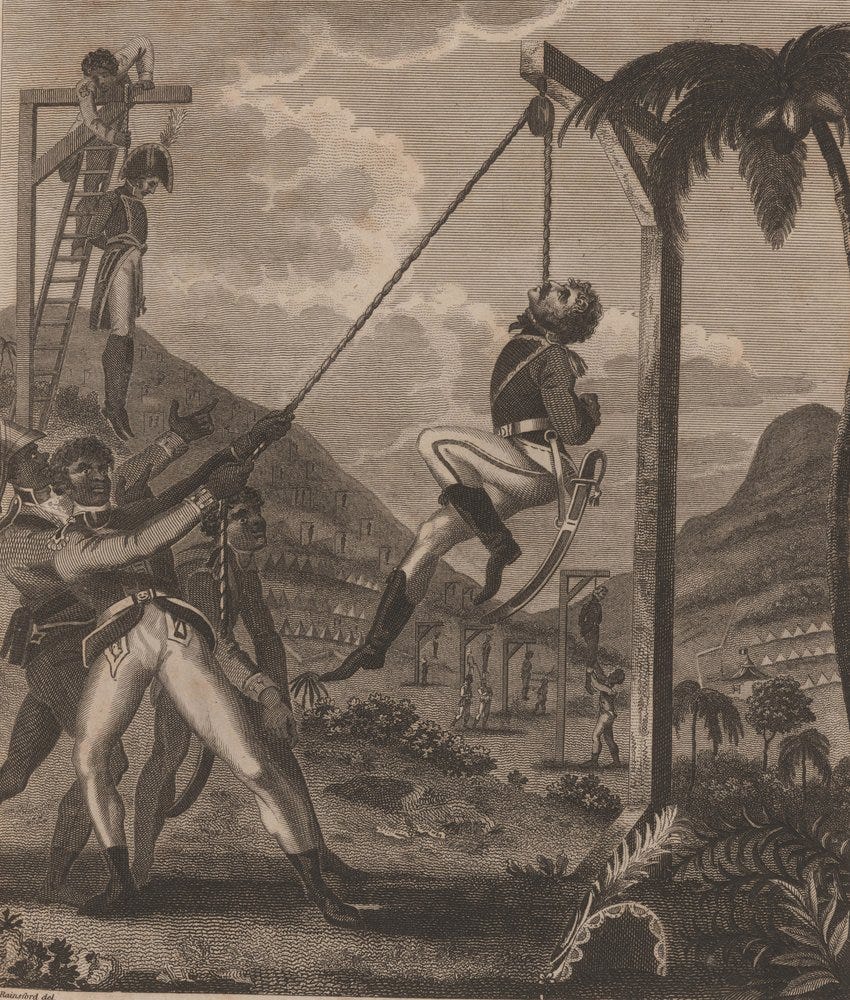
We know that history does not repeat itself; what repeats itself is always the process of the rise and fall of empires, the emergence and disappearance of peoples and races. That said, it is necessary to understand certain past phenomena and draw lessons from them for the future; Haitian history is exceptional for understanding certain phenomena that occurred, as well as catastrophes that are looming in the medium and long term.
In the 18th century, Haiti, or Saint-Domingue, was considered the jewel of the West Indies, composed of 3 castes: Whites, Mulattoes, and Blacks; the first, landowners and holding privilege over the latter two; the mulattoes, of whom few were rural landowners, were a level above the pure-race blacks in Haiti. The Haitian economy was based on the planting of sugarcane, tobacco, and coffee, all exported to Europe. According to Lothrop Stoddard, in his book “The French Revolution in Saint-Domingue” (Saint-Domingue was at the time the name of the future Republic of Haiti), the revolt of the Black people began around 1780, stemming from the French Revolution. It happened that white people traveled to France at this time and absorbed the ideas of “Equality, Liberty, and Fraternity,” and upon returning, they spoke of these ideas to the enslaved people, which began to inflame anti-white sentiment in Haiti.
“Academics keep writing about the glorious slave revolt of Haiti (1791-1804). As if it still is the best thing that could have happened to Haiti. But it is the worst thing that happened to Haiti. Ever since the slave revolt against the French, Haiti has been in chaos. Massive human suffering, lasting destruction. Why celebrate that? But no: Let’s hold another conference on that fantastic Haitian Revolution.”
― Bruce Gilley
The Amis des Noirs, white people who proclaimed racial equality, also fueled this sentiment in the colony. With this cauldron of revolutionary ideas, and following the French Revolution of 1789, it only took two years for the Black people to rebel.
On August 21, 1791, the revolt broke out in Saint-Domingue, according to Stoddard:
“A group of national guards, who ventured out of the plain, were suddenly overwhelmed at the half-light of dawn by a horde of blacks, whose hideous standard was the impaled body of a white child. Only three soldiers escaped to deliver the terrible news.”
And it doesn’t stop there; Stoddard sought out the milder accounts among the most cruel. Here is another:
“The atrocities committed against white women and children are unbelievable: ‘The mulattoes,’ writes the Colonial Assembly to the commissioners in Paris – ‘They disembowel pregnant women, and before death, force the husbands to eat this horrible fruit.’ Other children are thrown to the pigs.”
The revolution unfolded in this way, the Amis des Noirs of our time conceal this information. Many whites from Saint-Domingue immigrated to the United States, knowing that if they stayed in their land, they would be brutally executed, while a good portion went to France. Napoleon Bonaparte also took part in this revolution, sending his brother-in-law, General Charles Victoire Emmanuel Leclerc and 40,000 troops, who initially succeeded in defeating the Haitian General Toussaint L'Ouverture and sending him as a prisoner to France, where he died of pneumonia. Dessalines took his place, and he lost several battles to Leclerc, although the French army as well as Leclerc perished due to yellow fever and its inability to adapt to the climate of Saint-Domingue, leaving the place in November 1803, and here is the Coup de Grace:
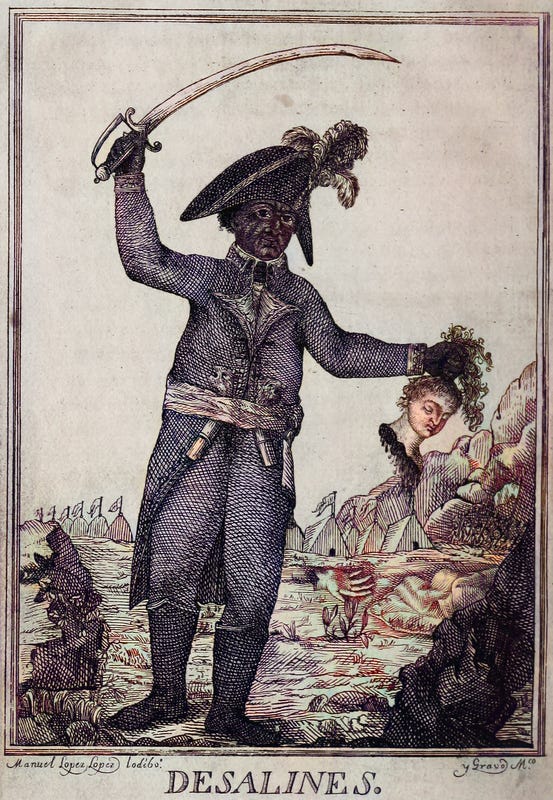
“When the French troops left the country in 1803, Dessalines promised protection to all the white civilians who had gone to France during the war. The favorable treatment afforded to whites induced a considerable number of them to return to Saint-Domingue. But as soon as the black leader was seated on his Imperial throne, barely had the following year begun, Dessalines issued orders to massacre the local white population, marking Haitian politics.”
The white Haitians were killed in a cruel and cowardly manner; according to Stoddard, this catastrophe was the harbinger of something even more terrible in the future. In the present day, the black movement uses violence typical of its race. All these anti-white agitations were foreseen by eugenicists in the past.
“...We have no other resource than destruction and flame. Bear in mind that the soil bathed with out sweat must not furnish our enemies with the smallest aliment. Tear up the roads with shot; throw corpses and horses into all the fountains; burn and annihilate everything, in order that those who have come to reduce us to slavery may have before their eyes the image of hell which they deserve.”
- Toussaint L’Ouverture in an 1802 letter to Jean-Jacques Dessalines
Important Announcements
Saturday Blockbuster!
The New Way in conjunction with Fifth Column Library is screening films relevant to our struggle each Saturday night at 8 pm EST.
This week we will be featuring two documentaries on Auschwitz:
George Lincoln Rockwell: A National Socialist Pioneer
Bilderberg: The Movie by Jake Bexx
White Power


The definitive edition of White Power by George Lincoln Rockwell has just been published by Fifth Column Library.
Here’s why this new edition was needed:
The official version from Rockwell’s own party was poorly formatted.
There was a ton of missing context.
It was clearly edited to add bias or reference events that took place after Rockwell was killed.
So of we fixed those issues.
Our new edition includes:
Clean, readable typesetting
Restored original text
Fair historical context
An updated forward
Over 40 pages of endnotes
Brand new cover art
Hyperlinks for easy navigation (PDF only)
6”x9” Hardcover and Paperback options
The new edition is available now: