


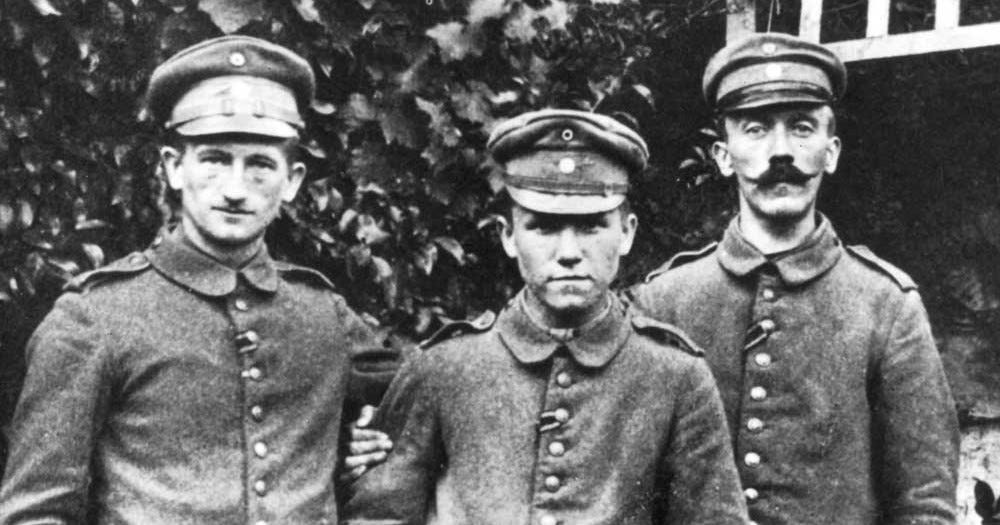
Among the most coveted decorations for bravery in this war is undoubtedly the Iron Cross. Many of our opponents are quick to attribute this to a certain love of showing off, which they believe characterizes Germania’s front-line soldiers. But they cannot know that, once one has stood face to face with death, one cares relatively little about the way in which one is honored by other people. They may never understand the value of mere life, because they themselves have never committed to something with the awareness that the odds were ten to one against coming out of it alive. Therefore, they cannot really be blamed for thinking this way—and we don’t blame them, because we know that circumstances will eventually force them to grow wiser.
It is another matter entirely when they attempt to impose such thoughts on others. That does indeed arouse our indignation, and in such cases, we will not hesitate to express this indignation in a manner that those involved will not soon forget.
We do not tolerate insults toward our front-line soldiers—and certainly not toward those who have been awarded the Iron Cross. For ultimately, someone who has been at war and has not received the Iron Cross may very well have been brave and resolute in battle. But of someone who has received the Iron Cross, we know for certain that he distinguished himself honorably and fought courageously.
The Iron Cross may be worn by anyone who has distinguished themselves in war. The highest officers, as well as non-commissioned officers and enlisted men, wear the ribbon and medal of this decoration on their uniforms. This point was recently emphasized again by Reichsleiter and Reichsminister Alfred Rosenberg when he spoke in Amsterdam to the National Socialists in the Netherlands. The Reichsleiter reminded his audience that one of the highest decorations from the previous World War, the “Pour le Mérite” order, could only be awarded to officers, whereas the Knight’s Cross of the Iron Cross may be worn by anyone who is a member of Adolf Hitler’s national army. In this context, we should also point out that the first and only Dutch recipient of the Knight’s Cross, Gerard Mooyman, held the rank of SS-Rottenführer when he earned his decoration.
This too demonstrates once again the socialist solidarity of all those who have placed themselves under the command of the Führer, as well as the socialist character of all the institutions created by him and led under his direction King Friedrich Wilhelm III of Prussia issued a call to his people, and his resistance to the foreign oppressor resonated with many of his countrymen, who took up arms to cast off the hated French yoke.
On March 10, 1813, in Breslau, the King established the Iron Cross, based on a design by Karl Friedrich Schinkel. On April 2 of that year, he awarded the first Iron Cross 2nd Class—and thus the very first Iron Cross—to Major Karl August Ferdinand von Borcke, who was 37 years old at the time. The battalion under this officer’s command had distinguished itself so notably during the battle near Lüneburg that the King honored the Major in this way and at the same time promoted him to Lieutenant Colonel. A few months later, on August 26, 1813, he was further decorated with the Iron Cross 1st Class.
The Iron Cross was reissued during the wars of 1870 and 1914. In the war of 1914–1918, it was awarded either for merit on the battlefield (with a black-and-white ribbon) or for service in the homeland (usually with a white-and-black ribbon, though in quite a few cases still with the black-and-white one).
In the World War of 1914–1918, the following were awarded:
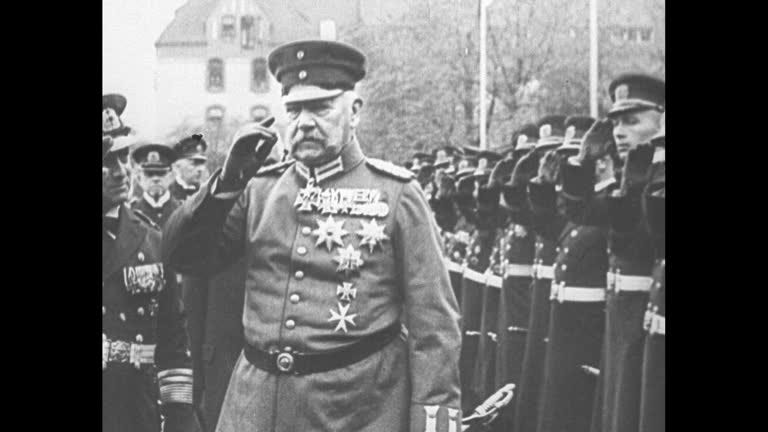
1 Iron Cross with the Golden Star (the so-called Blücher Cross, awarded to Field Marshal von Hindenburg)
5 Grand Crosses (to Emperor Wilhelm II; Field Marshals von Hindenburg, von Mackensen, and Prince Leopold of Bavaria; and General of the Infantry Ludendorff)
218,000 Iron Crosses 1st Class
5,196,000 Iron Crosses 2nd Class with the black-and-white ribbon
13,000 Iron Crosses with the white-and-black ribbon.
As is well known, the Führer himself was also decorated with the Iron Cross, both 1st and 2nd Class, during the World War of 1914–1918. Remarkably, the forerunner of National Socialism, Houston Stewart Chamberlain—a man of English birth who had become a naturalized German—was likewise appointed a Knight of the Iron Cross by the Kaiser, because he had, as a publicist, committed himself to the cause of Germany and its allies
Several Dutchmen, too, who fought alongside Germany—mainly against France—during that war, earned the Iron Cross 1st and 2nd Class.
It was precisely the Germans who had been decorated with the Iron Cross who proved themselves the best patriots through their all-sacrificing courage and total willingness to serve. It is therefore not surprising that the hatred of the Marxist traitors to the nation, during the infamous November days of 1918—and even long afterward—was directed especially at them. In the disgraceful postwar literature with which the Jews flooded Germany, the rabble who tried to rip the Iron Cross from the chests of the brave German men who had stood at the front for four years were glorified in a way that not even a dog would stomach.
Nevertheless, there were still enough patriots for whom the medal of honor retained its old value. As we noted earlier, when a Jewish official insulted the Führer, the propaganda department of the N.S.D.A.P. wanted to distribute a poster in response, showing Adolf Hitler with the Iron Cross 1st and 2nd Class clearly visible on his tunic. The fact that those in power banned this poster proves more clearly than anything else how dangerous they considered this argument to be for their position among the German people.
Henrik Herse also points out the value of the Iron Cross in the postwar period in one of his books. In Das Fähnlein Rauk, he describes a stage play about the war, written by a front-line soldier. Dissenters try to disrupt the performance with whistling. The curtain is lowered, and the lights are turned on. The theater director steps into the spotlight to address the audience. “On his chest, the war decorations tinkle softly,” writes Henrik Herse. Such scenes are not limited to novels—they truly took place in Germany in the 1920s. And time and again, there was a group of strong-willed individuals who stood proudly by their convictions.
The men then wore the Iron Cross as their badge of recognition. They knew: “There is one who also stood firm; he, too, experienced it all—he knows everything about it.” These men formed the core of the N.S.D.A.P., the S.A., and the SS.
Anyone well-acquainted with Mein Kampf also knows that the Führer, for various positions that needed to be filled, repeatedly drew upon men he had come to know at the front. In this way, these men, even after their duty at the front had ended, continued to form a strong community—one against which the enemies of the fatherland repeatedly broke their teeth.
And when the Führer took power in Germany, no one dared any longer to drag the Iron Cross through the mud. One could once again wear, with peace of mind, the visible symbols of hard and courageous service at the front without being attacked by criminal rabble in the streets.
When the enemies of the Reich again pounced upon the Germanic heartland and declared war on it, one of the Führer’s first proclamations was to reestablish the Iron Cross. According to Article 2 of this decree—dated September 1, 1939, the anniversary of the Battle of Sedan—the Iron Cross is awarded solely for exceptional bravery in the face of the enemy and for outstanding leadership in commanding troops.
Through amendments dated June 3, 1940, and September 28, 1941, to the above-mentioned decree, the Führer organized the Iron Cross, as we know it today, into the following classes:
The Iron Cross 2nd Class
The Iron Cross 1st Class
The Knight’s Cross of the Iron Cross
The Knight’s Cross of the Iron Cross with Oak Leaves
The Knight’s Cross of the Iron Cross with Oak Leaves and Swords
The Knight’s Cross of the Iron Cross with Oak Leaves, Swords, and Diamonds
The Grand Cross of the Iron Cross
The Grand Cross of the Iron Cross is awarded solely for actions that decisively influence the course of the war. The Führer has to date awarded this decoration to only one man: Reich Marshal Hermann Göring, in the Reichstag session of July 19, 1940.
The Knight’s Cross of the Iron Cross with Oak Leaves, Swords, and Diamonds was awarded for the first time to Colonel Mölders, because in the current war alone, he had already shot down 101 enemy aircraft. If we include his successes in the Spanish anti-Bolshevik liberation struggle, he had achieved a total of 115 aerial victories. Since then, the award has been given eleven more times. The most recent recipient was SS-Gruppenführer and Lieutenant General of the Waffen SS Herbert Gille, who was awarded this distinction by the Führer on April 25. SS-Gruppenführer Gille is the commander of the SS Panzer Division “Wiking,” which, alongside other Germanic volunteers, also includes many Dutchmen.
On March 31 of this year, the Führer awarded Field Marshal von Kleist the Knight’s Cross of the Iron Cross with Oak Leaves and Swords, making him the 60th soldier of the German armed forces to receive it. The Knight’s Cross of the Iron Cross with Oak Leaves was awarded by the Führer on June 9, 1944, to Lieutenant Colonel Horst Niederländer, the 491st soldier of the German Wehrmacht to receive it. How many Knight’s Crosses have been awarded in total is not known to us, but at the time SS-Rottenführer Mooyman received his, the total number of these bravery awards had not yet reached 2,500.
It can, of course, happen that a soldier who was already awarded the Iron Cross during the World War of 1914–1918 becomes eligible again for that decoration due to his conduct in the current war. In such cases, he receives a clasp bearing the year 1939, which is worn above the cross for the 1st Class, and on the ribbon for the 2nd Class Iron Cross.
The Führer personally awards the Knight’s Cross and the higher honors to soldiers. The award certificates are written on parchment and signed personally by the Führer.
The Iron Cross 1st and 2nd Class, as well as the corresponding clasps, are awarded on behalf of the Führer by the supreme commanders of the three branches of the armed forces and the Chief of the High Command of the Wehrmacht, each for the branch they command. They are authorized to delegate this authority to the division commander or to an officer of equivalent rank.
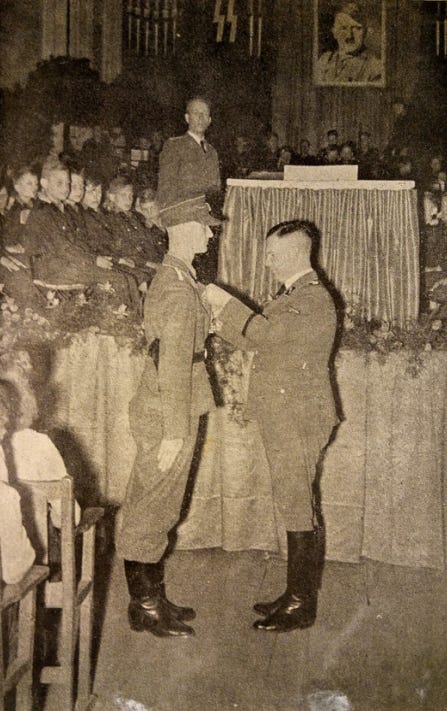
In this context, we would also like to point out that, not long ago, at a political meeting held on Dutch soil, the Iron Cross was awarded for the first time by one Dutchman to another. The Foreman of the Germanic SS in the Netherlands, SS-Standartenführer J.H. Feldmeijer, presented SS-Obersturmführer Rollema with the Iron Cross 2nd Class at an SS meeting in Maastricht, in recognition of demonstrated bravery on the Eastern Front.
In itself, this is nothing special. The Foreman is also part of the SS hierarchy, in which one’s nationality matters little—or actually not at all. What counts here is solely the good blood and the position one holds within the SS hierarchy. That we nevertheless draw attention to this event is due to the fact that such moments so clearly demonstrate the equality which those with separatist aims are always loudly proclaiming and endlessly discussing—while within the SS community, it belongs among the facts that are taken for granted. Only the man who receives the Iron Cross matters here, as the Foreman himself remarked, because ultimately, the Iron Cross is awarded in the name of the Führer.
It is remarkable that the Iron Cross, in terms of form, has remained virtually unchanged. Only the front side now bears the swastika and the year 1939, while the back carries the founding year 1813. Furthermore, the ribbon that belongs to the Iron Cross is black-white-red, and the initials of the founder, King Wilhelm Friedrich III, have been omitted.
One difference between the Iron Crosses of 1813, 1870, and 1914 on the one hand, and that of 1939 on the other, is that the first three were Prussian decorations, whereas the latter is a badge of honor of the Greater German Reich.
In essence, we already view the Iron Cross in its current form as a Germanic badge of honor, even though this is not yet established in decrees, laws, or other regulations. But isn’t that also still the case with the Reich itself—yet it already lives in our hearts and minds, and certainly not least in the places where men of the same blood defend our living space against the attacks of our enemies?
One day, it will also be officially established on paper that the Iron Cross is a distinction of the Reich that is becoming reality these days—of Germania. For the men of the SS, this will be a proud and glorious moment, for it will signify recognition of their courage, their willingness to serve and sacrifice, and their perseverance shown in this current war, which will determine what the world will look like for the next thousand years.
Originally published in SS-Vormingsbladen, August 1944
Looking for free books? Then check out the Fifth Column Library!
