


Chapter Introduction
Before we begin, I would like to inform you of what this chapter is about and what it includes. In Volume II; Chapter I-II, I detailed where Ethos, also know as Jake Leone, conspired to dox my personal information to use it to blackmail me for nefarious reasons. He orchestrated the threatening of my family (including my 1 year old niece), the attempted destruction of my business, and the implication of my organization in the terroristic shooting that occurred at Brown University.
These are the following charges that can be brought up if I were to pursue legal action (non-civil):
Federal Charges
18 U.S. Code § 2261A - Stalking1
Whoever
(2) with the intent to kill, injure, harass, intimidate, or place under surveillance with intent to kill, injure, harass, or intimidate another person, uses the mail, any interactive computer service or electronic communication service or electronic communication system of interstate commerce, or any other facility of interstate or foreign commerce to engage in a course of conduct that—(A)
places that person in reasonable fear of the death of or serious bodily injury to a person, a pet, a service animal, an emotional support animal, or a horse described in clause (i), (ii), (iii), or (iv) of paragraph (1)(A); or
(B)
causes, attempts to cause, or would be reasonably expected to cause substantial emotional distress to a person described in clause (i), (ii), or (iii) of paragraph (1)(A), shall be punished as provided in section 2261(b) or section 2261B, as the case may be.
18 U.S. Code § 1038 - False information and hoaxes2
(a)Criminal Violation.—
(1)In general.—Whoever engages in any conduct with intent to convey false or misleading information under circumstances where such information may reasonably be believed and where such information indicates that an activity has taken, is taking, or will take place that would constitute a violation of chapter 2, 10, 11B, 39, 40, 44, 111, or 113B of this title, section 236 of the Atomic Energy Act of 1954 (42 U.S.C. 2284), or section 46502, the second sentence of section 46504, section 46505(b)(3) or (c), section 46506 if homicide or attempted homicide is involved, or section 60123(b) of title 49, shall—
(A)
be fined under this title or imprisoned not more than 5 years, or both;
(B)
if serious bodily injury results, be fined under this title or imprisoned not more than 20 years, or both; and
(C)
if death results, be fined under this title or imprisoned for any number of years up to life, or both.
Pennsylvania
Harassment (18 Pa.C.S. § 2709) and (18 Pa.C.S. § 2709(a.1)3
§ 2709. Harassment.
(a) Offense defined.--A person commits the crime of harassment when, with intent to harass, annoy or alarm another, the person:
(1) strikes, shoves, kicks or otherwise subjects the other person to physical contact, or attempts or threatens to do the same;
(2) follows the other person in or about a public place or places;
(3) engages in a course of conduct or repeatedly commits acts which serve no legitimate purpose;
(4) communicates to or about such other person any lewd, lascivious, threatening or obscene words, language, drawings or caricatures;
(5) communicates repeatedly in an anonymous manner;
(6) communicates repeatedly at extremely inconvenient hours; or
(7) communicates repeatedly in a manner other than
(a.1) Cyber harassment of a child.--
(1) A person commits the crime of cyber harassment of a child if, with intent to harass, annoy or alarm, the person engages in a continuing course of conduct of making any of the following by electronic means directly to a child or by publication through an electronic social media service:
(i) seriously disparaging statement or opinion about the child’s physical characteristics, sexuality, sexual activity or mental or physical health or condition; or
(ii) threat to inflict harm.
Stalking (18 Pa.C.S. § 2709.1)4
§ 2709.1.
(a) Offense defined.--A person commits the crime of stalking when the person either:
(1) engages in a course of conduct or repeatedly commits acts toward another person, including following the person without proper authority, under circumstances which demonstrate either an intent to place such other person in reasonable fear of bodily injury or to cause substantial emotional distress to such other person; or
(2) engages in a course of conduct or repeatedly communicates to another person under circumstances which demonstrate or communicate either an intent to place such other person in reasonable fear of bodily injury or to cause substantial emotional distress to such other person.
Criminal Coercion (18 Pa.C.S. § 2906)5
§ 2906. Criminal coercion.
(a) Offense defined.--A person is guilty of criminal coercion, if, with intent unlawfully to restrict freedom of action of another to the detriment of the other, he threatens to:
(1) commit any criminal offense;
(2) accuse anyone of a criminal offense;
(3) expose any secret tending to subject any person to hatred, contempt or ridicule; or
(4) take or withhold action as an official, or cause an official to take or withhold action.
Terroristic Threats (18 Pa.C.S. § 2706)6
§ 2706. Terroristic threats.
(a) Offense defined.--A person commits the crime of terroristic threats if the person communicates, either directly or indirectly, a threat to:
(1) commit any crime of violence with intent to terrorize another;
(2) cause evacuation of a building, place of assembly or facility of public transportation; or
(3) otherwise cause serious public inconvenience, or cause terror or serious public inconvenience with reckless disregard of the risk of causing such terror or inconvenience.
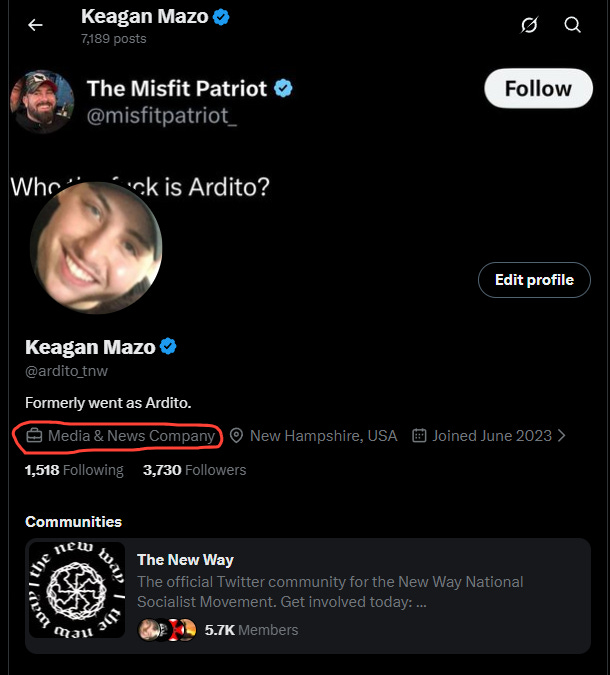
The combined jail time for these offenses would be at least 40 years. So, as a journalist, which you can see by the screenshot of my Twitter profile below, I couldn’t sit back and let a very dangerous individual go unknown in the community. So using my journalistic freedom which is guaranteed under the First Amendment, I decided to bring this newsworthy story to everyone’s attention.7
Legal and Ethical Disclosure Statement
All information contained in this report has been obtained exclusively from publicly available records and sources. These sources include, without limitation, official government documents, court records, property and lien filings, business registrations, voter registration records, federal, state, and local agency databases accessible under applicable freedom of information laws, and reputable published news reports. No confidential, sealed, private, or restricted materials were accessed or utilized. This report is prepared for informational and journalistic purposes only, does not constitute legal advice, and makes no representations as to the exhaustive nature of the information presented. Readers are advised to independently verify facts through official sources and to consult legal professionals for any matters requiring formal interpretation. The author and publisher (myself) disclaim any liability arising from the use of or reliance upon this information.
The Man Behind the European Ethos Project
The European Ethos Project is an account on Twitter which has over 18K followers and is reportedly a best selling author on Amazon.
This account was created on September 13th, 2024. The first username he ever used was @EuropeanEthos which he kept until Mid-September. By early October, he had changed his username to @Ethos_Project and finally by mid-October, he had changed it to what it is now, Ethosrevival. This is also the name username that he uses on Substack, Jake Leone.
Examining the Name Jacob
The name Jacob comes from the Latin Iacob, which was from the Greek Ἰακώβ (Iakob), which was in turn from the Hebrew Yaʿaqov (יַעֲקֹב). The name is derived from the Biblical account of Jacob (later named Israel), who was the son of Isaac and Rebecca (or Rebekah), and the father of the twelve founders of the twelve tribes of Israel. He was born holding his twin brother Esau‘s heel, and his name is explained as meaning “holder of the heel” (a jewish idiom for a deceiver) or “supplanter,” because he twice deprived his brother of his rights as the firstborn son and of his father’s blessing.
This account can be found in Genesis 25:27-33;8
So the boys grew. Now Esau was a skillful hunter, a man of the field; but Jacob was a simple man, dwelling in tents. Now Isaac loved Esau because he ate his venison, but Rebekah loved Jacob. Then Jacob cooked a stew; and Esau came in from the field, and was weary. So Esau said to Jacob, “Let me taste this red stew, for I am exhausted.” Therefore his name was called Edom. But Jacob said to Esau, “Sell me your birthright today.” Esau, replied, “Look, I am about to die. What good then is this birthright to me?” Then Jacob said, “Swear to me today.” So he swore to him, and sold his birthright to Jacob. (Esau was the older son, so the right of the firstborn was his. This right taught the firstborn to embrace Abraham’s faith. But he despised this faith, because of his fear of death. He despised the very faith that could save him from death [Hebrews 12:16-17].)9
As well as 27:1-29;10
Now it came to pass, when Isaac was old and his eyes were so dim he could not see, that he called Esau his older son and said to him, “My son.” And he answered him, “Here I am.” Then he said, “Behold now, I am old. I do not know the day of my death. Now therefore, take your weapons, your quiver and your bow, and go out to the field and hunt game for me. Then make me savory food, such as I love, and bring it to me that I may eat that my soul may bless you before I die.” Now Rebekah was listening when Isaac spoke to Esau his son; and Esau went to the field to hunt game for his father. So Rebekah spoke to Jacob her younger son, saying, “Indeed, I heard your father speak to Esau your brother, saying, ‘Bring me game and make savory food for me, that I may eat it and bless you in the presence of the Lord before my death.’ Now therefore, my son, obey my voice according to what I command you. Go now to the sheep and bring me from there two kids, choice and good, and I will make savory food from them for your father, such as he loves. Then you shall take it to your father, that he may eat it and bless you before his death.” Jacob said to Rebekah his mother, “Look, Esau my brother is a hairy man, and I am a smooth-skinned man. Perhaps my father will feel me, and I shall seem to be a deceiver to him; and I shall bring a curse on myself and not a blessing.” But his mother said to him, “Your curse be on me, my son; only obey my voice, and go, get them for me.” So he went and got them and brought them to his mother, and his mother made savory food, such as his father loved. Then Rebekah took the choice clothes of the elder son Esau, which were with her in the house, and put them on Jacob her younger son. She also put the skins of the kids on his hands and on the exposed part of his neck. Then she gave the savory food and the bread she had prepared into the hands of her son Jacob. Thus he went to his father and said, “My father.” And he said, “Here I am, Who are you, my son?” Jacob said to his father, “I am Esau your firstborn; I have done just as you told me; arise, sit and eat of my game, that your soul may bless me.” But Isaac said to his son, “How is it you have found it so quickly, my son?” He said, “Because the Lord your God brought it to me.” Then Isaac said to Jacob, “Come near, that I may feel you, my son, whether you are my son Esau or not.” So Jacob went near to Isaac his father, and he felt him and said, “The voice is Jacob’s, but the hands are Esau’s.” Thus he did not recognize him, because his hands were hairy like his brother Esau’s hands; So he blessed him. Then he said, “Are you my son Esau?” He said, “I am.” He said, “Bring your game to me, my son, and I will eat from it, that my soul may bless you.” So he brought him wine, and he drank. Then his father Isaac said to him, “Come near and kiss me, my son.” So he came near and kissed him; and he smelled the smell of his clothing. Thus he blessed him and said: “Surely, the smell of my son is like the smell of a field the Lord has blessed. Therefore, may God give you of the dew of heaven and the fatness of the earth, and plenty of grain and wine. Let peoples serve you, and nations bow down to you. Be lord over your brethren, and let your mother’s sons bow down to you. And cursed be everyone who curses you, and blessed be those who bless you.” (The Lord is present everywhere and fills all things. Thus, Isaac would give the blessing of the firstborn in His presence. The blessing of the firstborn gave the eldest son a double portion of his father’s inheritance. He would also become the ruler and head over his brethren upon his father’s death, and be responsible for the welfare and administration of the family.)
And finally in Genesis 27:30-40;11
Now it happened, as soon as Isaac finished blessing Jacob his son, and Jacob had scarcely gone out from the presence of Isaac his father, that Esau his brother came in from his hunting. He also had made savory food, and brought it to his father, and said to his father, “Let my father arise and eat of his son’s game, that your soul may bless me.” And his father Isaac said to him, “Who are you?” So he said, “I am your son, your first born, Esau.” Then Isaac trembled exceedingly, and said, “Who? Where is the one who hunted game and brought it to me? I ate all of it before you came, and I have blessed him—and indeed, he shall be blessed.” When Esau heard the words of his father, he cried with an exceedingly great and bitter cry, and said to his father, “Bless me—me also, O my father!” But he said, “Your brother has came with deceit and has taken away from your blessing.” Then Esau said, “Is he not rightly named Jacob? For he supplanted me these two times. He took away my birthright, and now look, he has taken away my blessing.” So he said, “Have you not reserved a blessing for me?” Then Isaac answered and said to Esau, “Indeed, I have made him your lord, and all his brethren I have given to him as servants; with grain and wine I have sustained him. What shall I do now for you, my son?” Esau said to his father, “Have you only one blessing, my father? Bless me—me also, O my Father!” But when Isaac was troubled, Esau lifted up his voice and wept. Then Isaac his father answered and said to him: “Behold, your dwelling shall be of the fatness of the earth, and of the dew of heaven from above. By your sword you shall live, and you shall serve your brother; and it shall come to pass, when you become restless, that you shall break his yoke from your neck.” (The blessing of the firstborn was denied Esau because he despised the faith of Abraham. Because of this, he could find no place of repentance in order to inherit the blessing of the firstborn son [Hebrews 12:16-17]. Likewise, in the Day of Judgment, people who in this life reject the offer of the future inheritance will be unable to find repentance in that day.)
In England, the name Jacob was most often used by jews during the Middle Ages and a variant of the name, James, was used much more commonly by Aryans. However, that changed by the time of the Protestant Reformation when the name Jacob became much common to see among Christians. In America, the name was much more commonly used by jews prior to the 1980s until it steadily grew in popularity amongst Aryans beginning in the 1970s to the end of the 1990s, becoming the top ranked name from 1999 to 2012.
Here are some famous examples of jews named Jacob that were born in or immigrated to America before 1981:
Jacob Tapper, is an American journalist. He is the lead Washington anchor for CNN, hosts the weekday television news show The Lead with Jake Tapper, and co-hosts the Sunday morning public affairs program State of the Union.12
Jacob Gyllenhaal, (born December 19, 1980) is a jewish actor who has worked on screen and stage for over thirty years. Born into the Gyllenhaal family, he is the son of film director Stephen Gyllenhaal and screenwriter Naomi Foner (his mother is jewish), and the younger brother of actress Maggie Gyllenhaal. He began acting as a child, making his debut in City Slickers (1991), followed by roles in his father’s films A Dangerous Woman (1993) and Homegrown (1998). His breakthrough roles were as Homer Hickam in the biopic October Sky (1999) and a troubled teenager in the thriller Donnie Darko (2001). Gyllenhaal expanded to big-budget films with a starring role in the 2004 disaster film The Day After Tomorrow.13
Jacob Scher, (May 25, 1908 – September 27, 1961) was a jewish journalist, lawyer and tenured journalism professor at the Medill School of Journalism at Northwestern University in Evanston, Illinois.14
Jacob Schiff, born Jakob Heinrich Schiff; January 10, 1847 – September 25, 1920) was a German-born jewish banker, businessman, and philanthropist. He helped finance the expansion of American railroads and the Japanese military efforts against Tsarist Russia in the Russo-Japanese War.15
Jacob Epstein, (November 10, 1880 – August 21, 1959) was a jewish and British sculptor who helped pioneer modern sculpture. He was born in the United States, and moved to Europe in 1902, becoming a British subject in 1910.16
Jacob Javits, May 18, 1904 – March 7, 1986) was a jewish lawyer and politician from New York. During his time in politics, he served in both chambers of the United States Congress, a member of the United States House of Representatives from 1947 to 1954 and a member of the United States Senate from 1957 to 1981. A member of the Republican Party, he also served as Attorney General of New York from 1955 to 1957. Generally considered a “liberal Republican,” he was often at odds with his own party. A supporter of labor unions, the Great Society, and the civil rights movement, he played a key role in the passing of “civil rights” legislation. An opponent of the Vietnam War, he drafted the War Powers Resolution in 1973.17
Jacob Bronowski, (January 18, 1908 – 22 August 1974) was a jewish mathematician and philosopher. He is best known for developing a humanistic approach to science, and as the presenter and writer of the thirteen-part 1973 BBC television documentary series, and accompanying book, The Ascent of Man. He was widely regarded as “one of the most revered intellectuals on the global stage.”18
Jacob Neusner, (July 28, 1932 – October 8, 2016) was a jewish academic scholar of judaism. He was named as one of the most published authors in history, having written or edited more than 900 books.19
Jacob Arabo, (born Yakov Arabov, but changed his name to Jacob Arabo to fit in with the jewish infiltrators in America; June 3, 1965) is a jewish jeweler and watchmaker who founded Jacob & Company in 1986 and grew it to become an international luxury brand. He began strictly as a jeweler with designs that appealed to celebrities who became regular customers.20
Jacob Blaustein, (September 30, 1892 – November 15, 1970) was an American entrepreneur, philanthropist, and diplomat who founded the American Oil Company with his father Louis Blaustein. Blaustein was an ardent promulgater of the detrimental “Civil Rights,” for jewish people, and an advocate for multilateralism through the United Nations, serving as a United States delegate to the UN under five U.S. presidents.21
Jacob Rader Marcus, (March 5, 1896 – November 14, 1995) was a scholar of jewish history and a reform rabbi.22
Jacob “Jack” Weinstock, Comedian and vaudeville performer; pushed jewish humor in American theater; wrote for Milton Berle and appeared in early TV sketches.23
Jacob Potofsky, (November 26, 1894 – August 5, 1979) was a Russian-born American trade unionist, best known as second president of the Amalgamated Clothing Workers of America, succeeding founder Sidney Hillman.24
Jacob Arvey, (November 3, 1895 – August 25, 1977) was an influential Chicago political leader from the Depression era until the mid-1950s. He may be best known for promoting the candidacies of liberal Democratic politicians such as Adlai Stevenson and Senator Paul Douglas of Illinois.25
Jacob Cohen, (April 20, 1923 – January 20, 1998) was a jewish psychologist and statistician best known for his work on statistical power and effect size, which helped to lay foundations for current statistical meta-analysis and the methods of estimation statistics. He gave his name to such measures as Cohen’s kappa, Cohen’s d, and Cohen’s h.26
These are just some of the numerous jews that were or are named Jacob before Jacob became more commonly associated with Aryans here in America.
Examining the Nickname Jake
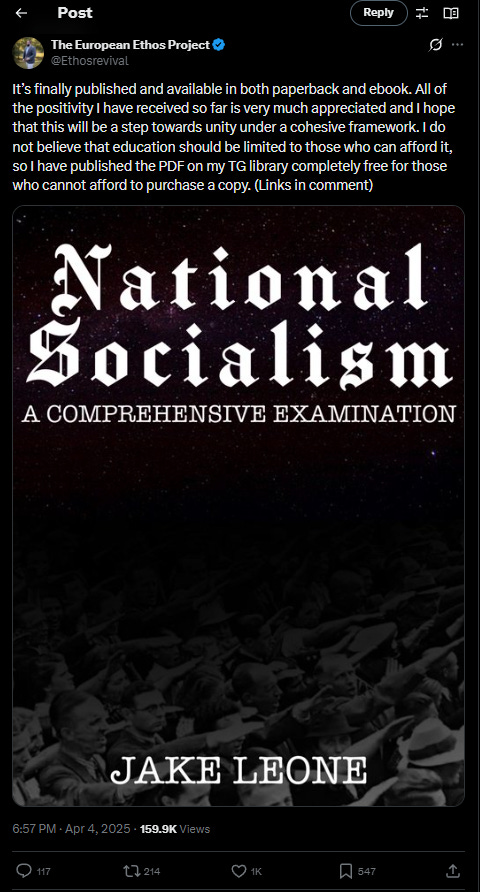
After examining the name Jacob, attention must be drawn to the nickname, Jake, which he has used for the publication of his “magnus opus,” “National Socialism: A Comprehensive Examination.” The contents of the book will be discussed in the next chapter.
The nickname “Jake” is a modern English diminutive of Jacob, which has deep roots in jewish tradition as the name of the biblical patriarch. In jewish onomastics (the study of names), diminutives like “Jake” emerged prominently among Ashkenazi jews in English-speaking contexts, particularly during 19th–20th-century immigration and assimilation in the U.S. and U.K., where it served as a secular (kinnui) form alongside the sacred Hebrew name.
Below is a curated list of scholarly sources from onomastics, jewish studies, and historical linguistics that explicitly connect “Jake” to jewish naming patterns. These draw from biblical etymology, diaspora adaptations, and hypocoristic (pet-name) formations.
A Dictionary of Ashkenazic Given Names: Their Origins, Structure, Pronunciation, and Migrations by Alexander Beider:27
“Ashkenazic Jews traditionally used two given names: a sacred one (shem ha-qodesh) in Hebrew or Aramaic, and a secular one (kinnui) in Yiddish or the local vernacular. The sacred name was used in religious contexts (e.g., Torah readings, legal documents), while the kinnui was for everyday life. Biblical names dominated the sacred repertoire for males, with Yaʿaqov (Jacob) being one of the most frequent from the earliest periods (11th–12th centuries). Yaʿaqov derives from Hebrew ‘one who holds the heel’ (Genesis 25:26), referring to the biblical patriarch. Its frequency increased after the 13th century due to the revival of patriarchal names (Avraham, Yitsḥaq, Yaʿaqov). In medieval Hebrew charters from the Rhineland (e.g., Speyer, Worms), Yaʿaqov appears in ~15–20% of male names, often paired with vernacular forms like Jakop or Yankev. Double given names (shemot meshukadim) were rare before the 18th century but became common in Eastern Europe, e.g., Yaʿaqov Yosef (Jacob Joseph). Frequency data from 16th–19th-century metrical books (Poland, Ukraine) show Yaʿaqov in 8–12% of male births, higher than Moshe (5–7%) but below Yitsḥaq (10–15%). Feminine equivalents (e.g., Rivka for Rebecca) followed similar patterns, but male biblical names like Yaʿaqov were more rigidly adhered to.” [Excerpt 1: From Chapter 1 – Ashkenazic Naming Traditions (pp. 1–50)]
“Hypocoristics (pet forms) are created by truncation, suffixation, or phonetic reduction, often reflecting Yiddish phonology. For biblical names, the sacred form remains intact, but the kinnui undergoes heavy modification. For Yaʿaqov (Jacob): The primary Yiddish kinnui is Yankev or Yankl (from Middle High German Jakop → Yiddish Jankev, with /k/ → /x/ shift). In Western Yiddish (Germany, 12th–16th centuries), forms include Jakop, Jäcob, or Kob (truncation). Eastern Yiddish (Poland-Lithuania, 16th–19th centuries) favors Yankl, Yankele, or Koppel (from Latin Jacobus → Judeo-Slavic Kopel). In English-speaking diaspora (U.S., U.K., post-1880s immigration), phonetic adaptation yields Jake as a direct truncation of Jacob/Yankev (/dʒeɪk/ from /jɑŋkəl/, dropping the nasal and suffix). Jake is undocumented before the 19th century but surges in U.S. vital records (1880–1920) among Ashkenazic immigrants, appearing in ~3–5% of Jacob-named males in New York and Chicago censuses. It functions as a secular kinnui, e.g., sacred Yaʿaqov + kinnui Jake. Other English variants: Jack (older, from medieval Jakke), Cob (archaic). Suffixation examples: Yankele (diminutive, affectionate, common in Hasidic communities); Jäkale (Western Yiddish). Truncation without suffix: Yank, Kop. These forms illustrate Yiddish’s role in preserving biblical roots while adapting to local vernaculars. In non-Jewish contexts, Jacob diminutives like Jake are rare pre-1800s, highlighting Ashkenazic specificity.” [Excerpt 2: From Chapter 3 – Creation of Hypocoristic and Pet Forms (pp. 80–120)]
“Yiddish phonology, blending High German, Hebrew, and Slavic elements, systematically alters foreign names. For Semitic Yaʿaqov: Initial /j/ remains, but /aʿ/ diphthongizes to /ɔɪ/ or /ɔj/ in Eastern dialects (Yoyvl/Yankev). The /q/ (uvular fricative) softens to /k/ or /x/ in vernaculars. Medieval Judeo-German (12th–14th centuries): Iacob → Jakop (loss of final /b/, vowel reduction). Example from Frankfurt charters (13th century): ‘Jacop’ (morphophonemic variant of Jacob), cited alongside Süsskind (from Yiddish Ziskind). This Jacop form influenced early Ashkenazic onomastics, spreading to Bohemia and Poland. In 19th-century American Yiddish: Yankev → Yank or Jake via anglicization ( /jæŋk/ → /dʒeɪk/, nasal loss and vowel fronting). Ellis Island records (1892–1924) show 12% of Yaʿaqov immigrants anglicizing to Jake, vs. 5% to Jack. This reflects assimilation: Jake as a ‘neutral’ English pet form, retaining the initial /j/ and core syllable from Hebrew Yaʿaqov.” [Excerpt 3: From Chapter 4 – Phonetic Changes Related to Yiddish Phonology (pp. 121–151)]
Personal Names that Became Ethnic Epithets by Irving Lewis Allen:28
“Most of the names for Jews derive from given names, though the family names Levi and Goldberg have been used. The following given names have been recorded as slurs when used generically: Abe and Abie (from Abraham), Dave, Ikey and Ike (from Isaac), Ikey-Mo (from a blend of Ikey and Mo, from Moses), Izzy (from Isadore), Jake (from Jacob), Max, Moses, Mouchey (perhaps from Moishe, Le., Moses), Sol (from Solomon). Sammy is from Samuel, but see my discussion of the generic Sammy under terms that connote low status and anonymity. For women, Rachel and Rebecca similarly, were used.” [Pgs. 315-316]
The Genealogy of Jake Leone
Jake Leone by his statements is an Aryan of Scottish/Italian descent. However, by examining these statements, his physiognomy and his family lineage, a clearer picture of Jake Leone can be painted. Below is a piece of a family tree that Jake posted on Twitter on October 26th, 2024.
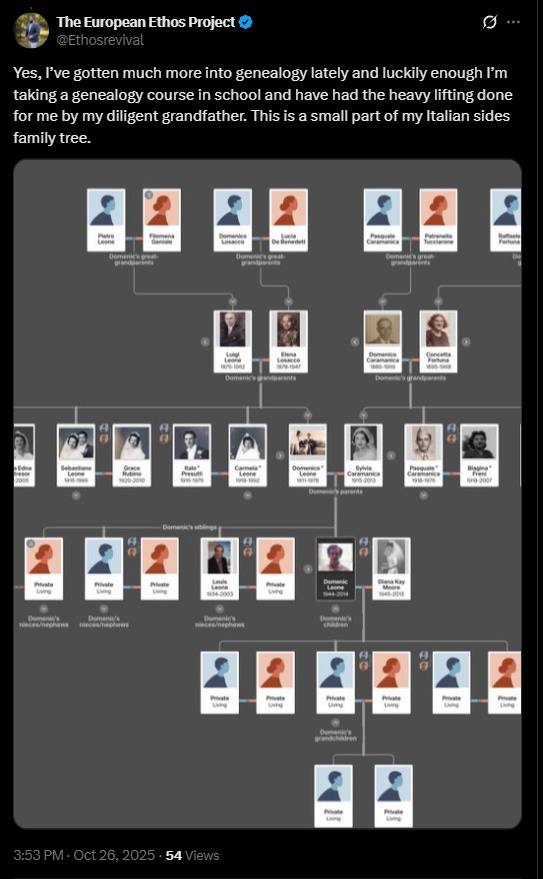
All sources I will be using are easily attainable through public means (including obituaries, social media statements, etc.). Taking a closer look at Jake’s family tree which focuses on his reported Italian family heritage, the following last names can be seen in his direct lineage:
Leone
Losacco
“De Bendett”
Rubino
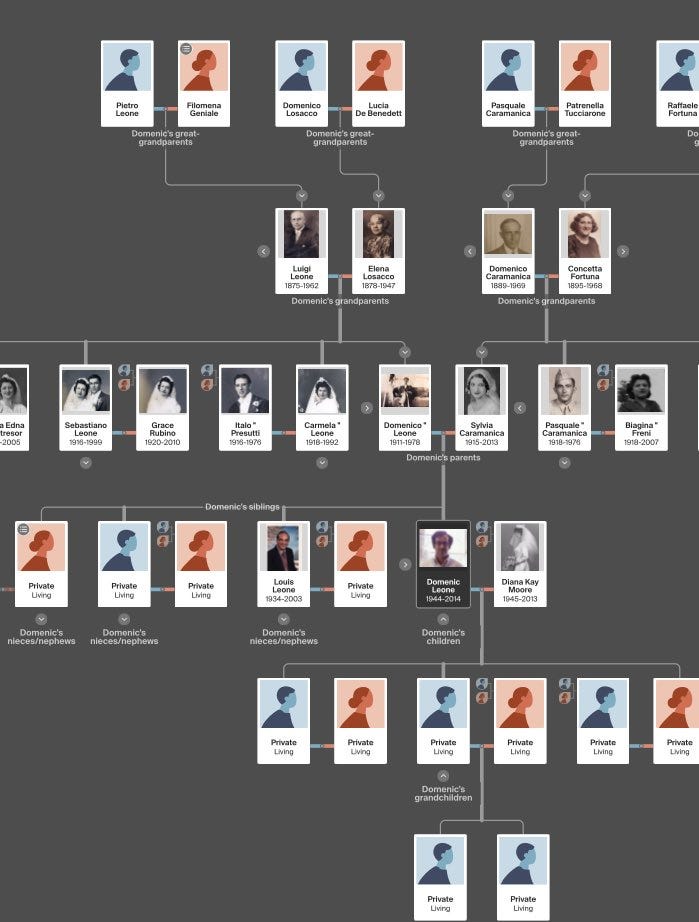
Upon examining a closer image of Jacob’s family tree, it is determined that there are three examples of possible jewish lineage:
Leone, meaning lion in Italian (used by jews as a nod to the Lion of Juda).
“De Benedett”
Rubino29
Examining the surname Leone
Below is a curated list of scholarly sources from onomastics, jewish studies, and historical linguistics that explicitly connect these last names to jewish naming patterns. These draw from biblical etymology and diaspora adaptations.
These two sources link the last name of Leone to jews:
Italian Jewish Roots Surname Research by Rabbi Barbara Aiello (She uses Nicastro’s Judeca and the history of the Jews in Calabria by Vincenzo Villella as a direct source).30
The Surnames of the Jews of Italy by Samuele Schaerf (1925).31
This source explicitly ties jews with the surname of Leone to Caltagirone, Catania, Sicily, Italy:
Italia Judaica: The Jews in Italy from segregation to the first emancipation by Jonathan Israel [Wikipedia lists the name without purchase. Translated to Leo in English, but listed as Leone in Italian.]32 33
Further examination of The Surnames of the Jews of Italy by Samuele Schaerf provides more evidence of jews with the surname, Leone, being found in Sicily:
“Leone – Cognome ornamentale dal simbolo del ‘Leone di Giuda’. Presente in famiglie sefardite a Palermo e Siracusa dal XIV secolo. Varianti: Leoni, Leonino. Attestato in 46 famiglie siciliane nei registri del 1470.”
Translation: “Leone – Ornamental surname from the symbol of the ‘Lion of Judah’. Present in Sephardic families in Palermo and Syracuse from the 14th century. Variants: Leoni, Leonino. Attested in 46 Sicilian families in the 1470 registers.” [1925, p. 98]
There are two sources that state that jews from Sicily were forced to flee after the Alhambra Decree of 1492 and went to the Lazio region.
The first source comes from Cecil Roth’s “The Jews in Malta”:34
“After the expulsion from Sicily [1493], many of the exiles crossed to Calabria or sailed to Naples, but a number found their way to the Papal States, including Rome, where the popes offered temporary asylum to Sicilian and Spanish refugees.”
The second source comes from Shlomo Simonsohn’s “The Jews in Sicily, Volume 18, Under the Rule of Aragon and Spain”:35
“The Sicilian Jews who refused conversion fled in large numbers; some to the Ottoman Empire, others to the Italian mainland. Records from the Roman ghetto show arrivals from Sicily in 1493–1494, integrating into the existing Jewish community under papal protection.”
While the majority of jews fled to the Ottoman Empire, North Africa, or other Italian regions like Calabria and Campania, a smaller number sought refuge in the Papal States due to initial papal protection under Pope Alexander VI (1492–1503). However, no specific records of jews with “Leone” as a surname migrated from Sicily to Lazio can be found.
Looking at this from the perspective that perhaps the surname Leone didn’t originate in Sicily, a curious thing is discovered. There is one particular case of a noble family of jewish ancestry and banking fame from the Lazio region called Pierleoni that originates in the 11th century. After 1060A.D., a jew by the name of Pier Leoni (also known by the first name of Pietro or Petrus) becomes very influential and powerful. His surname was first documented by the Latinized form of his full name, Petrus Leonis. In Medieval Italy, Latin was used to denote surnames, a practice which was not commonly found in the Italian language, however, it is documented that Pier Leoni or Pietro di Leoni/di Leone did use the Italian form of Leonis as a surname. This is the first documented case of that surname in the Lazio region. In fact, it became common to use fixed surnames after the death of Pier Leoni, hence the family Pierleoni (sons of Peter Leo, or Peter the Lion). The Pierleoni family would go on to gain control of important strategic and symbolic assets: among them — Castel Sant’Angelo (the tomb of Hadrian which was granted to them by Pope Urban II in 1098), fortifications, tower-homes, the Isola Tiberina, and properties around the Teatro di Marcello. Their financial and political power made them central players in the intense ecclesiastical and aristocratic conflicts of 11th–12th-century Rome (Papacy vs. Imperial power; nobles vs. clergy; competing Roman clans such as the Frangipane). Not to mention Pier Leoni’s son went on to become Antipope Anacletus II.36 37
No records can readily be found that show that the surname Leone or its variant, Leoni, were established before the time of Pietro di Leone (11th century).
This is the first usage of Leone as a surname in mainland Italy. The first introduction of Leone to Sicily was by the House of Leone (Spanish) after Aragon annexed the island. However, if you look at modern maps, the ancestries of Sicilians is very telling.38
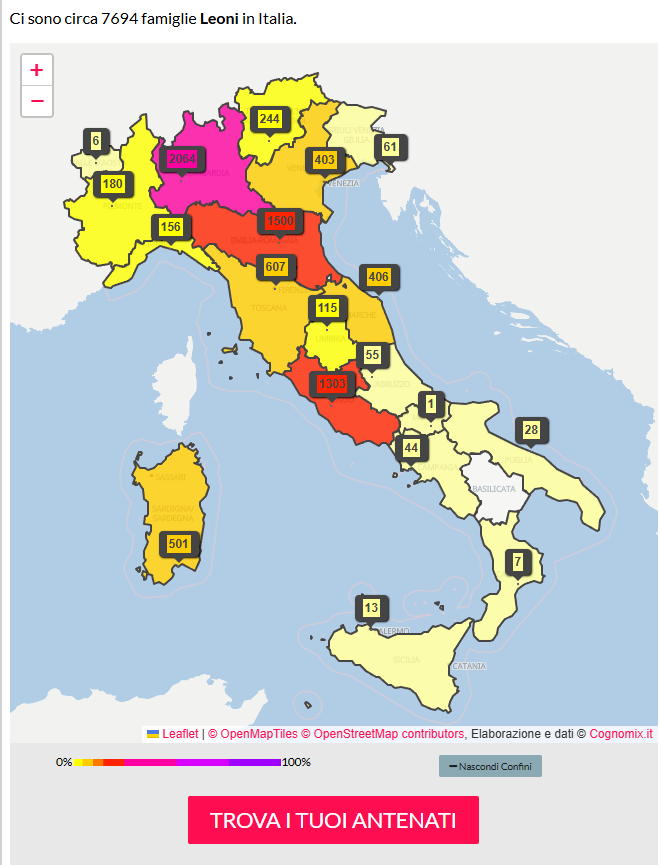
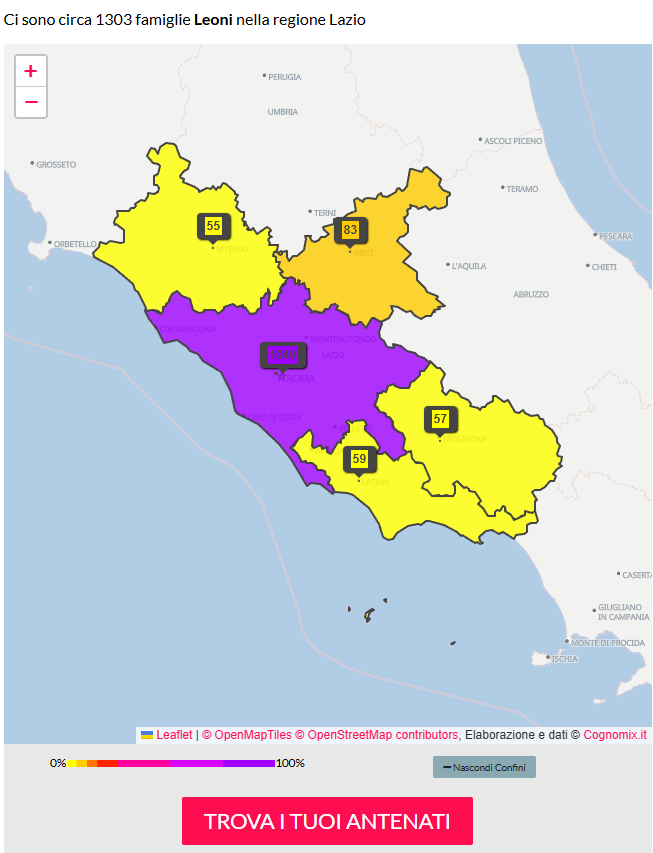
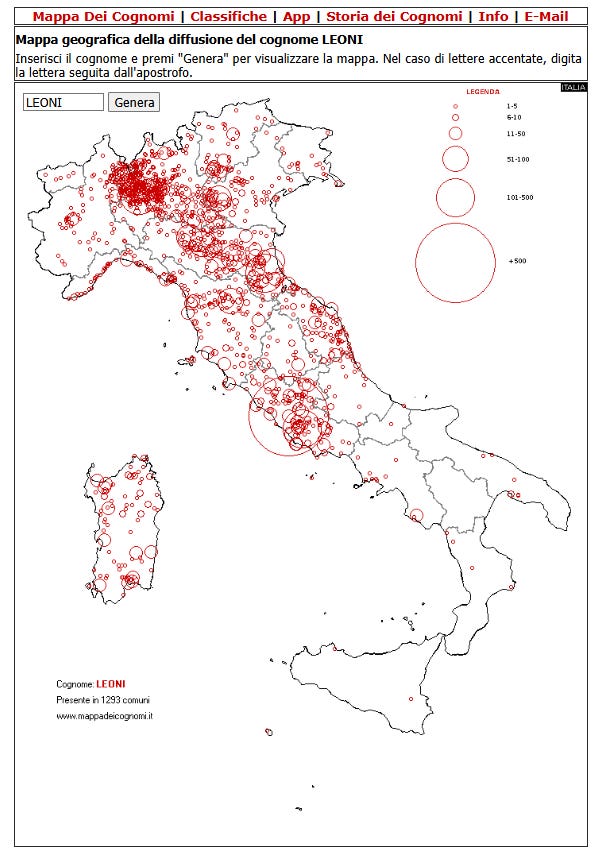
For context, here are maps that show the number of families in modern Italy with the last name Leoni. Leoni is heavily present in Lazio and Northern Italy, however, it is extremely rare in Southern Italy and specifically Sicilia where the Leone surname was documented among jews.
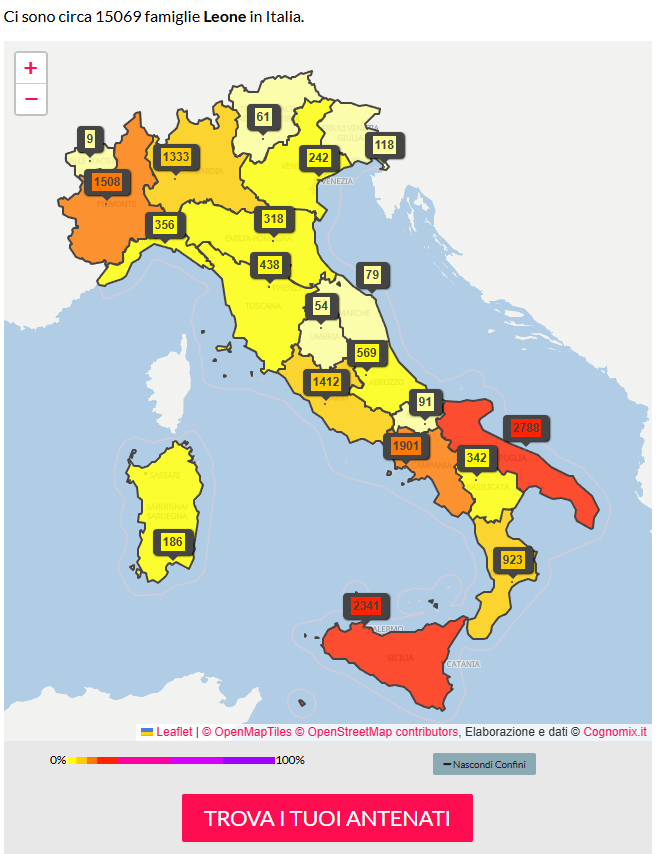
And these map shows the amount of families with the last name Leone. Leone is heavily present in Sicilia, Puglia, Lombardia, Campania and Piedmonte. No maps will show Leonis, as Latin phased out of everyday use.
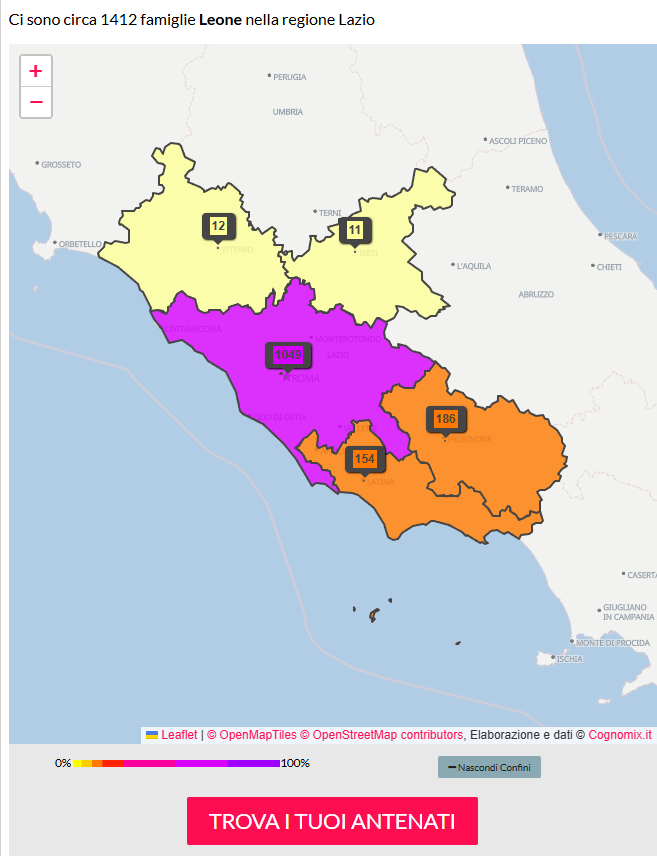
In modern Italy, there are a reported 41,540 jewish people. Jewish population density is always centered around high population centers such as Rome (Lazio), Milan (Lombardia), Turin (Piedmonte), Florence and Livorno (Toscana) and Venice (Veneto). The regions with the highest amount of historical jewish admixture are Puglia, Sicilia, Calabria, and Campania, where the surname Leone is most present.39
Examining more maps shows that the areas associated with the highest concentration of jews are exactly where the surnames Leone and Leoni are most present.
Mappa geografica della diffusione del cognome LEONE
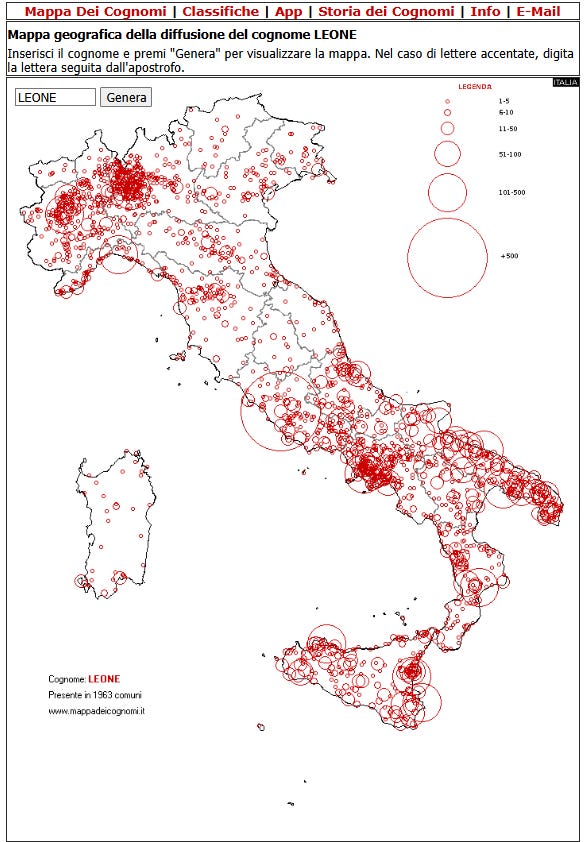
Mappa geografica della diffusione del cognome LEONI
Searching for recent examples of jews with the surname, Leoni, brings up the jewish school in Vignatagliata and a chief rabbi named Leone Leoni who in 1943 was forced to shut down the jewish school by the Fascist Government. However, that’s not the only thing that is noticeable.
Under Testimonials the following is found:
Testimony by Roseda Tumiati
“’Where is Debenedetti?’ I ask around amazed with my gaze along the other rows. ‘And Levi with bangs and long silk stockings?’ But how, we’ve been together for seven years since first grade. ‘They are not there because they are Jews” Raffaele repeats and adds: “The Duce said that they cannot come to school near us, that we must stay away from them because they are impure!’. Impure Debenedetti and Levi? ‘Are they unclean and undermine world peace with their riches’ Riches? But Debenedetti has a railway worker dad and Levi has a dad with a toy shop in an ugly, narrow street...”40
Examining the last name, De Benedett.
The surname De Benedett was listed on Jake’s family tree, however, searching for that surname will bring up zero historical results. That’s because by the 1800s, when his ancestor Lucia “De Benedett” would have been born, Italian surnames similar to hers had long adopted the standardized variants, Benedetto/Benedetta and Benedetti. Not “Benedett.” From now on the surname “De Benedett” will be treated as De Benedetto/i/is.
Around the time of the jew, Pietro de Leone (11th century), a noticeable shift towards adopting fixed surnames is recorded. Before that time, names like “de Leone” would have been strictly patronymic. This means that every new descendant would take on the name of their father, such as Pietro de Leone did with his father. However, to reinforce the evidence from earlier, Pietro de Leone’s sons took on the surname, Pierleoni. This means that Pietro de Leone did in fact use “de Leone” (or its variants) as a proto-fixed surname and that his children took on the new surname, Pierleoni (meaning sons of, first name, Peter, last name, Leo), denoting that de Leone was used in an official capacity as a surname. With fixed surnames becoming common after Pietro de Leone and then his son’s adoption of a new surname, the preposition of “de” (Italian for “of”) was formalized into fixed surnames.
From the institute of the Italian Encyclopedia, Treccani:41
Surnames ending in -is very often derive from Latinized paternity formulas, typical of the chancery tradition, which are constructed with the ablative and, generally, the preposition de or di: De Petris, De Martinis, De Andreis, De Robertis, and Robertis. Numerous surnames that derive from patronymics or matronymics are expressed with prepositions placed before non-Latinized names: D’Angelo, D’Anna, De Maria, Di Maria, De Giovanni, Di Giovanni, Della Giovanna, Dell’Antonia, Degli Antoni. These patronymics are popularly considered an indication of noble lineage, usually indicated by the lowercase character: de, di; hence the habit of writing one’s surname in this way even in the absence of historical documentation regarding the family’s true nobility.
This means that Lucia De Benedetto/i/is would have been had ancestors that adopted the practice of using the capitalized “De” in order to indicate noble lineage.
To determine which region Lucia’s surname originates, Treccani will be used again:42
Territorial distribution
The spread of these surnames, particularly the most numerous, is often pan-Italian (with the exception of Tuscany, Umbria and northern Marche and smaller presences in the North-West and Emilia-Romagna); however it can at least be noted that De + name in the singular is typically southern, especially Campanian. De + name in the plural is instead northern (De Carli, De Franceschi, De Gregori, De Martini, De Mattei, De Stefani). De + name with ablative exit -is (and on some occasions -ibus) is present above all in Central Italy (De Andreis, De Angelis, De Carolis, De Stefanis) or in the Centre-South (De Sanctis, De Santis), but in some cases exclusively in the South (De Franciscis, De Matteis, De Robertis). Finally, Di + name (always in the singular) is generically central-southern, with numerous presences in Sicily and even more so in Abruzzo.
The density map of De Benedetti shows that this surname is most commonly associated with high population centers in Northern Italy as well as the Lazio region. It also has the largest amount of modern Italians with that surname.
Mappa geografica della diffusione del cognome DE BENEDETTI
Diffusione del cognome De Benedetti
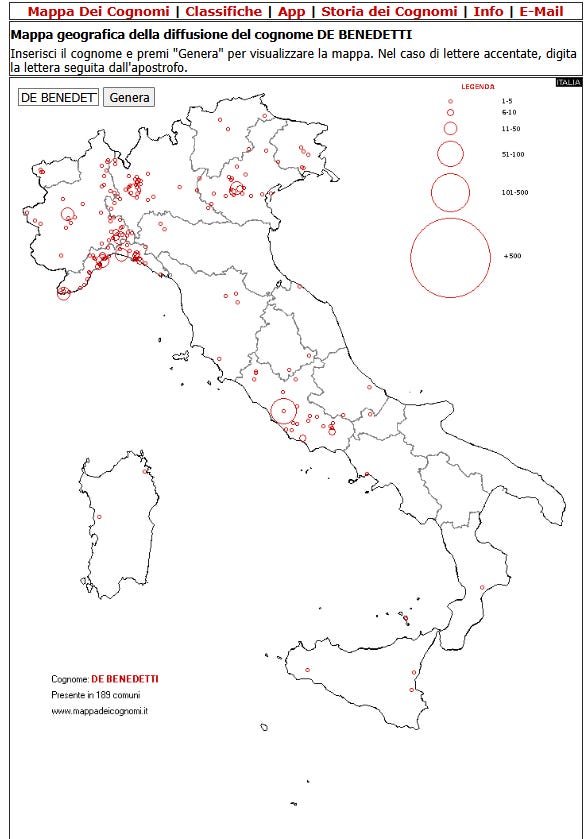
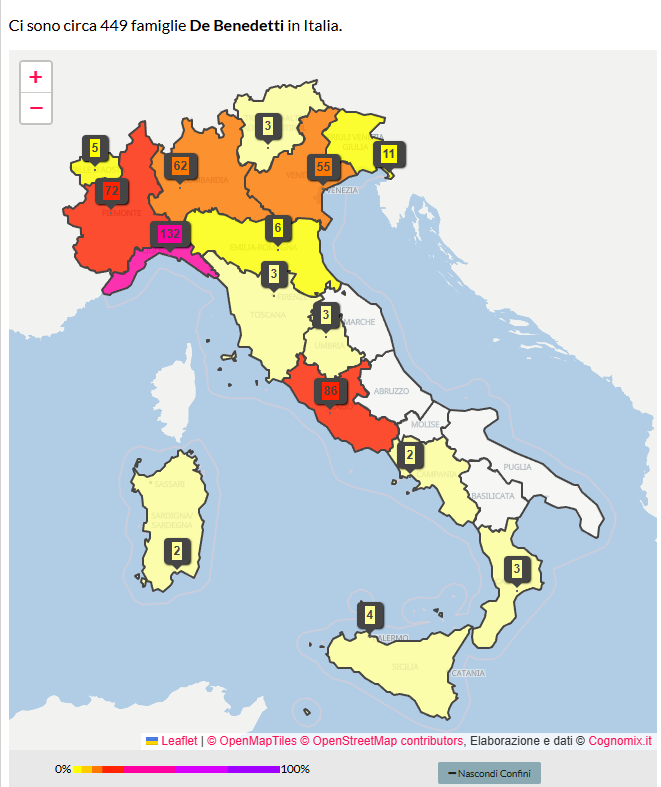
Examining these maps of the surname “De Benedetto,” it is observed that this name is most associated with high population centers and Southern Italy, where the greatest amount of historical jewish ancestry is present in Italy.
Mappa geografica della diffusione del cognome DE BENEDETTO
Diffusione del cognome De Benedetto
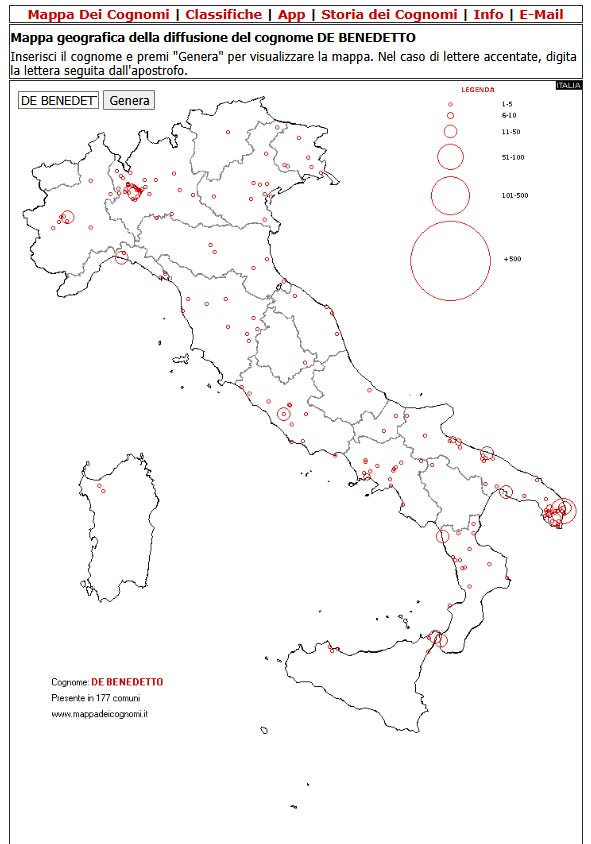
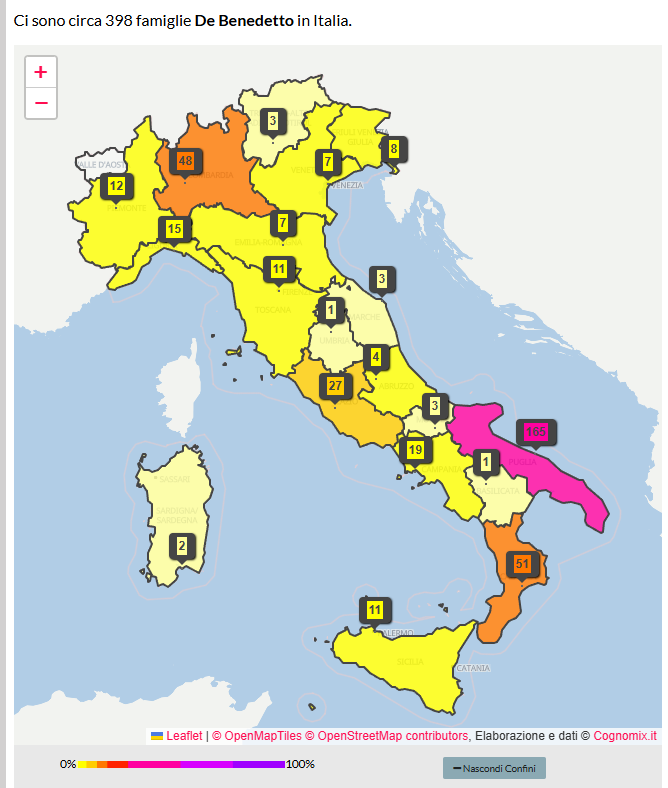
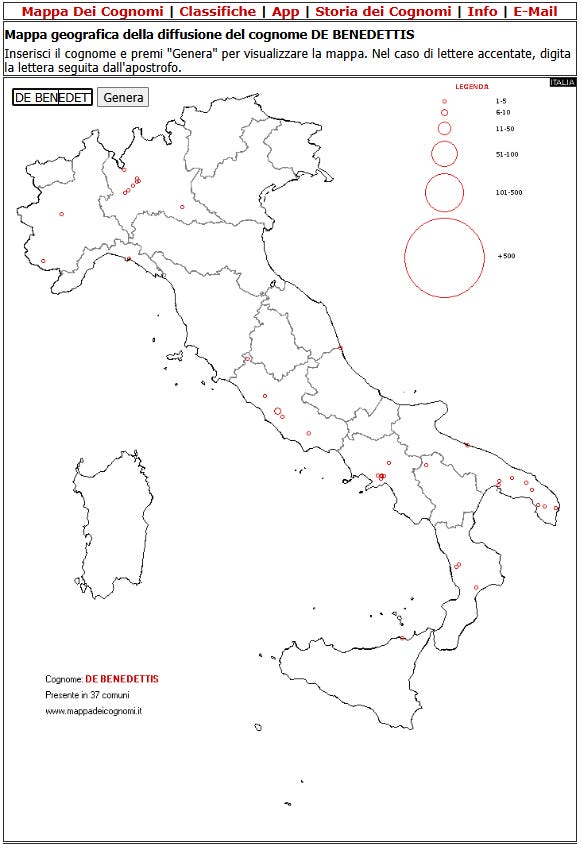
Finally examining the surname “De Benedettis,” it is observed that this surname is associated with high population centers and Southern Italy.
Mappa geografica della diffusione del cognome DE BENEDETTIS
Diffusione del cognome De Benedettis
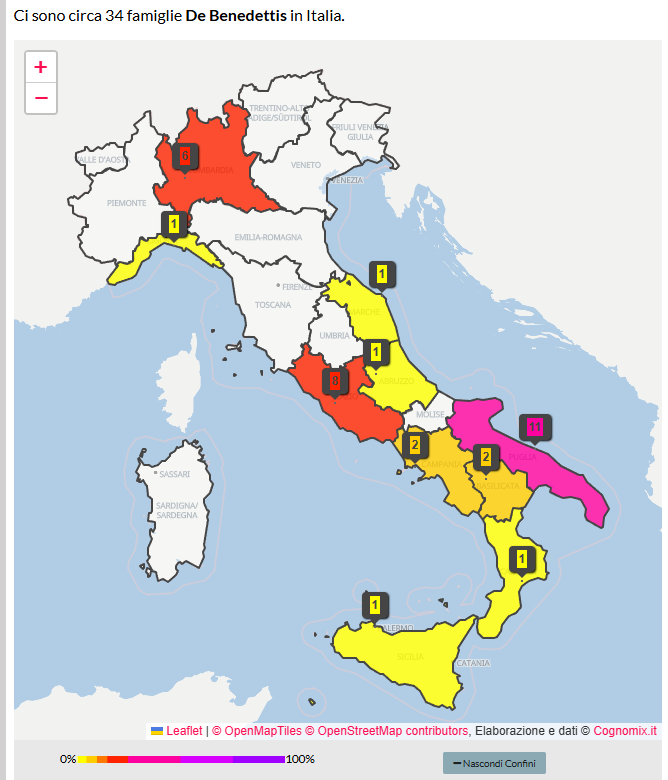
The earliest record of the fixed surname (not patronymic) “de Benedetto” is recorded in Shlomo Simonsohn’s The Jews in Sicily, Volume 16 (Leiden: Brill, 2009), which it is recorded four times (Secondary source added below because “The Jews in Sicily” is behind a paywall):43
de Benedetto, Israel 1482
de Benedetto, Lia [of Palermo; a shoemaker] 1480
de Benedetto, Muxa [of Palermo & Marsala] 1468-1489
de Benedetto de Cappecta, Daniel [of San Marco] 1468
These jews were neofiti (Southern Italian crypto-jews). The neofiti were descendants of jews who were forced to convert to Roman Catholicism in 1493. They continued to secretly practice certain elements of Judaism, as did many of their descendants. The neofiti listed above were from Termini Imerese, Sicily.44
The Spanish Inquisition had begun in 1478 but it did not reach Sicily until 1504. When it did, it is recorded that 15 jewish families fled from the island and found protection on the mainland. There is no mention of their names. However, it is noted that of all of the regions in Southern Italy, Apulia has the greatest amount of Italians with jewish admixture, roughly a 29.1% chance of having J2. J2 indicates potential jewish influence, as well as Middle Eastern and Greek/Anatolian influence.45
Narrowing down my search, I was able to uncover that Elena Losacco’s mother’s name was actually Lucia Debenedetto. Elena was born in Bari, Italy, which is in the Apulia/Puglia region. I was also able to determine that her husband, Luigi Leone was also born in Bari.
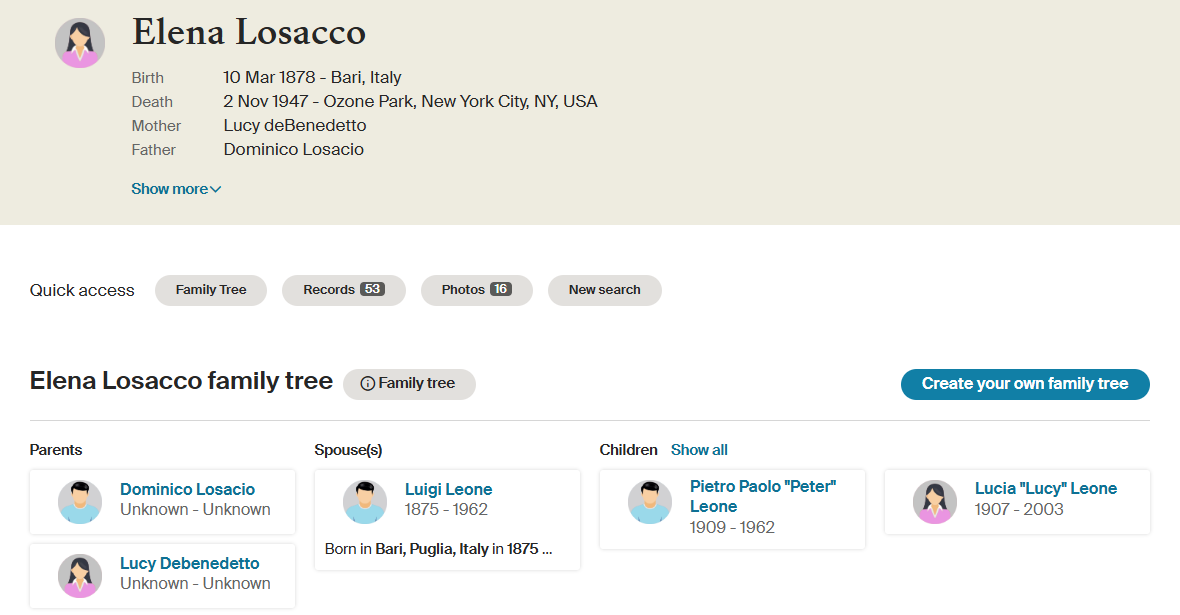
Originally I had been operating under the assumption that Jake’s family originated from the Lazio Region because of the tweet I screenshot below.
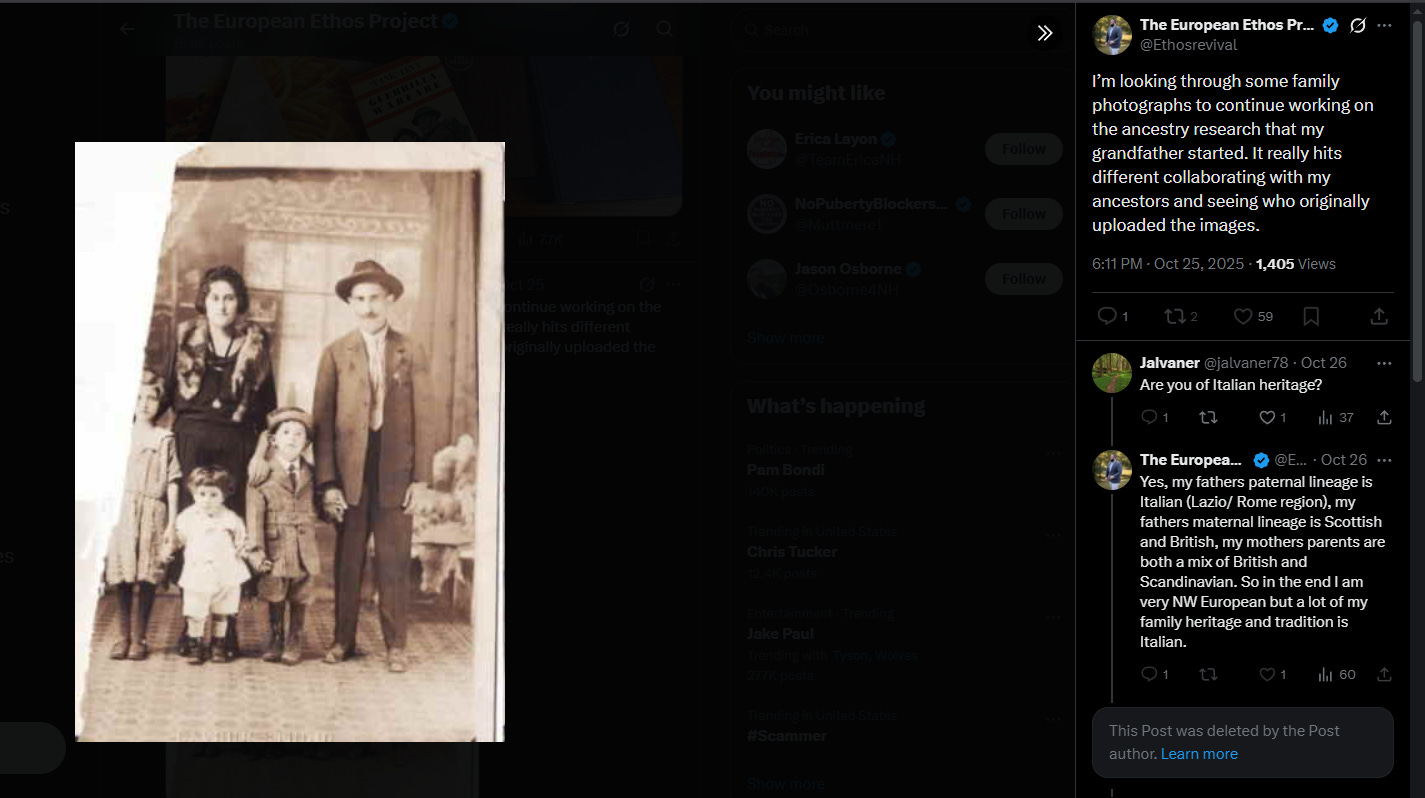
However, because the Leones are actually from Bari, Apulia (Puglia), Italy, that means that Luigi Leone would have at least a 32% chance of having J2 (increased due to being born in the 1870s). Statistically speaking, since J2 is carried in the Y-chromosome that means Jake Leone would have a 1-3 chance that his Y-DNA is J2. This does not mean that Jake Leone is jewish, but it certainly increases his odds of having jewish ancestry, especially because Leone and Debenedetto have both been used by jews as surnames in that region.
Modern Big-Y testing of men with 19th-century Bari ancestry shows the following J2 branches are the most common (in rough order):
J2a-L26 → J2a-Z467 → J2a-Z6064 → J2a-Y146400 and downstream branches (Greco-Anatolian / Balkan clade) – the single most common J2 lineage in Bari today
J2a-L26 → J2a-PF5197 → J2a-Z387 → J2a-L70 (often Levantine / ancient Phoenician-related)
J2b-M12 (smaller but present, especially in coastal towns)
Only a tiny minority fall into the specifically sephardic/Italian-jewish J2 clusters (e.g., J-Y5402, J-FGC21008). Those exist in Apulia, but they are a subset of the broader 32 % J2 pool.
However, “Levantine / ancient Phoenician-related” would count as semitic, which is the same type of ancestry as jews. Calculating the raw probability without assuming Luigi was J2-positive—we treat him as a typical individual from the population:
Probability of Greco-Anatolian/Balkan J2: 14–16%.
Probability of combined Levantine-origin J2: 12–15%.
Ratio: Greco-Anatolian/Balkan is slightly more likely (about 1.05–1.3:1 odds in favor of Greco vs. combined Levantine).
Interpretation: Out of 100 Bari-born males like Luigi, ~14–16 would have Greco-Anatolian J2, while ~12–15 would have the combined Levantine-origin type. The remaining ~68–74 would have non-J2 haplogroups (e.g., R1b, E1b1b, common in Italy).
Now lets assume he was a J2 carrier. This is more relevant if we’re focusing on J2 internals (e.g., if DNA testing confirmed J2 but not the subclade yet). Here, we compare the two groups head-to-head within the ~32% J2 pool.
Probability of Greco-Anatolian/Balkan (given J2): 45–50%.
Probability of combined Levantine-origin (given J2): 38–47%.
Ratio: Roughly even, with a slight edge to Greco-Anatolian/Balkan (about 1:1 to 1.3:1 odds favoring Greco vs. combined Levantine).
Interpretation: Among J2-positive Bari men like Luigi, the Greco-Anatolian/Balkan clade is still the plurality (45–50%), but the combined Levantine-origin group is a close second (38–47%). The “other” J2 (~10–15%) would round out the rest, making Levantine-origin competitive but not dominant.
Realistically speaking, if Luigi Leone was J2 positive, Jake would have a 0–3% chance of having semitic ancestry. Of course, this is all assuming that his family isn’t actually jewish.
Examining the surname, Rubino
Examining the family tree again, we can see the name Grace Rubino. This would be Jake Leone’s great-great-aunt. Looking into the surname Rubino, Italian for “ruby” (the gemstone), we can find that the name has historical usage by jews. We can also see that Grace married Sebastiano Leone.46
Uncovering the Hidden Entries
Up until now, all of the genealogy that we have gone through has been mostly speculative on whether or not Jake has jewish ancestry. There are documented cases of Rubino, Debenedetto, and Leone all being used by jews (sometimes before it was common place for Christians), however, there has been no concrete evidence that Jake Leone had any jewish family members. That was until I discovered the obituaries of his grandparents, Domenic and Diana Leone.47 48
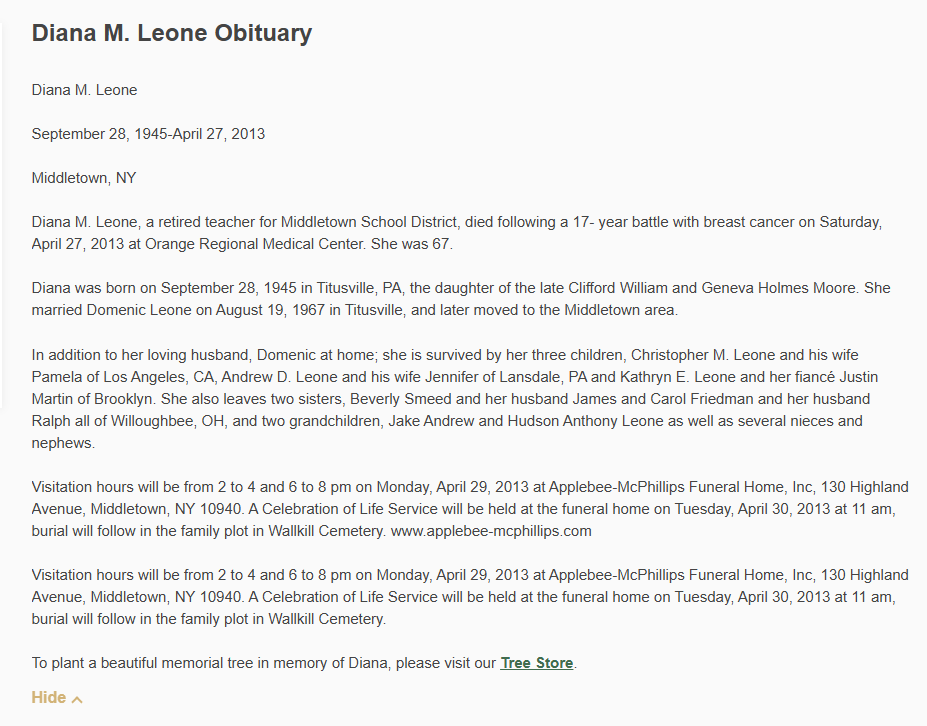
Beginning with Diana’s obituary, we can observe that she was born in Titusville, PA on September 28th, 1945. She married Domenic Leone on August 19th, 1967 and she passed away on April 27th, 2013. She was survived by the following:
Her husband Domenic Leone, who passed the following year.
Her son Christopher M. Leone and his wife Pamela of Los Angeles, CA.
Her son Andrew D. Leone and his wife Jennifer of Lansdale, PA.
Her daughter Kathryn E. Leone and her finance Justin Martin of Brooklyn, NY.
Her sister Beverly Smeed and her husband James.
Her sister ✡️Carol Friedman✡️ and her husband ✡️Ralph✡️.
Her grandchild Jacob Andrew Leone
And finally her grandchild Hudson Anthony Leone.
Ralph Friedman
Right away we can see the surname Friedman, which is jewish. And upon looking into Carol and Ralph Friedman, I was able to find Ralph’s obituary.49
It is plainly stated that the funeral services for Ralph were held at East Shore Universalist Unitarian Church in Kirtland, Ohio. For those that don’t know, the Universalist Unitarians reject the Trinity of God and aren’t Christian.
From East Shore’s website we can find the follow quote:50
“We join hands in Unitarian Universalist fellowship, pledging ourselves to an individual religious freedom that transcends all creeds, not to think alike, but to journey together.”
By stating “individual religious freedom that transcend all creeds,” they are saying the quiet part out loud. They’re jewish in spirit; in Ralph’s case, he’s jewish by spirit and blood, but nonetheless, we have finally have our first evidence of Jake having jewish families, if not by blood, by marriage. However, it gets worse.
Harvey Peskin
To find our next example of Jake’s jewish family members, we have to turn our attention to his grandfather Domenic’s obituary. In the obituary it is plainly stated that Domenic is survived by his sister Elena Peskin and her husband Harvey of Floral Park, NY. Peskin is a jewish surname.
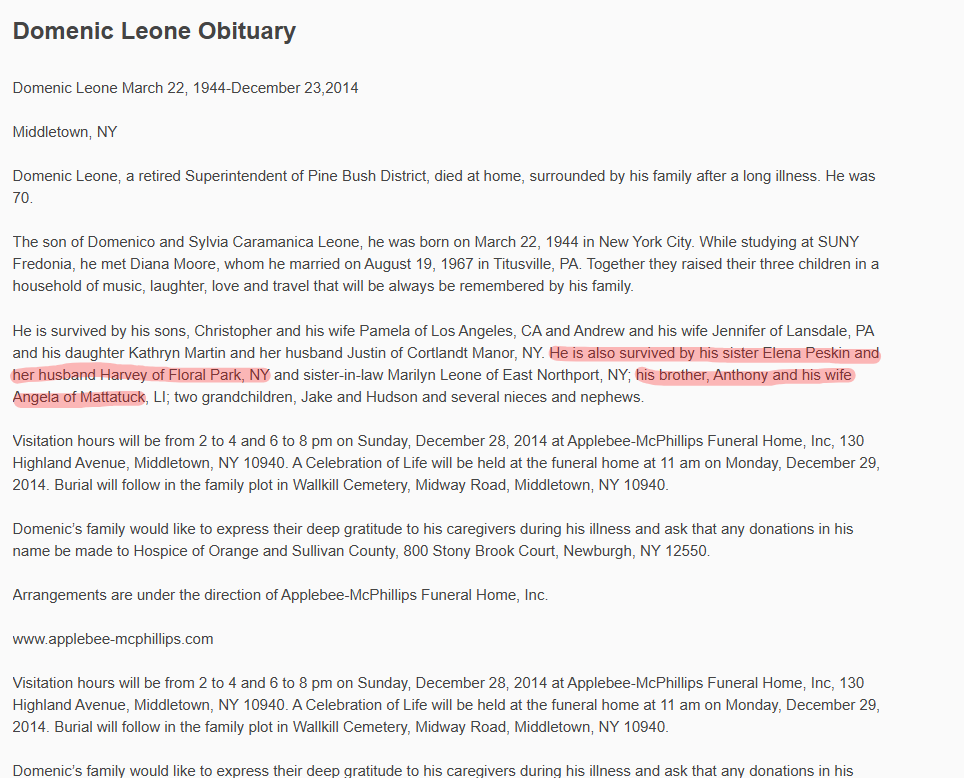
Looking into Harvey, I was able to uncover that he has a son with Elena named Eric. Eric Peskin is the Director of High-Performance Computing (HPC) at the Yale Center for Research Computing (YCRC).51

Statistics concerning Elena’s and Carol’s marriages.
Operating under assumption that Jake’s grandparents Diana and Domenic were Catholic, we can then look into the probability of Domenic’s sister, Elena, marrying a jew, as well as Diana’s sister, Carol:52 53 54 55 56 57
To estimate the probability, we use the following formula for one spouse having at least one sibling married to a Jew:

P(At least one sibling married to a Jew) = 1 - [P(No siblings married to a Jew)]^n

Where n is the average number of siblings.

For both spouses independently:

Joint P = [P(At least one sibling married to a Jew)]^2

U.S. Jewish Population Baseline:
~2.4% of U.S. adults are Jewish.
In Ohio: ~1.5% (177,295 Jews out of ~11.8 million).
In Pennsylvania: ~2.7% (347,850 Jews out of ~13 million).

Jewish Intermarriage Rate:
Overall: 42% of married Jews have a non-Jewish spouse (58% in-marriage).
Among non-Orthodox Jews (majority of U.S. Jews): 72% intermarry.
Catholic-Jewish intermarriages make up a significant portion of Jewish intermarriages, as Catholics are ~20% of the U.S. population and more regionally concentrated with Jews (e.g., Northeast/Midwest).

Average Number of Siblings (n):
For Americans born 1940–1980 (relevant for the parents’ generation in your scenario): ~3.9 siblings (total family size ~4.9, minus self).
More recent cohorts (post-1950): ~2–3 siblings on average. We use n=3 for conservatism.

Probability a Sibling Marries a Jew:
Rough estimate: (Jewish population % in region) × (Jewish intermarriage rate) × (Catholic % among non-Jews, ~20–25% in these areas).
National: ~0.5–1% per sibling.
Cleveland (Ohio, ~2.8% Jewish): ~1–1.5% per sibling.
Philadelphia (PA, ~4–5% Jewish): ~1.5–2.5% per sibling.

P(At Least One Sibling Married to a Jew):
National: 1 - (1 - 0.0075)^3 ≈ 2.2%.
Cleveland + Philadelphia: ~3–5% per spouse (higher due to regional concentration).

Joint Probability for Both Spouses:
National: (2.2%)^2 ≈ 0.05% (1 in 2,000).
Regional (OH/PA pockets): (4%)^2 ≈ 0.16% (1 in 625).
That’s a 0.16% or 1 in 625 chance that Jake’s great aunts would have both married jews if his grandparents, Domenic and Diana, were both Catholic. What if one was Protestant and the other Catholic?
Baseline Intermarriage with Jews:
Jews intermarry at ~42% overall (58% in-marriage).
Among intermarriages: ~20-25% involve Catholics and ~15-20% involve Protestants (no significant gap; both are common Christian partners).
(Pew notes Jews are “least likely” to intermarry compared to Catholics/Protestants overall, but within Jewish intermarriages, the split is even.)
P(sibling marries a Jew): ~0.5-1% per sibling nationally; ~1-2% in OH/PA regions (higher Jewish density).

Protestant vs. Catholic Adjustment:
Catholics: Overall interfaith marriage rate ~25% (mostly with Protestants or unaffiliated).
Protestants (mainline): 41% interfaith (higher due to more liberal denominations). Evangelicals: Lower (20-30%, more endogamous).
For Jewish intermarriage specifically: No differential—both groups are ~equal partners (e.g., 6% of interfaith pairings are Jew-Catholic vs. similar for Jew-Protestant). Assuming “Protestant” means mainline (common in OH/PA suburbs), P(at least one sibling married to a Jew) rises ~20-30% vs. Catholic (from ~2-3% to ~2.5-4% regionally).

P(At Least One Sibling Married to a Jew):
National (Catholic + Protestant mix): ~2.5-3.5%
Regional (OH/PA): ~3.5-5% (slight bump from Protestant’s higher baseline interfaith exposure).

Joint Probability for Both Spouses:
National: (3%)^2 ≈ 0.09% (1 in 1,100).
Regional (e.g., Cleveland OH + Philadelphia PA): (4.5%)^2 ≈ 0.20% (1 in 500).
There’s a slight increase, but it’s still a 1 in 500 chance (0.20%) likelihood.
Earlier in the screenshot of Domenic’s obituary, I also highlighted his brother Anthony. So why don’t we look into Anthony and then run the numbers again.
Anthony Leone
Using Domenic’s obituary, I was able to search for Anthony and then cross reference his obituary to confirm there was a match. From his obituary, we can determine that Anthony worked as a commercial lender for 47 years (c. 1973 - c. 2020) with Bridgehampton National Bank, American Community Bank and the Bank of New York.5859 The Bank of New York, as it was known prior to 2007, was the oldest bank in the United States and was founded by Alexander Hamilton. In 2007, the Mellon family purchased the Bank of New York and merged it with their Mellon Financial Corporation to create BNY Mellon. This is the same family that owns Carnegie Mellon University. To this day, BNY Mellon is still referred to as the Bank of New York or BNY.60
I was able to determine that Anthony worked for Bridgehampton National Bank from 1991 to 1999.61 And that he worked for American Community Bank from 2003-2016.62
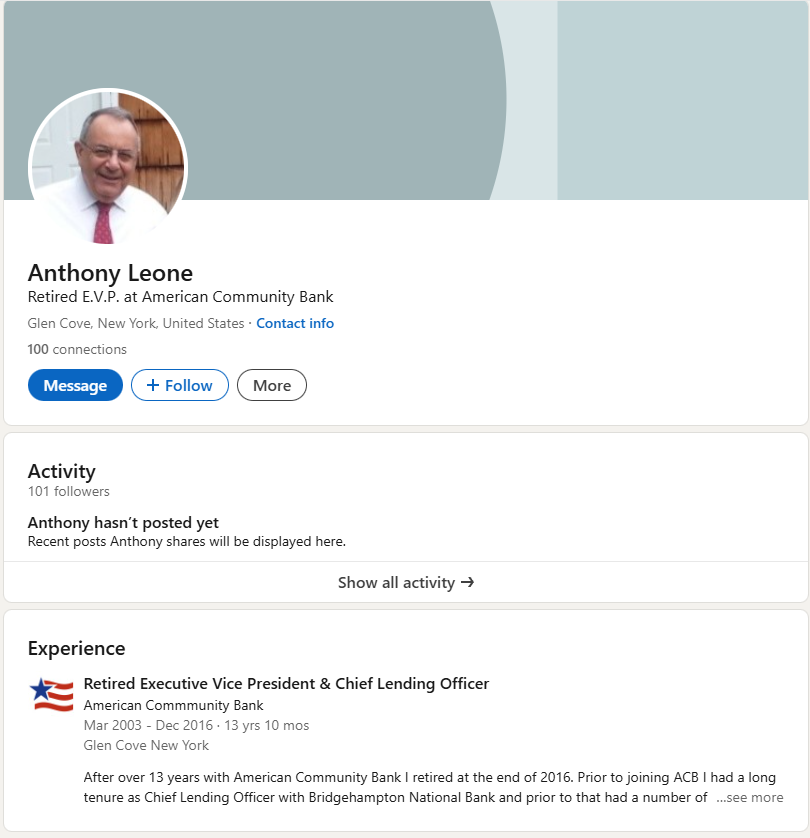
There aren’t any other listed companies for Anthony on his LinkedIn. We do know that so far the obituary for Anthony sequentially listed Bridgehampton National Bank (1991-1999), American Community Bank (2003-2016), and finally BNY. Aside from this obituary, there is no public link between Anthony and BNY, but the obituary also states that Anthony was a commercial lender for 47 years. Bridgehampton and American Community are also unaffiliated with BNY. So far, only 21 years are accounted for with the other two banks. Not to mention there is a 4 year gap between his time at Bridgehampton and American Community. What was he doing in the meantime?
It stands to reason that Anthony had been working at BNY for those 26 unaccounted years at the very least, or what is more likely, he was working at BNY at the same time as he was working at those other banks. Which would not be unusual for someone like Anthony.
For now we’ll put a pin in that and focus on Anthony’s family. He has a daughter named Denise and she married ✡️Jason Krane✡️. To confirm that Krane was jewish, I decided to complete Jake Leone’s family tree. What I found was pretty remarkable.
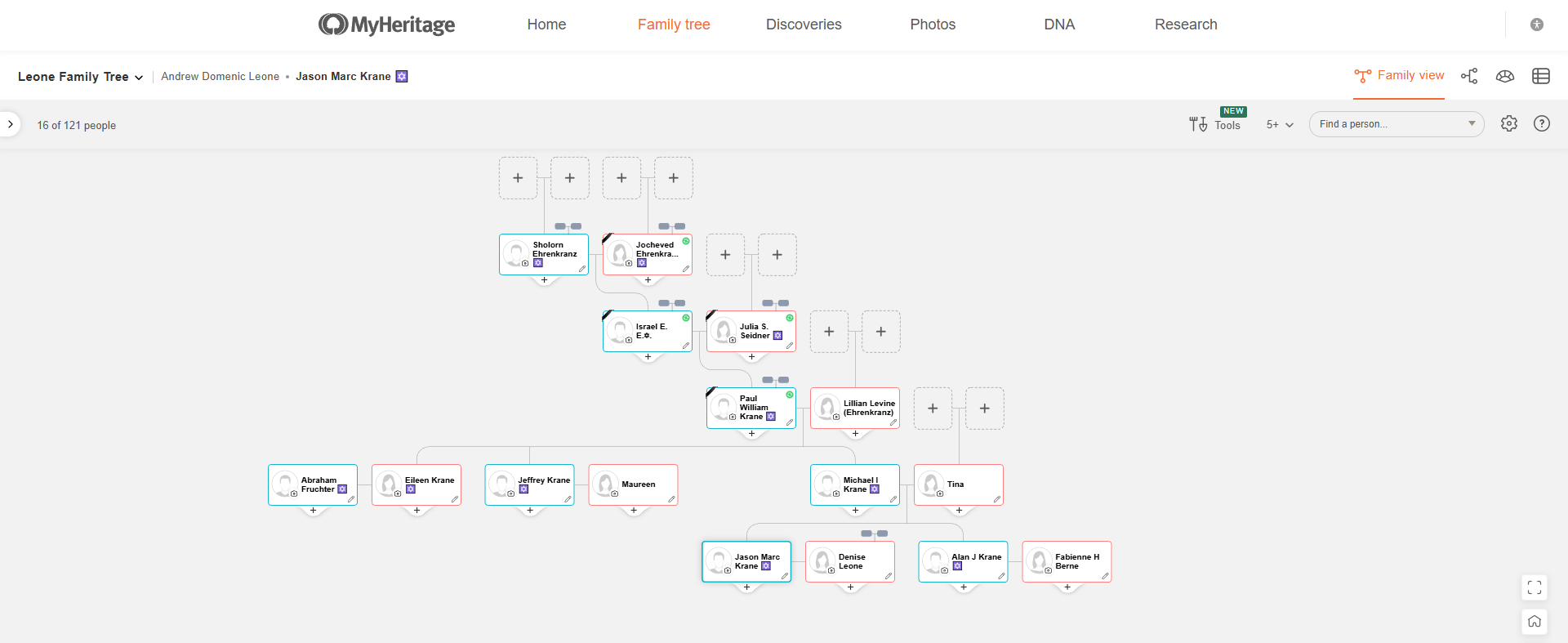
It turns out that Jason Krane’s family originates from Romania and their real surname is Ehrenkranz, which is a jewish surname.
So that means there are 3 points of jewish ancestry in Jake’s extended family. I think it’s time for some more math. Carol, Elena and Denise are supposedly Christian, before their marriages at least. So what is the probability that three Christian women from the same extended family, all living in the NY–PA–OH area, each marry a Jewish man? Assuming the marriages occurred between roughly 1950 and 2010, what is the approximate probability that this happens purely by chance?63 64 65 66 67 68 69 70 71 72 73 74 75 76 77 78 79 80 81 82
Jewish percentage of the total population in the relevant region and time period (averaged 1950–2010):
– Suffolk/Long Island NY and NYC suburbs: ≈ 6–9 % (peaking at 25% in NYC 1950s, stabilizing at ~10% by 2010)
– Rest of NY State + northeast PA + northeast OH: ≈ 1.5–3 % (e.g., PA ~2.65%, OH ~1.5%)
→ Weighted average for this family’s geographic footprint (heavy NY metro tilt): ≈ 5–6 %

Jewish intermarriage rate during the period these women married (1950–2010): average ≈ 25 % (very low 6–10% pre-1960, rising to 17% by 1970, 32% by 1980s, 52% by 1990, ~58% by 2000–2010)

Therefore, the probability that a randomly selected non-jewish (Christian) spouse in this region and era is jewish is:
P(one Christian woman marries a jewish man) = (jewish % of population) × (jewish intermarriage rate)
≈ 0.055 × 0.25 = 0.01375 (1.375 %)

Calculation (assuming statistical independence)
P(all three marry jewish men)
= (0.01375) × (0.01375) × (0.01375)
= (0.01375)³
= 2.599 × 10⁻⁶
≈ 1 in 385,000

Realistic adjustment for family/social-network correlation
Family members share neighborhoods, schools, workplaces, and social circles. Studies show intermarriage is 3–10× more likely within the same network. A conservative correction factor of 5× is commonly used.
Adjusted probability ≈ 1 in 385,000 ÷ 5 ≈ 1 in 77,000

Final Answer
Under pure random chance: ≈ 1 in 385,000 or 0.0002597%.
After correcting for family and geographic correlation: ≈ 1 in 70,000 – 80,000 or 0.0014286%-0.00125%.
So after correcting for his family and geographical correlation, the probability that three of his extended family members, assuming they are Christian, would marry jews is 1 in 70,000 - 80,000 or 0.0014286% - 0.00125%.
Using the same sources from the prior calculation, what would the probability be that they Jake’s three family members were actually jewish?
Here is the math using the exact same time period and geography (NY–PA–OH area, marriages 1950–2010):

P(all three marry jewish)
= 0.90 × 0.90 × 0.90
= 0.729
= 72.9 %

Using the more typical 93–95 % in-marriage rate for New York jewish women of that generation:0.93³ ≈ 80 %
0.95³ ≈ 85.7 %

Bottom line
If the three women were Christian: probability ≈ 1 in 70,000 – 385,000
If the three women were jewish: probability ≈ 73–86 % (i.e., **highly likely, almost expected)
After doing all of the math, the probability that Jake’s three extended family members were/are actually jewish would be 73-86%.
Andrew D. Leone
Andrew D. Leone, Jake’s father, was a licensed Professional Engineer (PE) based in the Greater Philadelphia. I say was because his PA license, Pennsylvania Engineer License #PA137109, expired back on April 19th, 2025.83 He earned a Bachelor of Science in Civil Engineering with a focus on Structural Engineering from the University of Pittsburgh (1992-1997).84 Andrew has 20 years of work history, working with E2Richards, Mainstay Engineering Group, JLA Group, and The Weintraub Organization before he founded his own company.

Penn Fusion Engineering, LLC is a boutique structural engineering firm founded in 2011.85 As a privately held company with 2–10 employees, it operates across Pennsylvania (not anymore), New Jersey, New York, North Carolina, Florida, Ohio, Michigan, and Texas, with registrations as a Foreign Limited Liability Company in states like New York (DOS #4855103, filed 2015) and Florida (M18000003027, incorporated 2018).86 Andrew also sponsored 3 H-1B visas (2022–2024) for engineering roles; no green card petitions.87
Information surrounding the H-1B visa recipient is not public, however, we can learn where the recipients were sent. All 3 recipients were sent to Tampa, Florida, which has a huge construction and equity boom happening right now. The last time Andrew brought an invader into the country to replace an Aryan was in 2024, however, we can reasonably say that the visa holders he brought in have a 71% chance of being Indian. USCIS approved 399,395 H-1B petitions overall and 283,397 of them were pajeets.88
Here’s a look at some of the company Andrew has worked for:
Pit-Des Moines, Inc. (1998-1998), Andrew worked as a project engineer on the National Ignition Facility (NIF) in Livermore, CA. The NIF is a massive laser testing site.
Spectrasite (1998-2002)
The Weintraub Organization, (2002-2005)
Johnson, Laschober & Associates, P.C. (2005-2008), which famously renovated the Miller Theater, named after ✡️Kathryn Bache Miller✡️.89
The Weintraub Organization, which is owned by ✡️Jeremy Weintraub✡️, was in a huge scandal in back in 2023 in Pasco County, Florida, when the company was contracted to do inspections for Pulte Home Company, LLC. The Weintraub Organization missed several inspection issues that later had to be corrected by other companies.90 This was around the time that Andrew began hiring H1-B visas as civil engineers in the Tampa area (next to Pasco County), who could also be used as subcontractors for home inspections in new construction developments. In 2020, The Weintraub Organization was sued by their competitor, Aquila Inspection Services LLC, where the company was accused of a “long-running fraudulent scheme” … “that jeopardized the public welfare”… “by engaging in fraudulent inspections at every phase of construction.”91
I find it pretty ironic that my father, whom Jake accused of being a “federal intelligence director,” spent his career deporting non-Aryans as a Border Patrol agent and Jake’s father was busy importing invaders to screw over Americans, in one way or another.
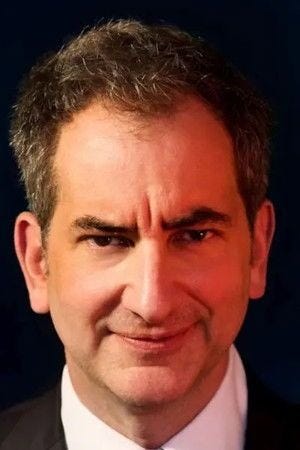
Christopher Leone
We now turn our attention to Christopher M. Leone and his wife Pamela Leone. This was quite the exciting find, because Christopher Leone is actually a big Hollywood producer who has made notable shows like Parallels (2015) and the Lost Room (2006), not to mention the comedy movie, Code 3, with Rainn Wilson that just came out this year.92
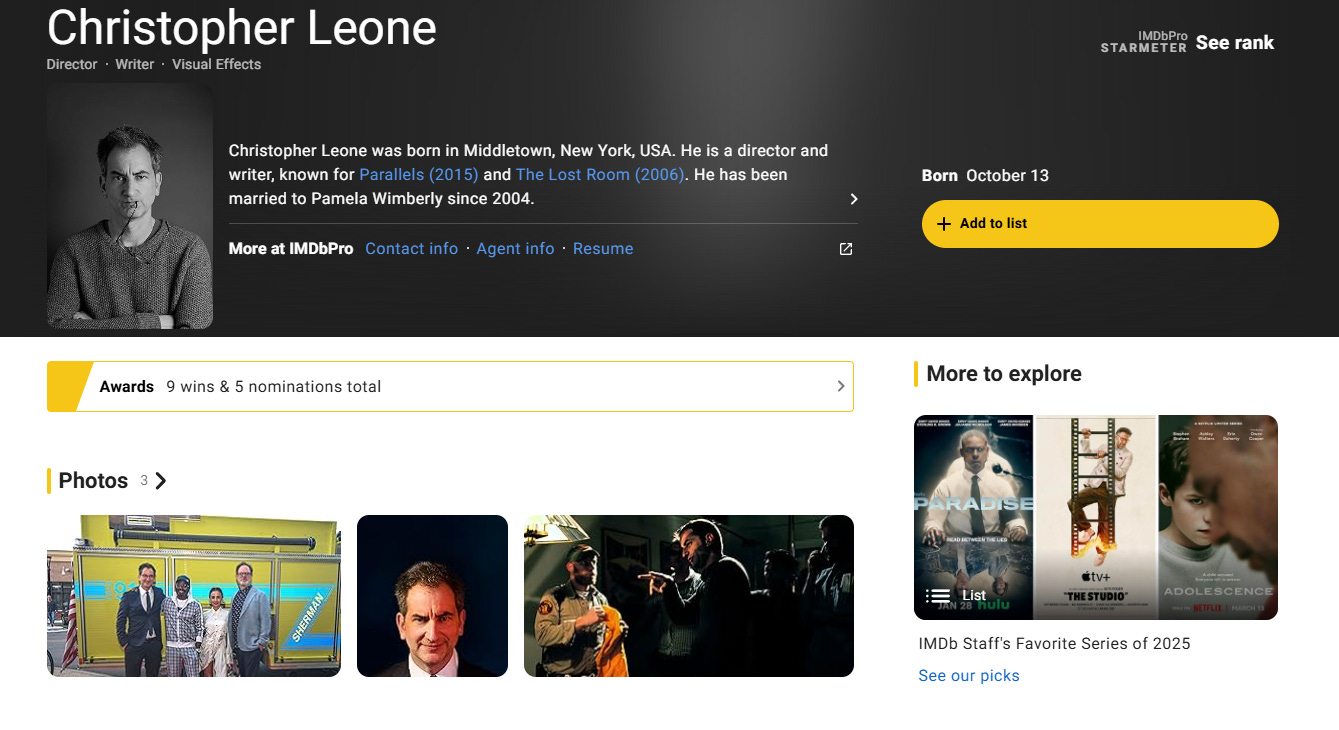
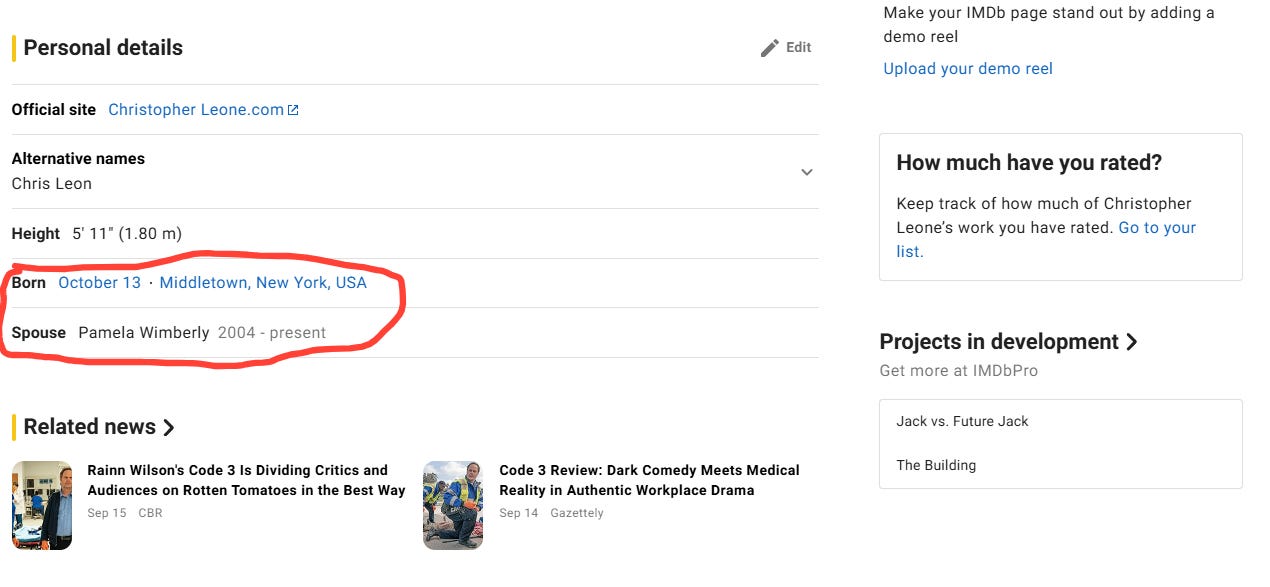
Using Jake’s own standard for physiognomy, we can see that he has called out someone with the same phenotype as his own uncle.
To Build a Better Mousetrap (1999)
The first piece of work that we can find from Christopher is his 1999 2 minute short film, To Build A Better Mousetrap, which was created while he worked at Digital Filmworks Inc.93 To clarify, Digital Filmworks Inc. was a massive company that works on high budget films like Planet of the Apes (2001), which had a budget of over $100 million ($183,119,774.01 in 2025). Even if it was produced in-house, they would need to spend $50K-$200K in 1999 ($97,275.51-$389,102.04 in 2025). This is quite the major investment for a first time director and undoubtedly by 1999, Digital Filmworks had already worked on larger budget movies such as Romeo + Juliet (1996, $14.5 million or $29,953,913.32 in 2025), Great Expectations (1998, $25 million or $49,711,963.19 in 2025), and Jingle All the Way (1996, $60-$75 million or $123,947,227.53-$154,934,034.42 in 2025). Why would Digital Filmworks spend $50K-$200K on a 2 minute short film by a first time director? It certainly couldn’t be used for a portfolio piece and Digital Filmworks never did any full length animated films in the same vein as that short film. Such an investment was incredibly risky.
On Christopher’s website, it is stated that To Build a Better Mousetrap “screened at over 50 film festivals, including the SIGGRAPH Electronic Theater.” At the time of production, the 3D animated short film would have been considered incredibly crude when compared to Pixar’s short film, Tin Toy (1988).94 It was also exceedingly rare for a production like this to be shown in all 50 festivals, including the SIGGRAPH Electronic Theater. Lets look at those odds by calculating from available information:95 96 97 98 99 100 101 102 103 104
Screening at over 50 film festivals is extraordinarily rare for any short film, including a beginner-level animated project like To Build a Better Mousetrap. Based on filmmaker reports, festival statistics, and submission data, the odds for a typical short film achieving this are extremely low—likely less than 0.01% (or 1 in 10,000+), and potentially far lower depending on the film’s quality, genre, and submission strategy.

Key Factors Influencing the Odds

Typical Submission Volumes: Most filmmakers submit to 20–100 festivals, with ambitious campaigns occasionally reaching 200 due to costs and time.

Acceptance Rates: Average per-festival acceptance is 1–13% for general or niche festivals, dropping to under 1% for top-tier ones like Cannes or Sundance (e.g., 1.5% for Sundance shorts). For animation/VFX shorts, inclusion in selective events like SIGGRAPH (overall program acceptance ~19–21%, but more competitive for the Electronic Theater) can boost visibility but doesn’t guarantee high volume.

Common Festival Runs: Successful shorts typically secure 5–15 screenings, with 20+ considered strong and 25–30 notable in publicized success stories; examples of 50+ are scarce, with one reported case of 50–80 screenings (though only ~20 from direct submissions, the rest via invitations or momentum).

Probability Modeling: Assuming a strong submission campaign (e.g., 100 festivals at 10% average acceptance), the expected screenings are ~10.
The probability of exceeding 50 follows a binomial distribution and is negligible (<<0.01%). Even at 200 submissions and a superb 13% rate (expected ~26), the odds drop to ~1 in a million or less due to variance.
K-7 (2006)
Christopher’s first notable work was “K-7,” an 18 minute short film that he wrote and directed.
From IMDB:105
An ordinary job interview becomes a battle for life or death when Vincent Kincaid scores a 'K-7' on his psychological profile. But what does 'K-7' mean?
Shot in a pseudo-documentary style with sci-fi/horror elements, this film was premiered at the 2006 Tribeca Film Festival, then screened at over 60 festivals worldwide (including SXSW, Slamdance, and Clermont-Ferrand). It won 12 awards, most notably:106
Best Live-Action Short – HBO U.S. Comedy Arts Festival
Best Short Film – CineVegas
Best Short – Portland Film Festival
K-7 was the project that directly led to Leone being hired by Lionsgate to co-create The Lost Room later that same year (2006). While he had done some uncredited visual-effects work and smaller student/independent projects earlier, K-7 is universally recognized as his professional debut as a writer-director. Here my favorite part from the short film:107
It is an extremely rare thing for a second-time filmmaker to premiere at the Tribeca Film Festival and to win so many accolades. In 2006, the Tribeca Film Festival was still one of the most competitive festivals in the world. For context, a total of 169 feature films and 99 shorts were selected from 4,100 film submissions, including 1,950 feature submissions, three times the total submissions from the first festival in 2002:108
Total submissions: 4,100 films
Total films selected: 169 features + 99 shorts = 268 films
268 selected ÷ 4,100 submitted = 6.54%
169 features selected ÷ 1,950 feature submissions = 8.67%
99 shorts selected ÷ (4,100 total − 1,950 features) = 99 ÷ 2,150 short submissions → 4.60% overall short-film acceptance rate
Even if a few more or fewer shorts were actually submitted, the short-film acceptance rate in 2006 hovered right around 4–5%.
So for a true first-time micro-budget short like K-7 to be one of those ~99 chosen out of ~2,150 submissions remains extraordinarily rare — roughly a 1-in-22 chance at best, and in practice far lower for debuts with no prior festival track record or industry attachments. However, the fact that Lawrence Mattis’ Circle of Confusion, a film company and the management behind the Wachowski brothers (the creators of The Matrix), which produced the short-film may just be the reason why it did so well.109
Lawrence Mattis was already a huge Hollywood producer and talent manager by the time K-7 rolled around.110 He had been instrumental in getting The Matrix made and after K-7 was produced, and he continued to work with Christopher very closely (most notably in Christopher’s 2025 movie, Code 3).111
Christopher and his long-time working partner, Laura Harkcom, were both being represented by Circle of Confusion as early as 2002. However, their sci-fi action thriller, Extinction, ended up never seeing the light of day, despite having been in development by Columbia Pictures.112 That wasn’t the only film that Christopher made in 2002 either, because he also made Re: Stinky Boss, which went absolutely nowhere and wrote for The Walter Mitty Condition, which also went nowhere.113 114
This was also the last production that Digital Filmworks worked on before they quietly went out of business. There is a credit to Digital Filmworks for the Roblox movie, The Last Guest, which came out in 2017, but after thorough research, the credit was merely a misattribution on behalf of IMDB.115 116
On the surface, K-7 appeared to be a massive success. However, it didn’t make any money and that was quite evident by Digital Filmworks riding out into the sunset that very same year.
The Lost Room (2006)
As stated previously, K-7 was what got Christopher hired to work with Lionsgate, where he worked on The Lost Room as a writer, which debuted the same year that K-7 debuted and “broke records.” The Lost Room is a 3-part (6-hour) sci-fi/mystery miniseries that aired on the SciFi Channel (now Syfy) on December 11th-13, 2006. Christopher was heavily involved in this project and even wrote the first episode.
Here’s the plot:117
“On May 4, 1966, at exactly 1:20:36 p.m., Room 10 of the Sunshine Motel on old Route 66 was erased from reality in a mysterious “Event.” The room now exists outside normal space-time. Everything that was inside the room at that precise moment became an “Object” with a unique supernatural power. The most important Object is the Key: it can turn any swinging door on Earth into a portal that opens directly into Room 10. From inside the Room you can exit to anywhere you can visualize… but the Room resets itself after about a minute, destroying anything (or anyone) that isn’t original to 1966.
Pittsburgh detective Joe Miller (Peter Krause) stumbles into this hidden world when his 8-year-old daughter Anna is accidentally trapped inside the Room during a reset, leaving her comatose in the real world. Joe’s desperate search to get her back drags him into a secret society of collectors, cults, and killers who will do anything to possess the Objects.”
It should be noted that the series features some interesting factions called “cabals”.
The Lost Room featured a recognizable cast:118
Peter Krause – Detective Joe Miller
✡️Julianna Margulies✡️ – Jennifer Bloom (mysterious ally)
✡️Kevin Pollak✡️ – Karl Kreutzfeld (wealthy, ruthless collector)
✡️Peter Jacobson✡️ – Wally Jabrowski (nerdy Object expert)
Dennis Christopher – Dr. Martin Ruber (scientist trying to explain the Event)
Elle Fanning – Anna Miller (Joe’s daughter)
Chris Bauer, Margaret Cho, Roger Bart, Epatha Merkerson in supporting roles
According to then Syfy president David Howe:119
“I think the challenge that we had with Lost Room is it was very difficult as a concept even though we loved it to kind of market it in one sentence or less because it was somewhat, you know, complicated to just explain to everybody there was this kind of, you know, missing room and a missing key etcetera, etcetera. And the thing about the objects was that their arbitrary powers were also problematic. The fact that, you know, you picked up an alarm clock and you had no idea what it would actually do. And I think that’s probably why the Lost Room didn't work for us. It was one of our lowest rated miniseries ever. And I think that’s pretty much - I think answers your question.”
At the time, The Lost Room was the lowest show on the totem pole and it was insanely expensive. Figures put the production cost at approximately $20 million, which was astronomically high for a miniseries in 2006. And the series never saw a season two.120 It was a complete flop. In comparison, Sci-Fi’s The Triangle cost $22 million and opened up to 5 million viewers.121 Meanwhile, The Lost Room could hardly pass 2.3 million viewers.122
What was really interesting is that joining him on the set of The Lost Room was Laura Harkcom and Paul Workman. All of whom had been at Carnegie Mellon University with him and they all shared the same teachers. Laura was the co-creator of The Lost Room and Paul served as its teleplay producer.
Laura was born in the US, most likely in the Pennsylvania area because of the presence of the last name Harkcom in the area, and she attended Carnegie Mellon University, which is where she met Christopher where they had the same creative writing class.123 124 125
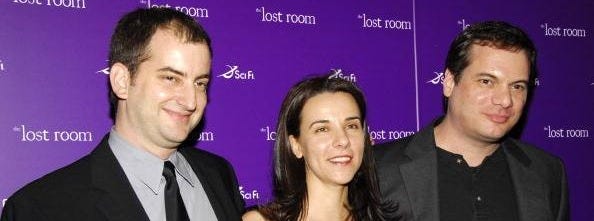
Laura Harkcom worked as a development executive at Warner Bros. where she oversaw the production of The Iron Giant (1999). Before that she worked as a story editor for the Disney movie, Tarzan (1999).126
Three of the people that helped propel her to Hollywood were her professors whom she shared with Christopher:
Peggy Knapp, a Phi Beta Kappa (PBK) member since 1959, and retired Creative Writing professor.127 She was a notable colleague of ✡️Gladys Schmitt✡️, another PBK member.128 129 For those that don’t know, PBK is a notorious Freemason wannabe secret society turned college fraternity/sorority with jewish ties.130 Notably, this was also the fraternity that produced Vivek Ramaswamy and what helped him receive the Paul and Daisy Soros Fellowship in 2011.131 Her husband, James, was a professor at the University of Pittsburgh and wrote a book on Ezra Pound which tried to subvert Ezra Pound’s antisemitism.132
✡️ Jane Bernstein✡️, a jewish author, essayist, and educator. With a career spanning fiction, nonfiction, and screenwriting, she has earned fellowships from the National Endowment for the Arts (NEA) and contributed to outlets like The New York Times Magazine and Creative Nonfiction. Since 1991, she has been a cornerstone of Carnegie Mellon University’s (CMU) Creative Writing Program, where she mentors emerging writers in memoir, fiction, and personal narrative.133 She has direction connections to Hollywood after having co-written the screenplay for Seven Minutes in Heaven (1986) starring ✡️Jennifer Connelly✡️.134 135
✡️ Sharon Dilworth✡️, who joined the Carnegie Mellon Creative Writing staff in 1993, was also one of their professors, though limited.136 137
These are the three people from Carnegie Mellon that made sure Laura, Paul and Christopher got into Hollywood. And the judaic/freemason influences would show up in Christopher’s next project which wouldn’t be made for another 4 years.
Bar Karma
After the Last Room was canceled, Christopher Leone began working on a limited series that lasted 12 episodes, Bar Karma (2010-2011). He personally directed two episodes, Hack Job & Man Walks Out of a Bar. From IMDB:138
“There’s a place called Bar Karma in between dimensions. When a lost soul needs guidance, they happen to stumble upon it and learn where the critical choices they’ve made in life are taking them and how to change things for the better.”
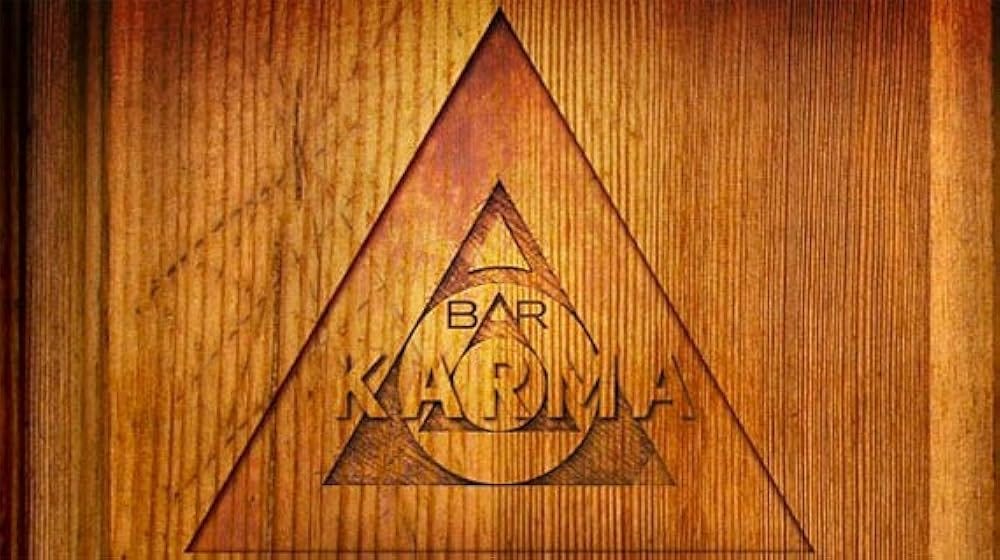
According to Freemasonry, the tetractys and the kabbalah tetragrammaton are linked. And according to KA Gold Jewelry, a well known esoteric jewelry manufacturer which is owned by two jews, the tetractys is also used by jews:139 140
“…the followers of the Kabbalah also believe that the Tetractys is an illustration of existence, of the way everything is structured in the universe.”
Nothing like them telling us exactly what they believe under the guise of entertainment. I am reminded of a quote often attributed to Father Leonard Feeney:
“Having a television in your home is like having a Jew in your living room.”
They think they’re pulling the wool over our eyes, but we can exactly what they’re doing. The subliminal messaging doesn’t work anymore.
Bar Karma focused on an innovative system that allowed viewers to determine how the series would progress, which should have boosted audience engagement. However, it never even made it into a second season. Just like all of Christopher’s projects so far, they had no return on capital or any sizeable fan retention.
Bar Karma was produced by Current TV, which was co-founded by former vice-president Al Gore and ✡️Joel Hyatt Zylberberg✡️ in 2005. Current TV was a small, independent cable network with limited distribution and viewership, focusing primarily on user-generated content, documentaries, news, and acquired programming. But here’s the thing, when Bar Karma was pitched to Current TV, they leapt at the opportunity to produce this show and have it as their flagship. At this time, Current TV had no other original content, but for some reason they agreed to make this show even though it had a whole new industry concept that would have been incredibly risky.
Bar Karma was technically considered a reality TV show because the audience was influencing the show directly, just like many other reality TV shows. According to the Writer’s Guild of America, top nonfiction shows on cable networks like The History Channel might budget $225,000–$425,000 per episode, while other nonfiction genres often fall in the $100,000 range or below (with smaller networks or lower-profile shows trending even lower).141
Compared to The Lost Room’s $20 million budget, the estimated $1.2 million for Bar Karma’s 12 episodes seems insignificant. However, Current TV never produced any other original content along those lines again and in 2013 Current TV was bought out by Al Jazeera for $500 million.142
So why did Al Gore and ✡️Joel Hyatt Zylberberg✡️ undertake such a risky investment? Well it might have to do with the fact that Al Gore’s father, Al Gore Sr., was a Freemason and there have been accusations that Al Gore Jr. is also a Freemason.143
Code 3 (2025)
Code 3 follows a paramedic that is so burnt-out by the job that he is forcing himself to resign, however, he first must embark on one last 24-hour shift to train his replacement.144
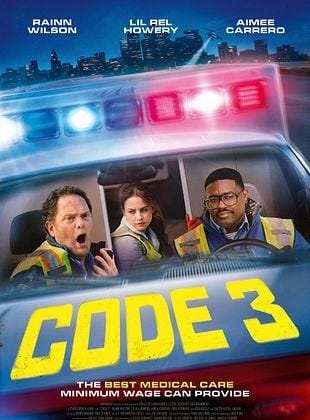
Originally when I began researching Christopher Leone, I had wrongfully assumed that Code 3 was successful. It had a strong B List lead in Rainn Wilson, who was part of one of the biggest comedy shows of my lifetime, and from the clips I saw of the movie, it looked to have been put together very well. After looking into its box-office returns, I discovered that Code 3 only netted $35K and quickly went to streaming services in an attempt to bring in more money.145 By industry standards, this film was not successful, especially because it had Lawrence Mattis and Circle of Confusion producing it.
Let’s do a little recap:
To Build a Better Mousetrap (1999), which was considered incredibly crude by the time it debuted, was able to somehow screen in over 50 film festivals, including the prestigious SIGGRAPH Electronic Theater, even though the odds would have been ~1 in a million of that happening. Digital Filmworks, the production company that produced it in-house, never made anything like it again and spent an enormous amount of money on the project when Christopher didn’t have any directing experience.
Re: Stinky Boss (2002) never saw the light of day.
Extinction (2002) was trapped in development hell and was never produced, despite Columbia Pictures’ involvement.
K-7 (2006), a movie about a guy joining the CIA, which roughly had a 1-in-22 chance at best, was somehow able to get into the Tribeca Film Festival and won 12 awards through other film festivals. However, one of the companies that worked on it, Digital Filmworks, never produced another movie again.
Bar Karma (2010-2011), was a financial failure and contributed to the eventual sale of Current TV in 2013 to a foreign company.
From 2011-2024, Christopher worked on several projects but none of the successful ones were projects he made. He contributed to successful movies, but it was never as a writer or a director.
Code 3 (2025), was extremely unsuccessful considering he had Lawrence Mattis’ Circle of Confusion producing it and he had a reliable draw in the form of Rainn Wilson.
Christopher has never had any of his own projects turn into success stories despite the accolades that he won against impossible odds. As I look into his career more, it seems to me that instead being hired on merit, he was chosen for a specific reason.
Earlier when we were going over Anthony, I said we should put a pin in the missing 26 years that were unaccounted for. Up until 2007 merger, BNY had been heavily involved in the film industry. When I was looking into BNY, I discovered that they had no official ties. However, before the merger of BNY and Mellon Financial, the old headquarters for BNY was One Wall Street in Manhattan, New York City.146 The Tribeca Film Festival headquarters is located just a mile up the road at 375 Greenwich Street, New York, NY 10013 for the old office.147 Post 2007, BNY is located on the same street as the Tribeca Film Festival (240 Greenwich Street to be exact, which is less than a ten minute walk).148 I was unable to find any direct evidence that Anthony or BNY had ever given money to the Tribeca Film Festival. In lieu of that, we now have to ask the question, whether or not it is possible for someone like Anthony to give money to the Tribeca Film Festival without making it public knowledge?
Yes, it is possible for an individual (including someone employed at BNY) to donate privately to the Tribeca Festival without the donation being made public. The Tribeca Festival is run by Tribeca Enterprises, a for-profit company, so individual donations are typically treated as private contributions rather than public charitable gifts.149 Since these are not tax-deductible charitable contributions (unlike donations to a 501(c)(3) nonprofit), there is no IRS requirement for public disclosure of donor names. This means that someone could give the Tribeca Film Festival money in order influence their choice of films.
We know that BNY and Mellon Financial merged in 2007, but the public announcement that the two companies were merging was on December 4th, 2006.150 However, the actual negotiations started all the way back in January, as according to Mellon Financial’s former CEO, Martin G. McGuinn Jr.:151
Within three or four months after the Mellon board removed me in January of 2006, it was in negotiations to sell the company to the Bank of New York. The sale was announced Dec. 4, 2006, and it took all that time to negotiate it.
At the surface level, there was an obvious fit. They were two of the four so-called Trust companies. We had sold our retail bank back in 2001, and they sold theirs in 2005. So they were kind of following our strategy, if you will. I’m guessing the initial discussions between Kelly and Renyi went on for at least a month.
Mellon Financial had been moving away from commercial lending to manage more assets and trusts, which was a process they started in 2001. Meanwhile, BNY, had also begun transitioning away from commercial lending by 2005. From McGuinn’s statements, we know that the merger had been discussed as early as April or May of 2006. However, since McGuinn had been removed from the company in January, it could have been the case that the board of directors had been planning this before the official negotiations took place.
In 2006, the Tribeca Film Festival took place from April 25th to May 7th, 2006.152 Just as the official negotiations for the merger of BNY and Mellon Financial were taking place. For the 2006 Tribeca Film Festival, submissions opened up on September 6th, 2005 and closed December 16th, 2005.153 This means that Christopher’s short film, K-7, had to have been completed either before or during this timeframe to be able to enter into the Tribeca Film Festival.
According to Mellon Financial’s former CEO, Martin G. McGuinn Jr.:154
That fall, in 2005, articles started appearing in the Pittsburgh Tribune-Review, the city’s secondary, conservative newspaper owned by Richard Mellon Scaife. The Tribune-Review was writing these articles every week saying, “McGuinn should go.” That was the headline. They said I was going to sell Mellon. And they accused me of living in New York. Literally once a week Scaife was doing these articles. And I’d be going down to the Duquesne Club, Downtown and someone would ask, “What’s going on?” People knew Dick Scaife was odd, but his articles were part of several things that were stirring up the waters, and I think that was its purpose. Scaife had gone after Jim Rohr at PNC another time, and Rohr and his board just waited him out until he finally went away.
At that time, our board meetings were becoming fractious. Some people were saying we should speed up the succession process. Some said we shouldn’t. We should do this. We should do that. Candidates were coming in and one of them was Bob Kelly, who ultimately became CEO. I liked him and he was one of the candidates that I recommended, and although I liked him, I said, “You talked about getting someone with operating experience. This guy’s been the chief financial officer. He doesn’t have any operating experience. What are we talking about here? Let’s be honest with ourselves.”
I got another call from Rodge Cohen saying that several board members were pushing this agenda of speeding the hiring up. And at that point, alarms started to go off for me. They should have been exploding by now, but I was still trying to run the bank and believed what the board was officially telling me. In retrospect, you can call it naiveté or stupidity, at least.In January 2006, I went off to Davos, Switzerland, which I’d been doing every year since I was CEO. It was at a ski resort, but I don’t ski. So for me, it was all work and it was good work, filled with business meetings. Two days after I arrived, I was at a dinner hosted by one of our biggest clients, and I got a message saying to call the office immediately.
I excused myself and called. I was told that the board had voted unanimously to hire Bob Kelly and, at his insistence, they made him CEO immediately. They said I had to be out in two weeks.
This means that commercial lenders like Anthony would likely suspect that McGuinn was going to be ousted from Mellon Financial. He would also have been aware that BNY had been pursuing Mellon Financial for years. Anthony would also have know that BNY had been following Mellon Financial’s plan to focus primarily on trusts and assets over commercial lending. It’s not crazy to theorize that with all of this information, Anthony, decided to give a substantial contribution to Tribeca Film Festival as a representative of BNY, knowing that BNY would focus less on commercial lending in the future.
Cristina Leone
To find out who Jake’s wife is, I first had to do some digging to see if I could find any old social media accounts that he may have used. And after enough time, I was able to find his old Facebook profile.

In the screenshot above I was able to see that a black woman had congratulated a Cristina Levin. And from there I began looking for any woman that resembled the one in the picture above with the name Cristina Levin.


Using Truthfinder.com, I was able to determine that Cristina Levin is married to Jake. I was also able to find out some more information that was pretty interesting.
Cristina has also gone by the name Coloteniuc, which is of Romanian descent. So I began digging through Jake’s Twitter and I discovered his reply on the tweet below.
After looking at the profile, I knew I had found Cristina. Which was only further proven when both of them posted about Russian tea cookies one day after the other.


Further proof was found when I discovered this picture of her below and cross referenced it with a picture he uploaded on his old Facebook account.
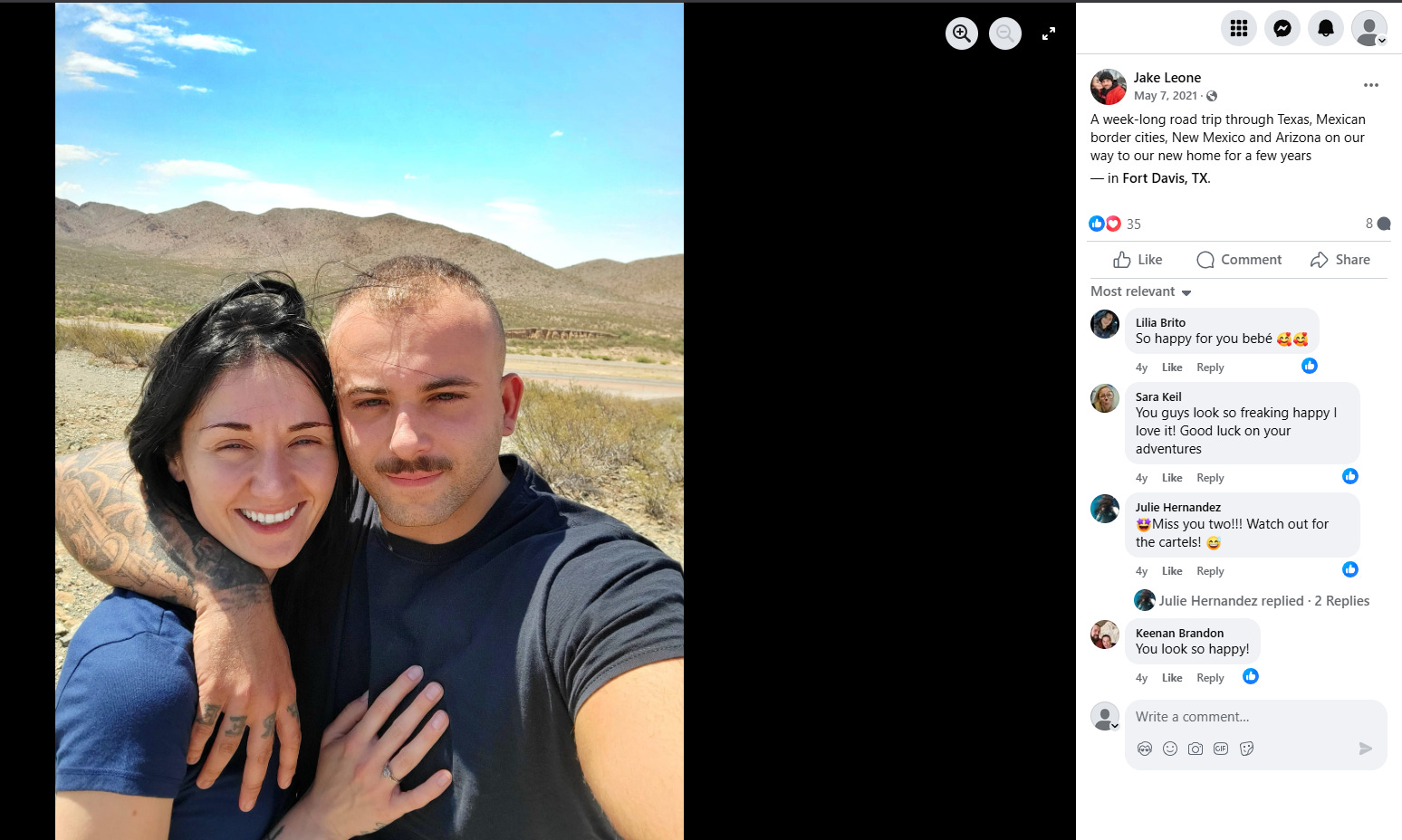
In her Truthfinder background check, it also listed Coloteniuc as her surname. In fact, it’s actually her maiden name (I’ll get to Levin in a moment). Cristina, as proven by the screenshot below, had been born and raised in Moldova.
Going back to Truthfinder (seen below), I was able to find out that Cristina also attended the following schools in Moldova:
Secondary School No. 62 (class/graduation of 2004), Chișinău, 1995–2004
Nicolae Testemițanu College (graduation/class of 2009), Chisinau, 2004–2009, pharmaceutical laboratory technician
Moldova State University (USM), where she graduated in 2012.
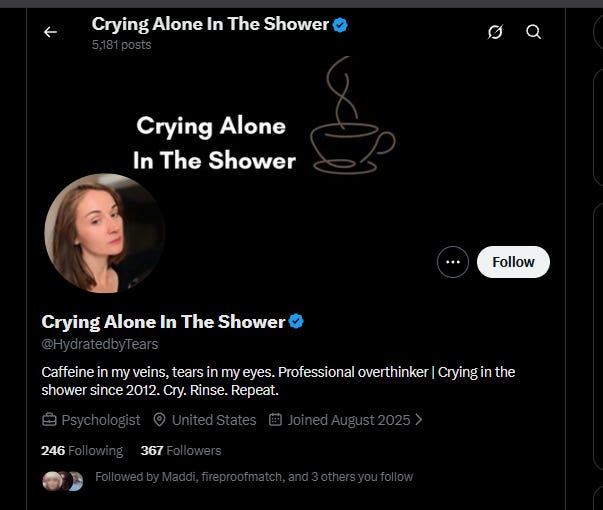
The year 2012 isn’t just when she graduated, it was also the year that she immigrated to America. Continuing to look on Truthfinder, I found the following addresses.


Cross referencing a post that Cristina made, I was able to determine that Cristina and Jake currently live at the same address that is listed on Truthfinder.

Also, I looked over the old addresses and I saw Cristina’s past residence at 211 143rd St, Ocean City, MD, was also shared by a man named Reid Levin.

Looking further into Reid Levin, I was able to uncover his father’s obituary from 2021. And in that obituary it mentions that his father, Bruce Levin, was given a jewish funeral that was overseen by rabbi Naomi Hyman, who is a rabbi at the Unitarian Universalist Fellowship of Easton, MD (earlier I mentioned that Ralph Friedman had his funeral services at East Short Unitarian Universalist Church).155
I then cross referenced the addresses of Bruce Reid Levin and Reid Levin and I confirm that they are in fact father and son and that Reid Levin was also jewish.

In Judaism, a marriage between a jew and a halachically valid Jewish convert is considered fully valid under jewish law (halakha) through a religious ceremony alone, without any requirement for government involvement or a civil marriage license. The essential elements are the kiddushin (betrothal, typically via the groom giving the bride a ring or object of value while declaring her consecrated to him) and nisuin (completion of the marriage, often under the chuppah with the seven blessings and ketubah), performed in the presence of two kosher witnesses. No rabbi is strictly necessary—any knowledgeable Jews can oversee it to ensure halachic compliance—though most couples involve one for guidance. However, many rabbis, particularly in orthodox and conservative streams, may refuse to officiate or recognize a purely religious wedding without a civil license, citing the principle of dina demalkhuta dina (”the law of the land is the law”), which obligates Jews to adhere to just civil laws in the societies where they live. This stems from the Talmud (e.g., Bava Batra 54b) and applies to matters like marriage registration where the state mandates it for legal recognition. Reform rabbis often explicitly advise against full wedding ceremonies without a license, opting instead for “commitment ceremonies” in such cases to avoid implying evasion of civil duties.
In practice, couples seeking a purely religious option might need to find a willing rabbi (more common in some orthodox or independent contexts) or conduct it privately, but this won’t grant civil benefits like spousal rights or tax status.
Regarding the bride taking the groom’s last name: Halakha itself has no inherent requirement or prohibition on surnames, as they are a relatively modern European convention not central to ancient jewish tradition—women were historically identified as “daughter of [father]” or “wife of [husband]” without changing family names.
Today, if done informally (e.g., socially or within the community), no government is needed—the bride can simply use the new name in daily life, and jewish sources don’t object. For legal recognition (e.g., on official documents), it requires civil processes like a court-ordered name change, as marriage isn’t the only pathway, though a purely religious union won’t automatically enable it via marriage certificate.156 157 158 159 160 161 162 163 164
If in a jurisdiction recognizing common-law marriage, consistent use of the name while living as married might eventually support legal status, but this still involves government validation. Details can vary by denomination (e.g., orthodox vs. reform) and location—consult a rabbi familiar with your situation for personalized guidance. And wouldn’t you know it, rabbi Naomi Hyman is part of a reformed synagogue that is also attached to an interfaith temple.165

Looking further into Cristina, I was able to determine that she was still using the surname, Levin, as late as June of 2025.166


Below is a screenshot of Jake (Ethos) talking about moving to Europe, which him and Cristina had planned. Which they will most likely do now that I have exposed them.

Why is Cristina still using the name Levin? Well it’s because in either reformed or orthodox jewish divorce proceedings, the husband can choose not to agree to the divorce. With Cristina still using the surname, Levin, it is likely that under jewish law, she is still married to Reid Levin.167
This is so whole discovery is so infuriating. Jake has been one of the most vocal people on race mixing in our sphere, almost more than I have. However, when I called out race mixing, I did it to prevent further miscegenation and to make sure our blood remained pure. When Jake did it, it was to virtue signal so you wouldn’t think that he would ever race mix. But he did.
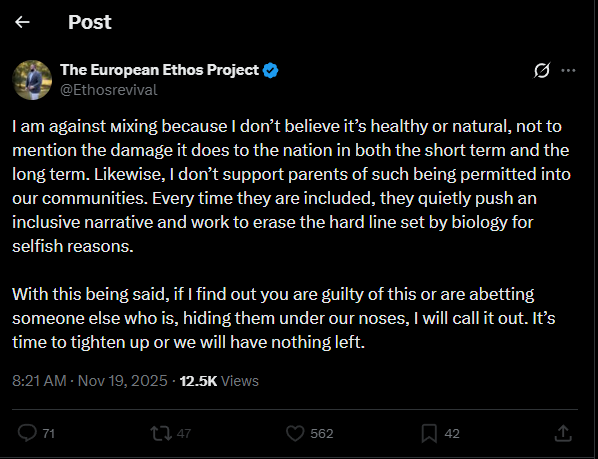
Below is more evidence that Jake and Cristina are related.
In the screenshot below, Cristina confirms that she has two children. Now the question is whether or not those two kids are Jake’s or Reid’s. My money is on them being Reid’s.

Conclusion
When I began looking into Jake Leone, I had sought to look at the facts for what they were. I began my research to rule out the possibility that he was genetically jewish, but as more and more was revealed, I realized that beyond a doubt, he was jewish.
His surname has a history of being used by jews, three of his extended family members have married jews, his great-uncle was a commercial lender for one of the largest banks in the world, his uncle is a Hollywood producer who looks jewish, his father hires H1-B visas, and most shocking of all, Jake married a jew.
Since the beginning of the breakdown between Jake and TNW, there has always been an issue where he has fixated on my organization above all else. And after the recent developments occurring during the situation where my family was threatened and Jake implicated himself, it is not unreasonable to assume that the reason he wants to take us down is because we represent something tangible that the other organizations don’t.
Focusing back on Christopher. His biggest amount of publicity that he has received is from Code 3, despite it being unsuccessful. He somehow always failed upwards and I personally don’t think it’s a coincidence that his nephew, Jake, has somehow become so prominent in the online National Socialist sphere in the year where Christopher has the most “recognition.”
Jake has concentrated his attacks on TNW, which is the only National Socialist organization that is exclusively Christian and focuses on building industry through my parallel economy doctrine. TNW is the future because we don’t focus on the tired method of activism that has been so prominent in our sphere. Instead, we understand that in order to field an army, we must have grain carts.
As Thomas Carlyle wrote:
“They were stronger than Turk and Saracen, but not than Hunger and Disease. Leaders did not know then, as our little Friend at Berlin came to know, that ‘an Army, like a serpent, goes upon its belly.’”168
Jake understands that my parallel economy model would make Aryans self-sufficient and non-reliant on outside forces or the traditional means that we have in America today. Jake also realized after the merger of my affiliate Céad Líne with Clann Éireann, that my model can be exported internationally.
Jake was also one of the largest proponents of “race first” (or race over religion), which meant putting the creation before the Creator. Not only was this blasphemous, but it also asserted that those who follow proper Christian teachings could not put their own people first. It was a scummy way to try and disenfranchise Christians, to keep National Socialism the way it is now and not the way it was actually intended.
As Joshua 23:12-13 states:169
12 “For if you turn away and attach yourself to the remnant of these nations among you, and intermarry and become mingled with them and they with you,
13 know for certain that the Lord will no longer utterly destroy these nations before you; but they shall be snares and traps for you, and nails in your heels and darts in your eyes, until you perish from this good land which the Lord your God has given you.
The last that I will say in this chapter is that now, the “race first” position will slowly fade away as the biggest supporters of Jake have always been pagan or spiritually jewish. And it will be known that it was me, Ardito, that plunged Christ’s flaming sword into the heart of the beast, for it was always destined to be that way.
Merry Christmas Jake
Ave Christus Rex
-Ardito
Orthodox Study Bible
Orthodox Study Bible
Orthodox Study Bible
Orthodox Study Bible
The escape of the neofiti is mentioned by N. FERORELLI, Gli ebrei nell’Italia meridionale, ed. Filena Patroni Griffi, Napoli, 1990, 215, note 4. For the archbishop’s demand, see: AMABILE, Il Santo Officio, 95–96
ibīdem
Demott, Bobby J. (1994). The History of Freemasonry in Tennessee
ibīdem
Orthodox Study Bible
Wow!! GOOD FOR YOU!! These ppl suck and I’m so happy you were able to hit back!!
Nice work. This guy is a scammer extraordinaire. Leveraging his money to spread a lot of unproven ideas to confuse people.