


In the second article in this series on grassroots nationalism and achieving the status of an accomplished activist, I wanted to discuss the political identity of a true dissident. Not just someone or something that bemoans the injustices of modern-day-society, but true dissidence that actually exists in some degree of tension with the prevailing political, cultural, or institutional ethos or apparatus.
Now don’t get me wrong, this doesn’t necessarily mean that every position it holds is radical, illegal, or outside the mainstream consciousness. However, I can’t get behind an organization that doesn’t hold some political opinions or refuses to commit actions that the government has deemed illegal. If you’re just going to be a good boy, what’s the point?
Honestum non semper quod licet, or for those of you whom only know the Latin phrase memento mori, “What is lawful is not always honorable.”
With that being said, the identifier “dissident” is better understood as a relationship that is in opposition to its counterparts or contemporaries, while not being in opposition merely for the sake of it. For all intents and purposes, it has an actual reason to exist.
From an organizational standpoint, the important question to ask is:
“What are they willing to defend even when doing so is unpopular?”
This question should help an organization distinguish foundational principles from temporary strategies, personal qualms or opinions, and tactical preferences.
So, what exactly makes the organization “dissident”?
I have already laid out one thing that makes a dissident organization actually dissident, but there’s more to the answer.
Despite conventional belief, being unpopular isn’t a metric an organization should consider if they want to be a dissident organization. It’s not a goal. If it was, why would anyone seriously consider joining them?
I know I wouldn’t expect people to join The New Way (TNW) if we constantly attacked organizations on the right when they didn’t deserve it. We can certainly have disagreements, but no one would want to work with us or join us if that were the case.
Organizations that constantly attack people for the sake of attacking people are insecure in their very nature or they’re controlled opposition. Although, plenty of “dissident” organizations will fall into this trap.
Successful organizations can and should have unpopular stances, but they have to remain popular enough that they gain more supporters overall. Otherwise, there’s really no point if you’re just going to hemorrhage supporters. To be frank, that’s actually retarded.
A good example was Atomwaffen Division (AWD). As far as the mainstream goes, they were absolutely loathed. However, underground nationalism loved their aesthetics for being hardcore, original, and trendsetting. Even today nationalist organizations still adopt AWD’s image for their own. So while the public that came into contact either loathed or feared them, the nationalists and youth they can into contact with wanted to be them.
It should also be said that unpopular opinions can become popular given enough persuasion and acceptance. At one point it was absolutely unpopular to suggest that women should have any voting rights. However, with the publicity and notoriety surrounding the Lindsay Clancy case, it’s now becoming popular to suggest women shouldn’t have any rights at all.
Imagine, a plurality of women defend a mother killing her 3 kids and suddenly society starts understanding the story of Eve and the Apple from Genesis. If only mankind learned its lessons.
Plenty of groups have widely unpopular opinions and they’re not dissident in any meaningful way. Likewise, a group can be highly controversial while simply occupying another established faction within the established political system—the Libertarian Party of New Hampshire prior to cucking to the Libertarian National Committee.


I can list 6 different characteristics that dissident organizations should have:
They believe that some important part of the prevailing society is inherently wrong and is in need of correction or eradication.
They are willing to articulate that disagreement publicly and boldly.
They develop their own analysis rather than simply adopting the language of established institutions—e.g. they don’t parrot other organizations.
They are willing to organize independently when existing organizations don’t or cannot adequately represent their objectives.
They maintain their core identity even when doing so carries reputational or social costs.
They seek to develop alternative ideas, parallel institutions, publications, networks, and/or practices.
The last point is arguably the most important in my opinion, because no one wants to listen to someone bitch and moan about something without offering a solution.
Dissidence—as I stated previously—shouldn’t merely mean opposition for the sake of it. An organization that exists entirely to say “no,” eventually becomes dependent on the the very system it opposes.
For example, look at the relation of rabbinic judaism and Christianity. Christianity prevails while remaining dissident to what is worldly. Meanwhile, rabbinic judaism exists just for the sake of being in opposition to everything that Christianity stands for—self evident by its parasitic nature.
A confident dissident asks themselves:
“What are we trying to build?”
That completely changes the organization from a group of protesters into an institution with an actual reason for existence. Without it, just pack up shop.
Establish the non-negotiable principles.
Every organization worth its salt needs principles that define who its members are. They should be few, clear, and so important the organization would collapse if they betrayed them.
Here’s four layers to think of when an organization asks itself “What are we trying to build?”:
Foundational principles — these define what the organization fundamentally believes and why it exists. These are the ones that are so important that removing them would destroy the organization.
Organizational principles — These establish how members are expected to behave toward one another and the organization itself. They aren’t as important as foundational principles, but they are incredibly important for operational cohesion.
Strategic positions — These describe how the organization currently intends to accomplish its objectives. They can be changed whenever deemed necessary without running the risk of organizational collapse.
Tactical preferences — These concern particular methods, campaigns, messages, events, or projects, and they can be changed at whim. However, if they are changed too frequently then members will notice how fickle the organization seems.
Fair warning, if they treat all four categories as equally important, they will fail.
For example imagine, if you will, an organization has 20 principles and members are expected to agree equally about all 20. In my experience, the organization will spend more time policing internal disagreement than accomplishing anything meaningful.
Use the 10 Commandments as a guide. Either literally or figuratively. Ten is a solid number of principles and easy to remember.
Whether members disagree with tactics is irrelevant as long as they remain unquestionably grounded in the foundational and organizational principles of the organization.
Foundational versus strategic positions.
Understanding the distinction saves a lot of headaches in the future, because it prevents enormous amounts of unnecessary infighting when there are objectives to finish.
Using the Flock camera example from the last article:
Principle: We believe that Flock cameras should be taken down.
versus:
Strategy: We believe the best way to take them down is to work with DeFlock.
The first is absolutely foundational while the strategy might change. Perhaps the organization is too controversial for DeFlock, maybe they’re not who they claim to be, or perhaps they don’t agree on the best path forward. Regardless, the is a principle and it cannot be changed. Meanwhile, the second is just a conditional strategy that can be changed whenever necessary without compromising any beliefs.
An organization therefore should be able to ask:
“If we changed this position, would we still be the same organization?”
If the answer is no, it’s probably foundational. If the answer is yes, it’s probably strategic. If they can’t answer that, they’re screwed.
Here’s a list of examples of strategic questions that I have had to ask myself as the head of an organization:
Should TNW concentrate on publishing or events?
Should TNW prioritize recruiting students or working class men like myself?
Should TNW focus on local organizing or national networking?
Should TNW use one social media platform or another?
Should TNW’s particular campaign last three months or six?
Should TNW’s membership dues be $10 or $25?
Should an event be online or in person?
The decisions behind these examples mattered enormously, but what I decided to answer these questions with didn’t change the identity of my organization. This is the distinction that gives leaders permission to adapt without feeling that adaptation constitutes betrayal of their principles. And it is a distinction that leaders must familiarize themselves with if they want to succeed.
Don’t confuse ideological coherence with complete agreement.
A proper organization needs coherence, but coherence is not unanimity in opinion or idea. In fact, unanimity for the sake of unanimity will cripple an organization. Real coherence allows for men to disagree, but the sense of duty to carry through the commands they were given.
A healthy organization can have members who disagree about:
historical political interpretations
economic policies
particular political candidates
tactical priorities
messaging or optics
organizational structure
With the caveat that this depends on the structure they are disagreeing with. If the majority of members are disagreeing about the hierarchy in an organization, they’re bordering on mutiny.
secondary philosophical questions
predictions about future political developments
The most important question is whether the members still share the organization’s core purpose and principles.
Consider the following diagram:
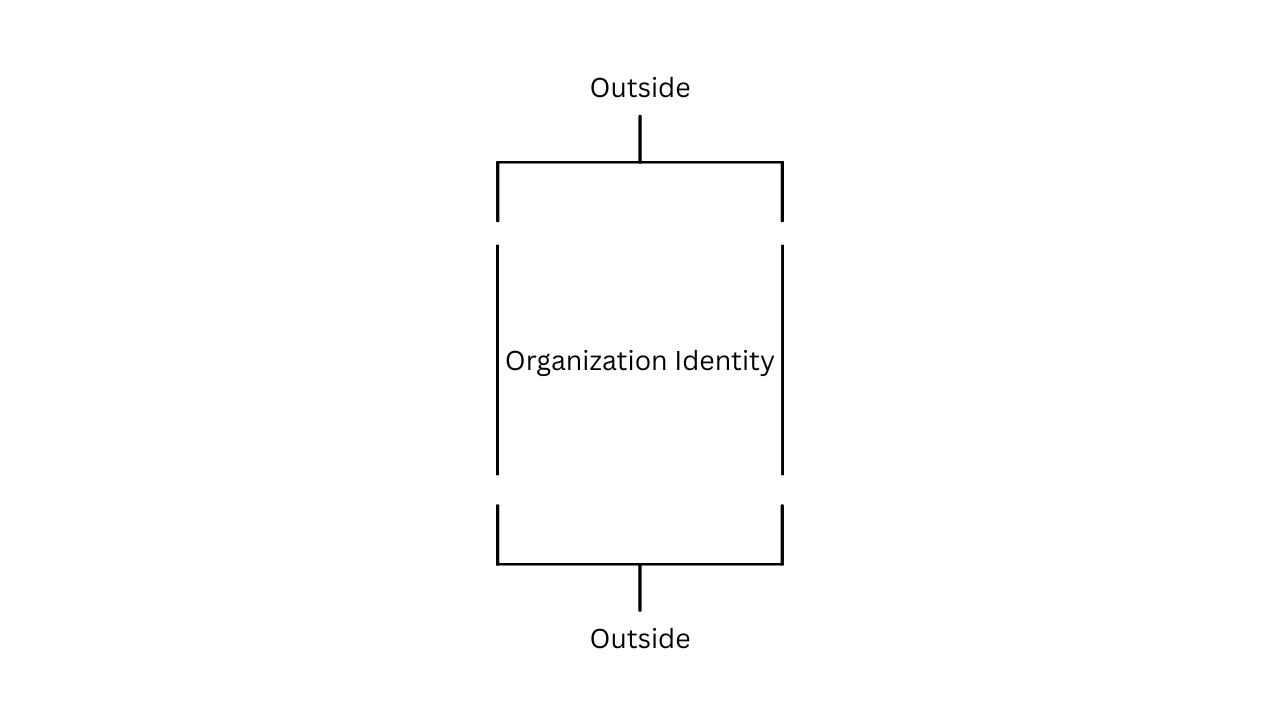
Not all members will stand in precisely the same place as others inside that boundary, but that doesn’t really matter. As along as they understand where the boundary is and why it exists, organizations can and should succeed. That being said, those who stand closest to the center are usually the greatest assets to an organization and the ideological drivers who drive success.
Creating an explicit hierarchy of disagreement.
What I have done with The New Way is create an explicit hierarchy of disagreement. At first, this may seem like something that is counterintuitive, but the results will speak for themselves at the end of the day.
Let me elaborate on the 4 categories:
Core principles — disagreement is incompatible with membership.
Organizational commitments — members are expected to respect these while participating in the organization.
Members who do not respect these will be disciplined or removed from the organization.
Strategic questions — legitimate disagreement which allows myself and my staff to choose one strategy for practical reasons.
This is particularly important when considering different options for enacting decisions. You might want to go one way, but someone else chimes in with a better plan. Legitimate disagreement is actually something that I want, because it makes TNW stronger.
Personal opinions — members are clearly free to disagree.
For example, I have one member who believes that we should try to work with pagans. However, the majority of my members—as well as myself—don’t think that should be considered. Regardless, we haven’t shunned him for his personal opinion, nor would it harm the cohesion of our organization unless he were to try to force it on us. Since he hasn’t, he can remain a member of TNW.
By doing this, I have allowed for the alleviation of the common organizational failure of turning every disagreement into a test of ideological loyalty. Essentially, this is a long-winded way of saying I wouldn’t turn everything into a dick measuring contest.
If someone were to disagree about an organization’s tactics, that shouldn’t automatically become a debate about whether they are “really” committed to the organization. It could be that they are trying to improve the organization where they see what they perceive to be a flaw.

Successful organizations need an intellectual center.
This is something that I touched on in last week’s article when I went over the developmental stages of influence. Ideological coherence doesn’t happen automatically and a movement will first start off at the intellectual influence stage, before moving onto the social influence stage, ending up at the organizational stage that this article mainly focuses on. However, throughout all of the stages there will need to be an intellectual center that pumps out ideas like a beating heart. If the heart stops, so does the body—the organization. If the body stops… well you get the idea.
For instance, when I started TNW in March of 2025, I had already been scouting for likeminded candidates to network with since October of 2024 with the use of this publication and social media.
So, TNW already had a defined body of foundational material to work with explaining what I believe, why I believe it, what problems I was attempting to address, what distinguished what I was saying from competitors, what principles I would expect of members, and which questions still have an open invitation for friendly debate.
From personal experience, a statement of principles like we have on TNW’s website, followed by a longer educational curriculum, is often better than a manifesto that nobody actually reads—looking at you Anselme Bellegarrigue.
Here’s what the distinction should be:
The principles establish the identity → The educational program develops the members’ understanding of that identity → The members radiate that identity outward → That identity is adopted by new members → The cycle repeats.
This will also make recruitment easier, because potential members can determine what they’re actually joining before committing to anything. This helps cut down on the amount of people who join an organization out of curiosity and then leave as soon as they get bored.
Dissidence always requires intellectual independence.
An important discipline for dissident activists is avoiding the assumption that everything mainstream is false simply because it’s mainstream.
It’s similar to how everyone thought Creed and Nickelback were shitty bands because they were mainstream. It turns out, they were always good bands, and it was artificially generated opinion that they sucked. Coincidentally, this is when Rap music began overtaking Rock amongst Whites… I’m sure that’s just a coincidence.
By adopting the assumption that everything mainstream is false, a dissident activist will produce a mirror image of the conformity they supposedly reject. Ergo, they become total posers without anything of substance to add to the actual conversation.
“You either die a hero, or you live long enough to see yourself become the villain.” - Harvey Weinstein
A good pop culture example of this can actually be found in the 1998 movie “SLC Punk!,” where the protagonist Stevo (played by Matthew Lillard) stops rejecting everything that is mainstream after realizing he had become a “poser.” Essentially a rebel without a cause and realizes he can use the mainstream system to his advantage:
In my opinion, a serious dissident organization should be willing to say:
“The mainstream is correct about this.”
“Our previous position was mistaken.”
The more you stand on principle, the less you will have to say this.
“The evidence doesn’t support our preferred conclusion.”
“We don’t know.”
My personal favorite. Just because I don’t know in the moment, doesn’t mean I won’t know in the future.
“This is a strategic judgment rather than an established fact.”
These are the things that actually strengthen organizational identity, because the goal isn’t to manufacture disagreement, it’s to develop the ability to think independently enough to disagree when disagreement is warranted. However, if disagreement isn’t warranted, then orders must be followed through as efficiently and passionately as possible.
Don’t make dissent itself the identity.
I briefly covered this in the article section “What exactly makes the organization ‘dissident’?” as well as in the previous subsection with the example of “SLC Punk!”. However, it definitely deserves a more fleshed out explanation, because it is a major trap that I have seen so many organizations and activists fall prey to.
An organization can and often will develop a culture in which being “against the establishment” becomes more important than having a coherent positive platform that actually accomplishes anything worth a damn.
If this is the case, everything basically becomes reactive:
The Democrats support mass illegal immigration → so Republicans support mass legal immigration.
The Republicans oppose abortion → so the Democrats support abortion up to conception.
To reference the example of “SLC Punk!” again, that’s not independence, that’s political inversion.
Here’s a good real world example that I can think of:
The founder of Hate Club, Combat Carl, got into a disagreement with Blood Tribe when he was a member. So, he decided to create his own organization that was essentially a carbon copy of Blood Tribe. Hate Club’s purpose was to dissent from Blood Tribe and that was what the core of its identity was.
Unsurprisingly, Hate Club collapsed in on itself.
So, a mature dissident organization should be able to answer what they would believe in if their opponents didn’t exist.
The question—
“What would we believe in if our opponents didn’t exist?”
—forces the organization to develop its own intellectual and institutional identity.
Preserve room for development.
Finally, a dissident organization should distinguish between having principles and having every answer. This is exactly why my favorite answer is “I don’t know.”
There should be legitimate areas of inquiry where members are encouraged to investigate, debate, and develop conclusions on their own.
A formulation I have used—even if it’s a bit corny—is:
“I’m firm on fundamentals, incredibly serious about evidence, generally flexible about strategy, and open to intellectual development for the benefit of the cause.”
In my opinion, this creates a much more sustainable culture. So, rather than demanding agreement on every question—which could cause the organization to implode—I favor wearing a silk glove over my iron first.
My goal with TNW is not to create members who repeat identical opinions, who are devoid of the ability to articulate their own thoughts or expand on the ones presented to them. You know, like Groypers. I want to create members who understand the organization’s fundamentals, can explain them intelligently, can disagree constructively about secondary questions, and can work together despite those disagreements.
And all successful nationalist organizations will have to adopt this mentality, or they will fail and at the end of the day. We don’t have that option.