


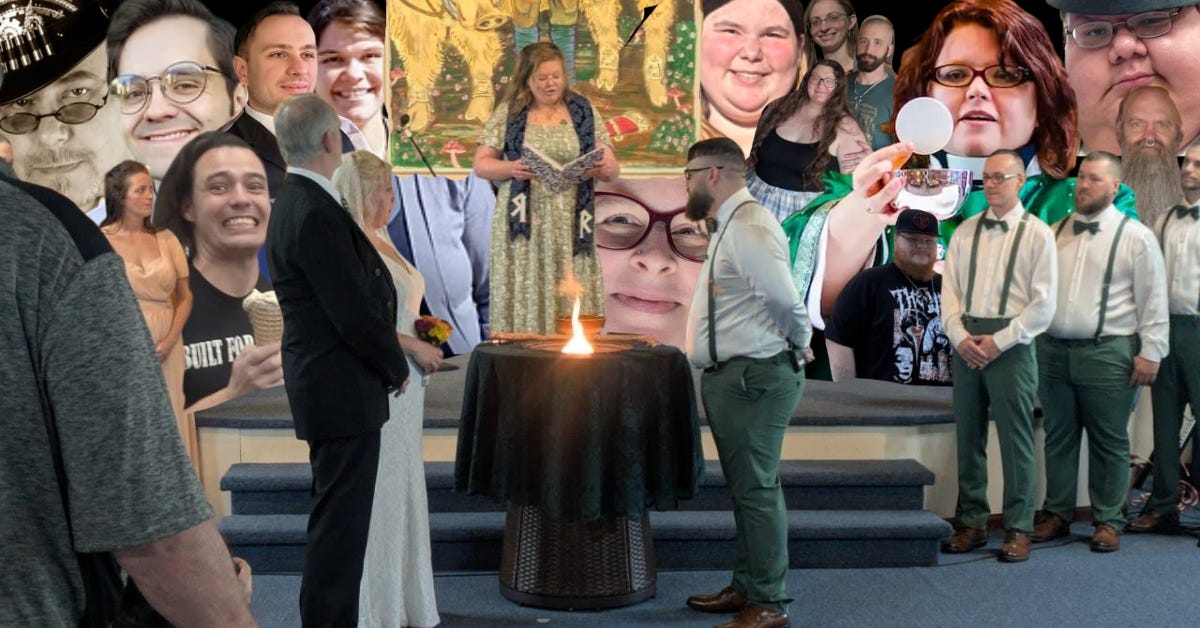
Neo-paganism is one of the most aesthetically famous answers to liberal democracy’s comically demonic ‘great mission’, and, more specifically, to the issue of how institutionally compromised much of Christianity either is or looks. However, this results in disappointment once one finds how scant their literary and historiographical references are for their claimed heritage and “tradition,” given the impassible millennium-long gap between the Vikings and 19th-century writers.
This is to say nothing of the dearth of sources pertaining to the eclectic categories, cultures, attitudes, and practices among different forms of paganism. What is extant famously comes from fragmentary material, later Christian accounts, and/or texts recorded centuries after the pre-Christian period. Their evidentiary basis for reconstructing coherent systems of belief is dubious at best.
In my exposure to neo-pagan beliefs through Notes and articles from creators both relatively famous and totally forgotten (R.I.P. Pelagius Heorth, your screeds were unmatched), I’ve noticed five errors in its thought that are required for its immediate objective of being a “superior alternative” to Christianity.
Honorable Mention: “Pagans are the only people doing stuff in real life.”
Not all neo-pagans are so pitiable as to claim this, but many do as a result of a certain demographical habit: being uppity about overtures to doing things in real life, to the point of presuming or even claiming a monopoly.
Said overtures are usually in reference to themselves as “building communities,” the first occasion where I heard this being Argent’s old streamsnipes of the Free Folk. He and Chris Bechtloff almost literally laughed them off the internet. Good times.
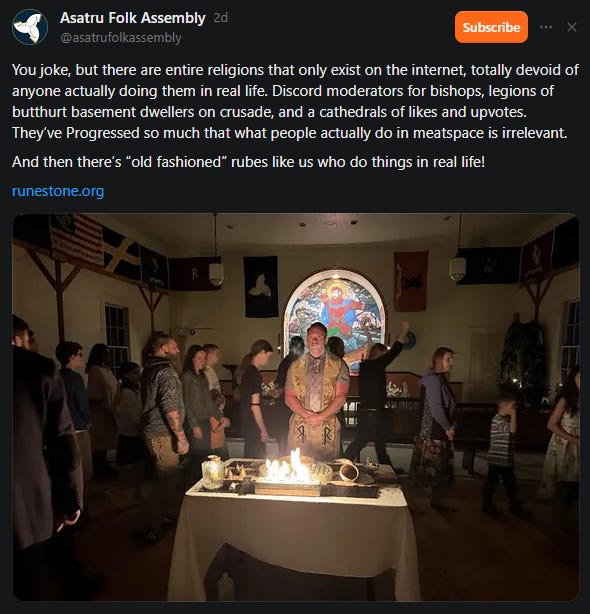
Yes, each demographic one can name has sections of absurd and parody-prone members, especially on the internet. The irony is that meaningful attention to neo-paganism has only been paid on the internet outside of infamy like that attained by Varg Vikernes. Meanwhile, in the hallowed halls of real life, it goes without saying that neo-pagans are not known for their charitable work—or much at all outside of worship services and participation in quickly-forgotten political efforts. By comparison, the contributions made by another often-parodied religious group in the Mormons are orders of magnitude greater than anything the neo-pagans have produced.
Honorable Mention #2: “Infighting” = we all die.
Even if this were true, its result would be the Christian having to choose between faith and mortal life. That has a famously predictable conclusion, much to the chagrin of Nietzsche.
Of course, it’s not true. Neo-pagans are a very small minority and have less real-world political influence than the Jehovah’s Witnesses. Who disallow voting.
Error #1: ‘Universalism is allegedly wrong.’
Neo-paganism is often framed as ethnically and culturally rooted, such as in their concept of the Volksgeist (the “spirit of a people”). Accordingly, belief in the gods is primarily dictated by one’s ancestral or cultural heritage; a German would worship Wotan, for example. However, some interpretations allow for a more plural approach, where one may also venerate multiple traditions or deities outside their own lineage in addition to those within it.
One of the foremost critiques of Christianity from this perspective is in its ‘universalism’—salvation being available to all people through the Lord of creation, regardless of color or creed.
In counter, inherent to the pagan framework are some serious questions one must ask:
Is there supposed to be a single pagan creation myth that is meant to be true over all others?
If so, this would appear to rely on a form of universalism, now applied across cultures or ethnic traditions instead of racially. The claim that religious truth is fundamentally particularistic or ethnically rooted would then be contradicted. Nor can any ‘overarching racial culture’ be at play because all the creation myths are different, often radically; compare Hesiod’s Theogony to the Norse.
If not, how is the existence of creation explained, and what’s even the point of such a belief?
If no single account is accepted as being universally true, this system lacks a unified explanation for the origin of existence and one can more or less choose what they want to believe. Truth would then become relative to culture, raising the question of whether it’s all merely symbolic.
If this is the case, the neo-pagan can pick and choose whichever gods he feels like—similar to the arbitrariness of non-denominational “Christianity”—so long as whoever made them up were White.
Pagan attempts at cosmogony are already troubled, as seen in one such idea being a “pregnant void”—primordial emptiness somehow containing latent potential or the seeds of creation. How this doesn’t collapse into an odd contradiction of “nothing containing something” is unclear; as ambiguity is not brilliance, contradiction is not profound.
Is the ‘Volksgeist’ is the source of divinity? If so, why even affirm the existence of distinct gods as objects of belief or worship?
If it is, the ontological status of the gods becomes dubious. Are they independent realities, or just expressions of a collective cultural psyche? If the latter, they’re on par with figures like Guan Yu in Chinese folk religion—venerated, but confirmedly nonexistent.
If the gods exist independently, one could argue that their truth holds regardless of ethnicity or culture. However, if belief in them is determined by ancestry, then religious truth is contingent on identity rather than objective, external reality itself.
If they, and also myths, are allegorical or ‘spiritual,’ how is this not just symbolic reductionism a la the New Age movement? The most coherent a framework like this could be is to treat religious figures as archetypes rather than existing entities. I.e., Jungism (after Carl Jung).
If the value of a religion lies primarily (practically, only) in serving a cultural and/or ethnic identity, how would this be any different than Giovanni Gentile praising the Catholic Church for its social and national utility, with no mention of it being true or untrue in itself?
“The Fascist State is not indifferent to religious phenomena in general nor does it maintain an attitude of indifference to Roman Catholicism, the special, positive religion of Italians. The State has not got a theology but it has a moral code. The Fascist State sees in religion one of the deepest of spiritual manifestations and for this reason it not only respects religion but defends and protects it. The Fascist State does not attempt, as did Robespierre at the height of the revolutionary delirium of the Convention, to set up a “god” of its own; nor does it vainly seek, as does Bolshevism, to efface God from the soul of man. Fascism respects the God of ascetics, saints, and heroes, and it also respects God as conceived by the ingenuous and primitive heart of the people, the God to whom their prayers are raised.”
- The Doctrine of Fascism, p. 9.
As universalism is to be opposed, so too is universally standardized dogma. This, however, leads to a dilemma concerning those who claim to be pagan but have politics opposed to right-wing neo-pagans, such as Wiccans. How could an anti-White pagan, or a New Age pagan, not count as pagan?
If politics or practices, however deep, self-evident, or bound in nature they’re held to be, are the basis on which such exclusions can be made, such a group and/or belief system would be enforcing a form of dogmatism, plain and simple.
Furthermore on politics: If exclusion is done based on political differences, this would demonstrate that sharing political goals is more important than anything to do with faith. Indeed, faith itself would be nothing but a pretense or secondary justification for ideology.
How could there be a ‘pagan European identity’ without universalizing what’s supposed to be tribal?
Even the terminology of an “Aryan culture” or “European pagan identity” requires generalizing the tribal and/or familial to suit a supranational category.
Today’s neo-pagans draw primarily from Northern European ethnic traditions—of which no two are the same to begin with—often supplemented with influence from 19th-century Romanticism and figures like Friedrich Nietzsche. However, the pre-Christian intellectual and institutional foundations of Western civilization are not Norse, Celtic, or Irish, but Greek and Roman. What results in a discontinuity, where the claimed inheritors of a tribe, race, and continent can’t even rely on their own pedigree to make that claim. Furthermore, say Europe’s nations become pagan; how would this need for stolen inheritance not cause tribal and nationalist tensions between the different peoples?

Error #2: ‘Christianity is Escapism’
This is taken from Nietzsche, the idea that Christianity’s sublimation of earthly life to that of judgment and the afterlife is “an escape.”
This assumes that belief in an afterlife undermines and even invalidates the significance of earthly life. However, we all know that something must happen after death, or else there’s no objective basis for life being considered important or meaningful to begin with.
What results is another conundrum, irrespective of whether any given neo-pagan belief system affirms the existence of an afterlife.
If there IS a pagan afterlife, is it eternal?
If so, then the ‘escapism’ critique is plainly hypocritical. If a pagan system affirms an afterlife—whether eternal or otherwise—then it appears to adopt the very feature criticized in Christianity. In that case, the charge of “escapism” risks becoming internally inconsistent.
If there is no enduring post-mortem existence, we then return to the age-old problem that life has no objective significance without an eternal condition to override entropy—that is, eventual dissolution over sufficient time.
If there is NOT a pagan afterlife—or none at all—see the ‘b’ above.
There’s also the belief that time is cyclical. Even if possible, an Earth that lives forever is a pointless one; repetition alone does not necessarily resolve the problem of meaning; an endlessly recurring process does not, by itself, establish lasting significance or purpose.
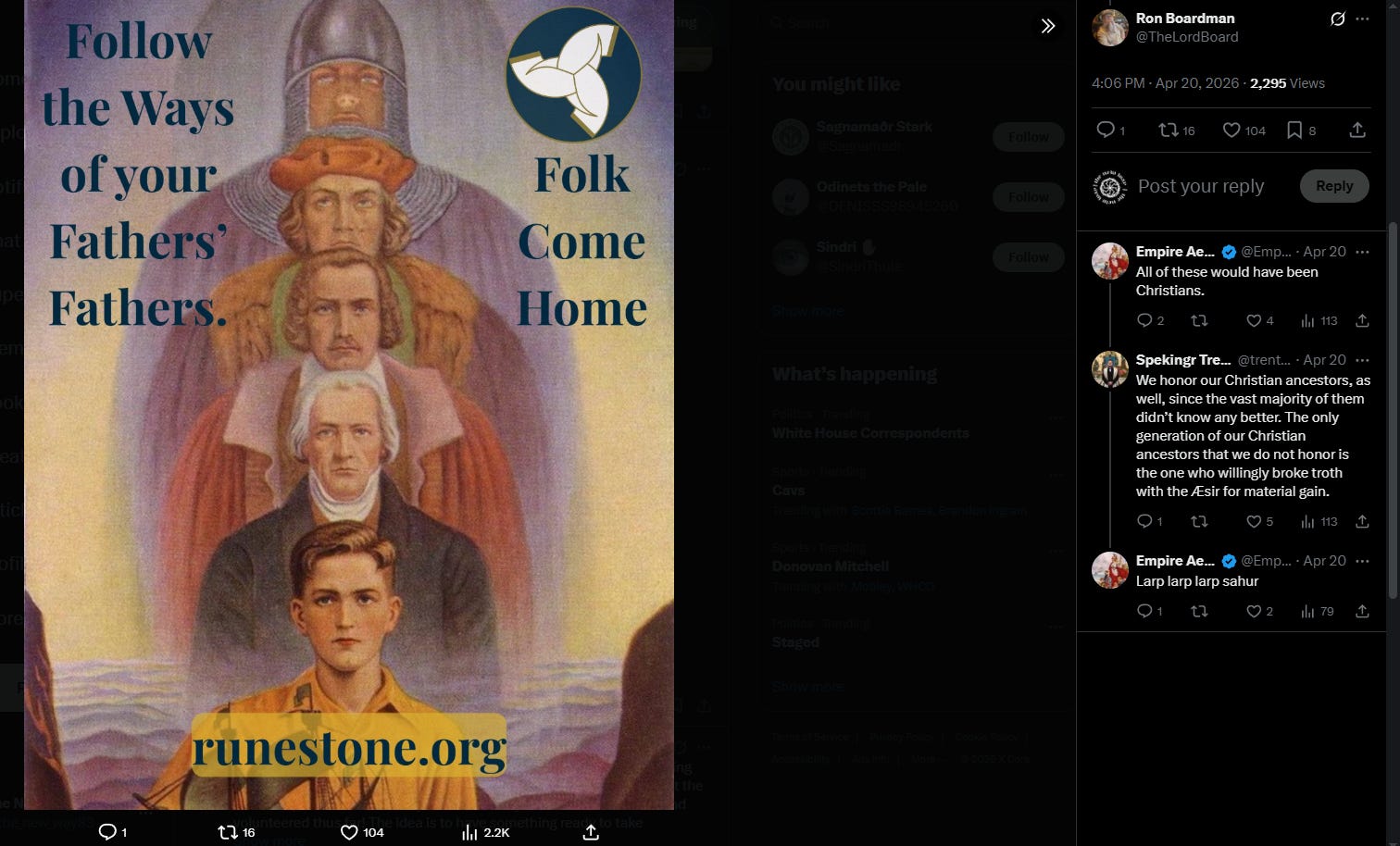
The notion that “Christianity is escapism’“ is quite ironic when you take into account how pagans also honor their Christian ancestors.
When it’s convenient, anyway.
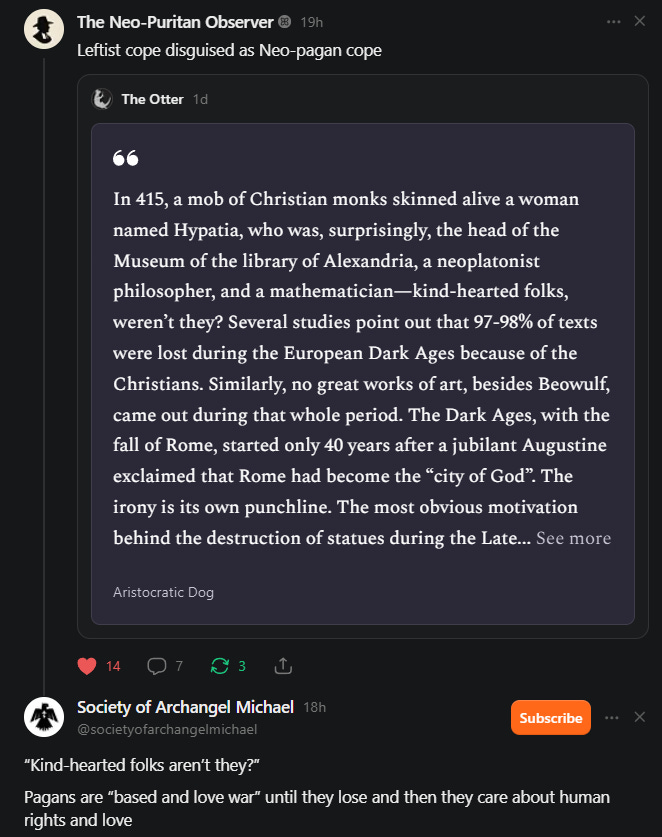
No, not even based on ‘they didn’t know any better.’ Merely convenience.
Error #3: ‘The differences between different denominations of Christians aren’t really important.’
Wotan’s printing press will start bouncing checks if it can’t get by milking paper-thin images of Christianity in “youth pastors,” the “religious Right,” the perennial low-hanging fruit in stereotypical Americanist Protestantism—most importantly the allowance to pretend that being able to critique an Evangelical magically makes you the slayer of High-Church Protestantism, Catholicism, and Eastern Orthodoxy. Hence why you never see pagans trying to argue with Orthodox or Catholic priests, and almost never with well-educated Protestant pastors.
An example of a vast difference between two Christian denominations is found in the comparison of Eastern Orthodoxy to Evangelicalism: Evangelicals are overwhelmingly represented in the Christian Zionist camp, while the Orthodox routinely called Jews the ‘Synagogue of Satan.’
This also reflects poorly on their historiography: for instance, any neo-pagan effort to understand the history of the early Church would be confounded by the need to understand and take account of famous heresies like Arianism, Gnosticism, and Nestorianism.
Error #4: ‘Christian identity is inherently anti-White.’
The neo-pagan perspective labels Christianity as inherently ‘foreign.’
Two examples of where this label fails are as follows:
The want for all peoples to be Christian does not mean progressive mongoloidism or ‘replace Whitey with immigrants,’ just like being neo-pagan does not mean being gay or a furry regardless of whatever bad-looking cases could be found. This notion relies on finding it novel that, if all 8 billion people across the world were Christian, Christianity would be largely non-White. One wonders if the prevalence of folk religion among Hispanics, Africans, Indians, etc. makes paganism the most brown-coded religion in human history.
This is a case where honoring our ancestors isn’t convenient for the neo-pagan (alongside decrying Alaric the Goth, Charles Martel, and others as “Jew-worshipers”). Recall Caesar’s conquest of Gaul, where tribal infighting allowed a people to be systematically conquered by an invading force otherwise numerically inferior to them.
If Europe remained pagan, how exactly would it have fared against the Muslims? How would the Greeks have fared against the Rashidun Caliphate? How would the Visigoths and Franks have fared against the Moors? How would Europe itself have fared against the Ottomans?Answer: Not well.
Error #5: ‘Christianity = Judaism and also modern Israel somehow.’
The foremost problem for anyone looking to nurse an interest in religious studies and the history of religious institutions is how the conclusions of scholars and enthusiasts alike are largely determined by their belief. In the Christian case, if Christ is not God, the natural conclusion is that He is a “Jewish leader” of dubious historical documentation whose life, words, and deeds are undoubtedly—though maybe not intentionally—embellished by His followers.
Of course, this is more logically flawed than people realize. If the accounts of the Gospels are false, what exactly are they? To answer this, modern historical sources who reach this conclusion often resort to making authoritative claims about the intentions of the Apostles in what’s only NOT accepted as an instance of egregious cultural bigotry because it’s about the Church.
Even Christian sources can fall prey to this.
The Gospels were not meant to be a historical or biographical account of Jesus. They were written to convert unbelievers to faith in Jesus as the Messiah of God, risen and living now in his[sic] church and coming again to judge all men. Their authors did not deliberately invent or falsify facts about Jesus, but they were not primarily concerned with historical accuracy.
- Thomas Bokenkotter, A Concise History of the Catholic Church: Revised Edition, p. 8.
“They weren’t lying, but they weren’t concerned with telling the truth.”
Your guess is as good as mine.
But such dancing is futile. The basic fact of the matter is that if the accounts of the Gospels are false, as with the naturalistic doubt of the Virgin Mary giving birth to Christ without having sex with a man, then some degree of falsification had to occur and the Apostles would have known of it. We’re then meant to believe that these learned men unanimously dedicated their entire lives to this lie, never betrayed it outside of one episode—the bribery of Judas Iscariot—and persisted in it even in the face of poverty, persecution, imprisonment, torture, immortalizing documentation of their misdeeds like St. Paul’s past as a Jewish persecutor, and death itself.
Even still, though the neo-pagans are more eager than most to call Christ a fictional Jew—for obvious reasons—it’s not irrational for them to do so; they’re working within the same limitations as any other non-believer.
What is irrational is to take this wrongheaded historiography and take it into the realm of absurdity.
Alongside neo-pagan complaints in the comments section of our previous Why White Christians and Pagans Cannot Coexist article, an example of this ‘in the wild’ can be found in the beginning of a sentence from this Note by Gildhelm:
“The whole of the Jewish tradition from its Iron Age henotheism, to the Jerusalem Church established by Peter, and through Augustine and on further…”
This is one of the biggest and most bizarre failings to understand history that one can find.
Darkshadow’s Why ‘Judeo-Christian’ Is a Myth article sums it up:
Christianity proclaims that the Law has been fulfilled in Christ. The Talmud reflects a worldview that not only rejects this claim, but in key passages, actively opposes it. For this reason, the two cannot be reconciled into a single theological tradition.
[…]
Christianity teaches that Christ rebuked corrupt religious authorities and revealed the truth of God. The Talmud presents Christ as condemned for doing exactly that.
The same pattern appears in other passages. In Sanhedrin 43a, Jesus is described as being ‘hanged’ on the eve of Passover, after accusations are made against Him. The text frames the event as a legal process and presents His execution as justified. The Talmud does not deny that Jesus was put to death, it reframes that death as warranted. And openly and proudly accepts Jewish responsibility.
This isn’t difficult to understand, but I doubt that any neo-pagan perspective could accept it without faltering. Without this error, they can’t explain why the most healthy and powerful state of humanity ever achieved was beaten by a “desert cult” of peasants, mystics, and “nobodies.” They can’t maintain the conditions of ‘God being dead’ that allow for Nietzsche to be upheld as the only available latter-day prophet. They can’t ignore claims that Christianity or its claimants were assaulted by the forces of demonic progressivism as with the cases of the French and Russian Revolutions—such would deprive paganism of its claim to exclusive sympathy. can’t seriously resist the fact that Christianity is foundationally European. Nor can they dismiss historical claims about Christianity’s role in shaping European identity, or reduce its development to purely external or contingent factors, etc., etc.
Going Forward
Dave Greene, in describing the tendency for online discussions to loop around pleasing questions while never getting to uncomfortable and productive ones, gives neo-paganism on Substack as an example:
Side A starts with Argument A1, then Side B replies with Counter-argument [B1], only to be confronted by a counter-counter argument A2 to which they retort with their own reply, B2.
The dialectic keeps going like this (A3 vs B3 followed by A4 vs B4 etc etc) until we get to something like A15 vs B15 and then something changes. One side (usually the side who started the argument so let’s call it side A) doesn’t like the implicit frame created by argument A15 vs B15 and therefore decides to blow up the conversation, either by reframing, trivializing the controversy, or otherwise creating an emotional dynamic that forces everyone to quit.
This implicitly restarts the internet’s perception of the problem, a “chat bot reset” where everyone watching walks away thinking “it’s complicated”. Invariably, when the conversation starts up again, people never start the new argument with A15 vs B15, they argue A1 vs A2, which is what side A likes doing. This circular dynamic is ideal for feeding an audience endless content, but never accomplishes anything because it steps around the crux that only develops later in the conversation.
Example here would be Paganism v Christianity on Substack. The controversy always starts with the accusation/question:
A1/B1 - “Why are modern Christians so weak and is this weakness destroying Western civilization?”
But invariably this dialectic leads, through many stages, to a more productive and advanced question:
A9/B9- “So what do pagans actually believe and how does this lead to the ethical behavior necessary for civilization?”
Pagans love the first (superficial) question and hate the last (critical) one, so they reset the chatbot and the conversation always starts once more from the beginning with nothing greater learned.
My experience, though I assume I haven’t seen what Greene here refers to, is that neo-pagans don’t have an issue with providing an answer to the question he presents. The issue is that the answer is of no use, as with their narratology:
Pagan White populations are immune to the winds of change—thinking that time will go on forever in (purpose-negating) infinitude, they by-necessity have to claim immunity to entropy—due to the alleged ‘timelessness’ of the ‘Volk’ whose ‘people’s soul’ is by itself the source of divinity but isn’t the god to worship, and all instances of change or defeat are entirely due to malevolent foreign actors. A pagan White population can never do anything truly wrong or stupid, and paganism is both the strongest state of man ever and the historical victim.
Liberalism taking some heritage from Christianity means that Christian ideas were poisonous from the beginning, but this conveniently doesn’t apply to paganism through whatever Christianity “took” from it. In fact, it actually means that whatever cool stuff Christians did is actually pagan.
This extends to complaints of “infighting.”
Neo-pagans would be a negligible minority outside of its recent right-wing politicization, and as this relies on failing to handle the Christian faith as egregiously as is needed to avoid paganism’s otherwise obvious insufficiencies, its existence is literally an instance of infighting perpetrated by a small group of at-best questionable intellectual, religious, and institutional value who can’t consistently treat those they complain at as they want to be treated without losing their talking points and more of their identity than they’re aware of.
Fin. No ‘Jew-written’ Bible quotes needed.

Great article, and a very crucial topic right now!
Was working on something similar actually.
I always go for the metaphysics when debating pagans. The Odin larpers have none. The neopagaans have better metaphysics but they still fail JTB.
Good post. On the part about pagans being more culturally relative, I don’t think they would argue on that. They’d probably embrace it because they’re uber-tribal. I saw this one podcast episode on Odysee by a group of National Socialists called, “Prussian Socialism,” and they admitted that relativism is a “good thing.” I was amazed that they straight up said it. Honestly, the only folk pagan I like is Aodhan.