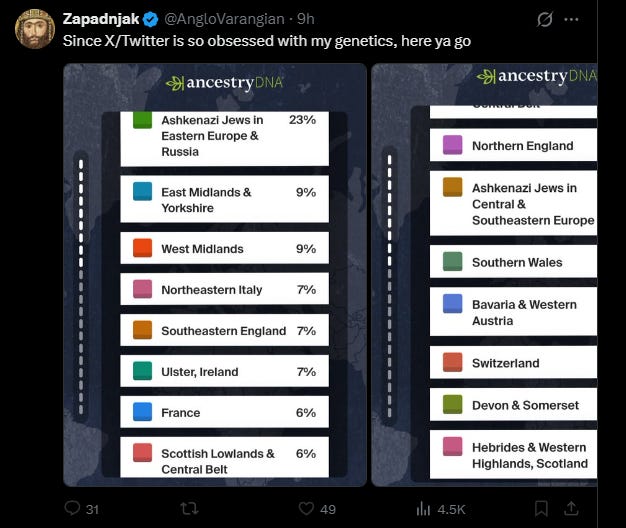
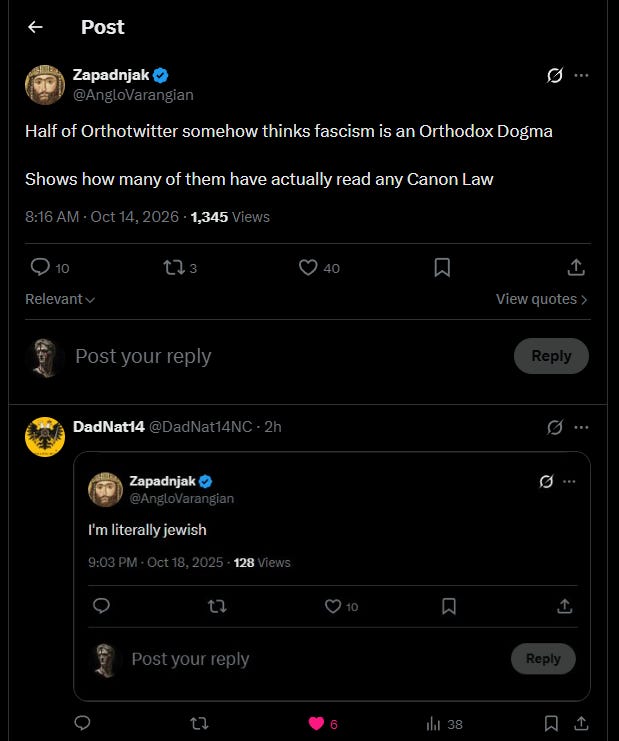
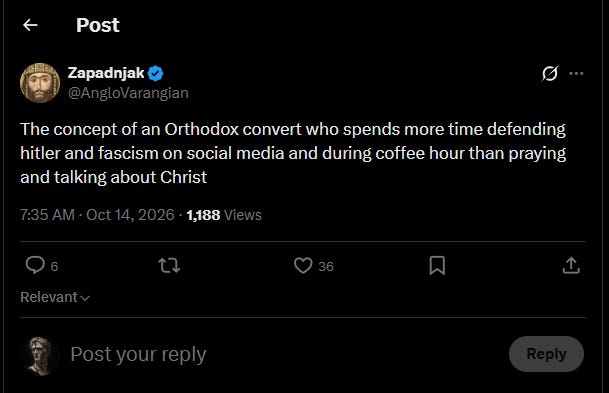
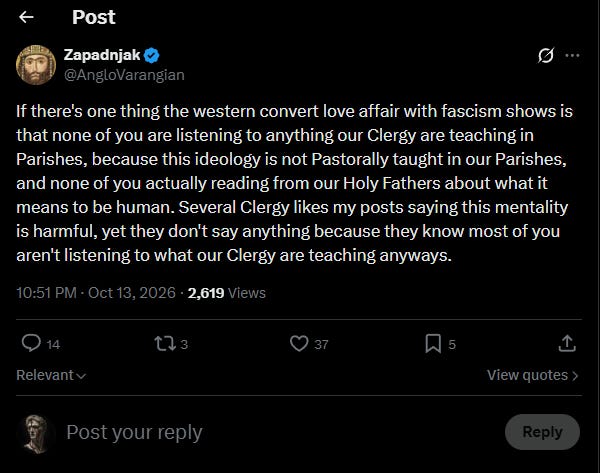
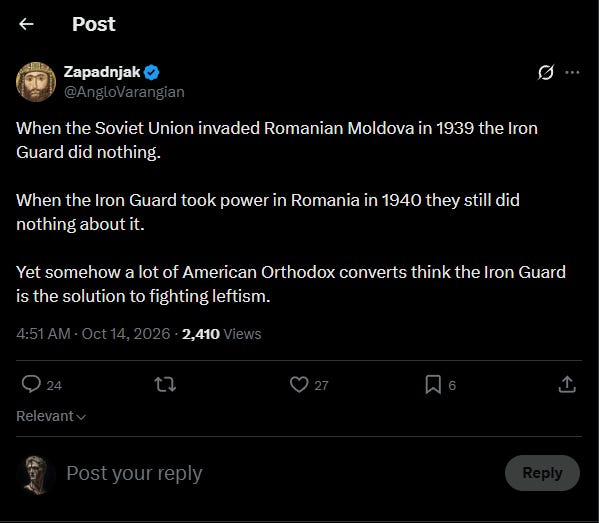
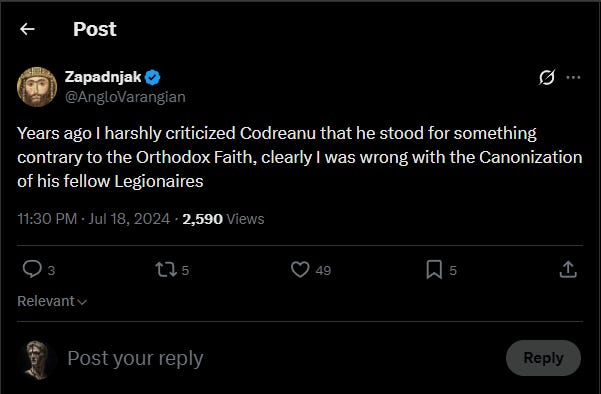
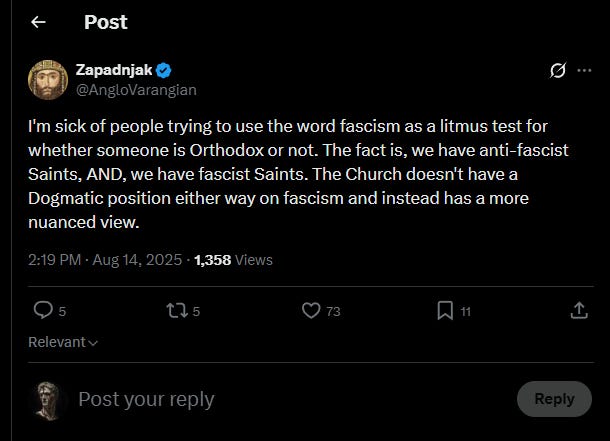
There seems to be a common misconception here in the US among Orthodox Christians that the Orthodox Church condemns “fascism.” This topic of argument was brought up on Twitter by an account going by the name of Zapadnjak. Who I exposed for being jewish.
Besides exposing him for being a subversive jew, I thought it would be best to correct the record and show Orthodox Christians that it is not counter to Orthodoxy to be “fascist.”
You can see one of my Legionaries using my screenshot calling out Zapadnjak for being a subversive jew.
Zapadnjak uses the term “Fascism” as a catch all term for different ideologies/worldviews. So lets break down the ones he’s most likely referring to:
Fascism is a revolutionary national doctrine that seeks to regenerate the nation through unity, discipline, hierarchy, and collective sacrifice. It rejects liberal individualism and Marxist class struggle in favor of a strong state that coordinates the interests of workers, employers, and other social groups for the common good. It places national duty above private interest and seeks to create a disciplined, vigorous people under decisive leadership.
National Socialism is a worldview that seeks to unite the German people into a single national and racial community, subordinating individual and class interests to the welfare of that community. It emphasizes German national revival, racial ideology, social solidarity among those it considered members of the national community, authoritarian leadership, and the pursuit of territorial retribution after the Treaty of Versailles.
Legionarism was originally a Romanian national and spiritual revolutionary movement that sought the rebirth of the Romanian nation through Orthodox Christian faith, moral purification, discipline, sacrifice, and service to the homeland. Its proponents envisioned a new Romanian man who would overcome corruption, selfishness, and materialism through spiritual transformation and national devotion. It combined Orthodox religious symbolism with militant nationalism, antisemitism, and revolutionary action, presenting national renewal as both a political and spiritual mission.
Counter to what Zapadnjak states in his post, there is nothing stated in cannon law that prohibits being a member of an organization that represents one of these ideologies/worldviews.
The closest thing you will find is a 2017 statement from the Assembly of Canonical Orthodox Bishops in the United States, who condemned racism, White supremacy, neo-Nazism, and other forms of hatred, explicitly stating that the actions of self-proclaimed fascists betray Christian values. However, this is an ecclesiastical statement, not a canon specifically prohibiting fascism as a political system.
Also, it’s worth noting that nothing that Legionaries—who hold true to the original teachings of Codreanu—believe is counter to Orthodoxy.
What Zapadnjak may try to use for his argument is the Synod of Constantinople in 1872, which declared that placing ethnic identity above the unity of the Church violates the apostolic constitution. But most people don’t actually understand what that Synod really means.
Arditi Magazine is a reader-supported publication. To receive new posts and support our work, consider becoming a free or paid subscriber.
Ethnophyletism
Before 1872, most of southeastern Europe (the Balkans) remained under the rule of the Muslim Ottoman Empire. However, as the Ottoman power waned and Bulgarian national consciousness grew, Bulgarians increasingly sought to preserve their language, cultural, identity, and religious life independently of Greek ecclesiastical leadership.
During this time, Bulgarian Orthodox Christians were generally under the jurisdiction of the Ecumenical Patriarchate of Constantinople. Rightfully so, many Bulgarians believed that Greek-speaking hierarchs dominated their church administration and did not adequately represent Bulgarian interests. So there’s two things happening at this time:
Bulgarians aspired for greater ecclesiastical self-governance and recognition of a distinct Bulgarian church.
The Patriarchate sought to preserve canonical order and the unity of the Church within its existing territorial jurisdiction.
So the argument between them was both religious and national, with the Ottoman government playing a decisive political role.
The creation of the Bulgarian Exarchate, 1870
In February of 1870, Ottoman Sultan Abdülaziz issued a decree establishing the Bulgarian Exarchate, an ecclesiastical institution intended to serve the Bulgarian Orthodox Christians across designated areas. However, the Ottomans had no right to do this and the proposed jurisdiction actually overlapped with that of the Ecumenical Patriarchate.
By 1872, the dispute had boiled over when Bishop Antim I was elected the first Bulgarian Exarch. At this point, the conflict was no longer merely about administrative reform, but over whether the Bulgarian ecclesiastical structure was canonically legitimate.
The Council of Constantinople
Convened under Ecumenical Patriarch Anthimus VI, the council met in Constantinople in September of 1872. It included the Patriarchs of Constantinople, Alexandria, and Antioch, the Archbishop of Cyprus, and numerous other bishops. However, not all Orthodox churches participated.
This where the council condemned ethnophyletism—the principle of organizing the Orthodox Church around ethnic or national identity rather than its territorial and ecclesiastical structure—and declared the Bulgarian ecclesiastical leaders involved in establishing the disputed jurisdiction schismatic. Its decree stated:
“We censure, condemn, and declare contrary to the teachings of the Gospel and the sacred canons of the holy Fathers the doctrine of phyletism, or the difference of races and national diversity in the bosom of the Church of Christ.”
So, what they decided was that the Church’s internal structure was not to become centered on organizing competing Orthodox jurisdictions within the same territory based on ethnicity.
The council’s position rested on the idea that the Orthodox Church is one Church in a given territory, rather than separate churches divided according to ethnicity. Essentially, what it opposed was the following:
Establishing parallel Orthodox jurisdictions in the same territory on the basis of ethnic identity.
Making racial or national distinction a governing principle of the Church.
Creating ecclesiastical structures that violated the Church’s established canonical order.
What it did not oppose was patriotism, national culture, national independence, and it did not call secular nationalism inherently heretical.
Was the council universally accepted?
While the council had substantial influence, not all Orthodox churches attended, and some supported the Bulgarian position. Interestingly, the Bulgarian Church remained out of communion with Constantinople until 1945 and still does not support the 1872 Synod, even to this day.
The council was not attended by representatives of every Orthodox autocephalous church. The Russian Patriarchate supported the Bulgarian position, and the Patriarch of Jerusalem withdrew from the council. Of the Patriarchs that went, Alexandria, Constantinople and Antioch all signed the decree.
This council was a regional council attended by a few Patriarchs and some bishops, but was not representative of the entire Orthodox Church. That doesn’t mean that the council’s decision doesn’t hold some authority, but it also doesn’t mean that an Orthodox Christian has to follow it if their Church doesn’t.
The 2016 Holy and Great Council of Crete explicitly listed the 1872 council among councils that condemned ethnophyletism as an ecclesiological heresy.
However, the 2016 council was not attended by every autocephalous Orthodox Church: the Russian, Georgian, and Bulgarian Churches did not participate. And interestingly enough, the Antiochian Church also did not participate.
So, what does that look like in numbers?
There are roughly 100-115 million Russian Orthodox Christians in Russia under the Russian Patriarchate. There are 3.2 million under the Georgian Patriarchate. And there are 4.1 million under the Bulgarian Patriarchate. So that’s roughly 107-122 million Orthodox Christians who belong to Churches that do not agree with the 1872 Synod. That’s not including the 40,100 adherents in the US.
Belonging to the Churches that support the 1872 Synod is roughly 34-35 million Orthodox Christians in Europe and the US.
While agreeing with the 1872 Synod may be more represented in the US, it’s far less accepted throughout the whole of the Orthodox Church.
Protecting the Truth
Zapadnjak assumes that Orthodox converts spend more time defending Hitler and Fascism on social media and coffee hour than praying and talking about Christ. This assumes that all Orthodox converts spend more time thinking about secular topics than Christ Himself. But he’s projecting.
Aryans, who make up the overwhelming amount of Orthodox converts have been told their whole lives that Hitler was the antichrist. Turns out, they were lied to. In fact it turns out the “bad guys” were actually the biggest defenders of Christianity and now Orthodox Christians are trying to speak the truth.
Just because the clergy does not pastorally teach fascism in our parishes, does not make it evil or sinful. As previously stated, there’s no canonical law prohibiting Orthodox Christians from being “fascists.”
Zapadnjak is also trying to use the argument of some clergy allegedly supporting him to make a call to authority. However, my argument is actually more sound.
The clergy’s involvement in the Legion went far beyond the occasional expression of sympathy. Many priests actively participated in Legionary organizations, while others even become electoral candidates and local organizers.
Fr. Vasile Boldeanu of Putna County and Fr. Nicolae Nițu of Roman are both notable examples of priests becoming Legionary county commanders, giving them positions within the movement’s political hierarchy.1 While local organizers include Fr. Gheorghe Doară and Fr. Aurică Nicolescu of Vâlcea were notable Legionary organizers in their communities, where they mobilized people to volunteer in the work camps and other Legionary activities.2
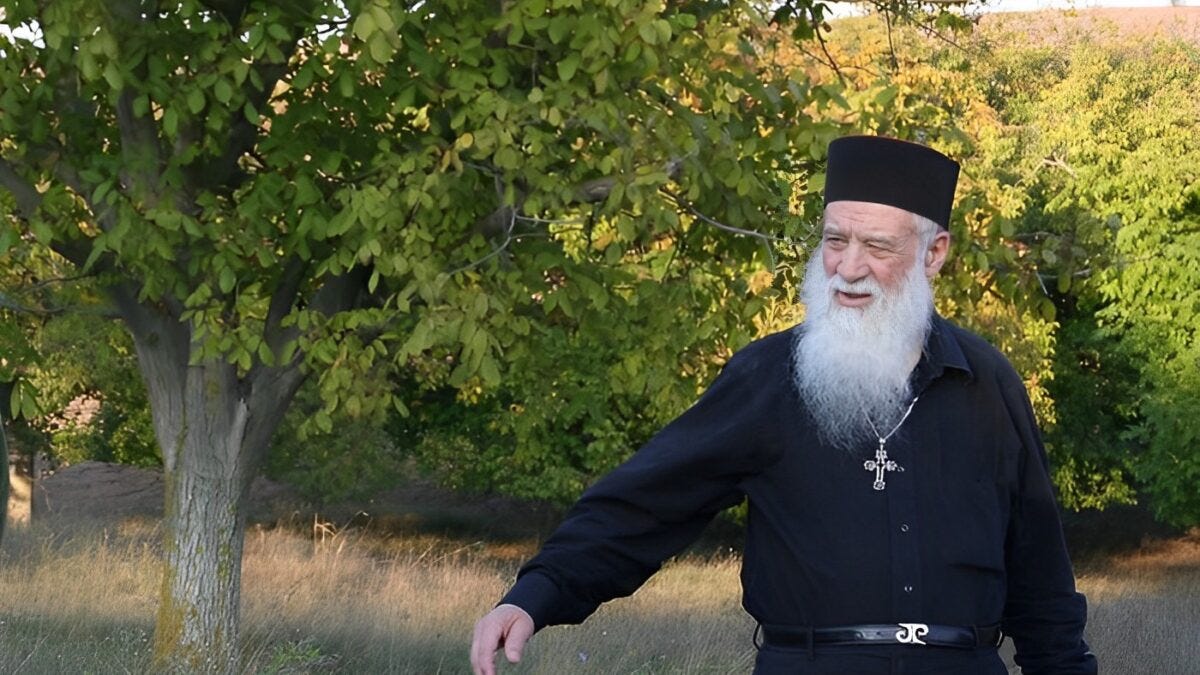
Honorable mention includes Fr. Iustin Pârvu.
Bishop Vartolomeu Stănescu
A significant case was Bishop Vartolomeu Stănescu of Râmnicu Vâlcea. He wasn’t simply a parish priest who sympathized with the movement, rather he was a regional patron of the Legion, mobilizing village priests and church resources, while encouraging priests to join. And Legionary commander Radu Gyr regarded him as an important spiritual figure for the movement.
Stănescu, rather than treating young nationalists as simply another political faction, regarded their activities as having potential social and moral value.
This demonstrated one of the fundamental reasons why the Legion was so important to the Romanian religious society. The Legion did not merely ask priests to vote for it or to convince their flock to vote for it. It presented exactly why the movement was necessary in the moral and material reconstruction of the country.
Metropolitan Nicolae Bălan
Among the most important clerical figures associated with the Legionary movement was Metropolitan Nicolae Bălan of Transylvania.
Bălan possessed a considerable amount of authority within the Romanian Orthodox Church and his relationship with the movement illustrated why clerical endorsement mattered.
Bălan’s support also demonstrates that sympathy for the Legion was not restricted to obscure parish priests and that there were senior members of the hierarchy who believed that aspects of the movement represented a legitimate response to the problems confronting Romania.
Metropolitan Gurie Grosu
Likewise Metropolitan Gurie Grosu of Bessarabia publicly praised Legionary work camps. His support was significant because it demonstrated that the Legionary movement’s emphasis on constructive labor provided a point at which nationalism, youth organization, charitable work, physical labor, and religious life could meet.3
Nationalism must be more than mere rhetoric, as it must become a form of service to your people.
Metropolitan Visarion Puiu of Bukovina
Puiu is another interesting example as he was actively supporting the Legion in the 1930s by financially supporting work camps, organizing Legionary projects, and spreading the Legionary ideology.4
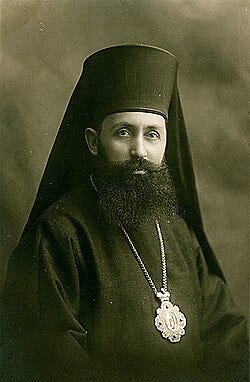
Visarion Puiu as bishop in the 1930s
In 1937, he defied government restrictions by holding religious services commemorating Ion Moța and Vasile Marin, Legionary leaders killed fighting in the Spanish Civil War.
After the war he established the Romanian Orthodox Diocese of Western Europe, served as its first hierarch. In 1955, however, Puiu sent Archimandrite Teofil Ionescu on a mission to Canada and the United States to organize Romanian Orthodox communities, and he was the author of the original plan (1926) for establishing a Romanian diocese in the United States, describing himself as its founder.5 This would later give birth to the Romanian Episcopate of America in 1929.
Orthodox Priests in General
The historian Francisco Veiga estimated that approximately 2,000 of Romania’s roughly 10,000 Orthodox priests had joined or worked with the Legion by 1937.6 Meanwhile, Oliver Jens Schmitt estimates that approximately 1/4 of Orthodox priests had joined or supported nationalists movements in general.7
Interestingly, the 1937 election demonstrated the extent of clerical participation. Of the 103 candidates associated with the Legion’s Everything for the Country organization, approximately 33 (or 1/3) were priests.8
Orthodox priests did not regard political participation as inherently incompatible with their vocation. They believed that the priest could serve the nation not only from the altar but also through public life.
Legionaries Later Becoming Authorities in the Church
After the Legionary government fell in 1941, many former Legionaries were subjected to horrific treatment. Especially when the communist government gained power. However, despite the persecution, there were many notable Legionaries who became officials in the Orthodox Church, especially in America. Honorable mention includes Fr. Arsenie Papacioc.
Archbishop Valerian Trifa, head of the Romanian Orthodox Episcopate of America.
One such individual was Valerian Trifa, who had been part of the Legionary government in 1941 and fled Romania after its collapse. However, by 1952 he had become an Orthodox bishop in America. And by 1957, he was running the Romanian Orthodox Episcopate of America. He was also the mentor to the current Archbishop of the Romanian Episcopate of America, Archbishop Nathaniel Popp. Archbishop Valerian never renounced Legionarism.
Fr. Vasile Boldeanu
During the National Legionary State, Boldeanu reached the rank of Legionary commandant and served as deputy to Nicolae Petrașcu, the government’s secretary-general. After the war, he became an Orthodox priest and worked with Metropolitan Puiu’s Romanian Orthodox organization in Paris. In fact, Metropolitan Puiu placed Fr. Boldeanu in charge of the largest Romanian Orthodox congregation there. He never renounced Legionarism.
Fr. Gheorghe Calciu-Dumitreasa
Originally part of the Frățiile de Cruce, a Legionary youth organization, he was arrested both in 1942 and 1948 for Legionary activity. However, after imprisonment, he studied theology and eventually became an Orthodox priest.
It was in 1978 that he became internationally famous for his oppositions to Romania’s communist dictator, Nicolae Ceaușescu, where he openly declared that Romanians had the right to worship their Orthodox faith openly and proudly. He was subsequently sentenced to 10 years in prison. However, he was released from prison due in part to pressure from supporters such as U.S. President Ronald Reagan.
In 1984, he was defrocked by the Romanian Orthodox Church (communist pressure) but became a priest of the Orthodox Church of America’s Romanian Episcopate of America.
Moreover, he continued to glorify the Frățiile de Cruce, suggesting the canonization of Iron Guard leader Corneliu Zelea Codreanu because of being martyred, as well as proposing his view of Legionarism.9
St. Ilie Lăcătușu
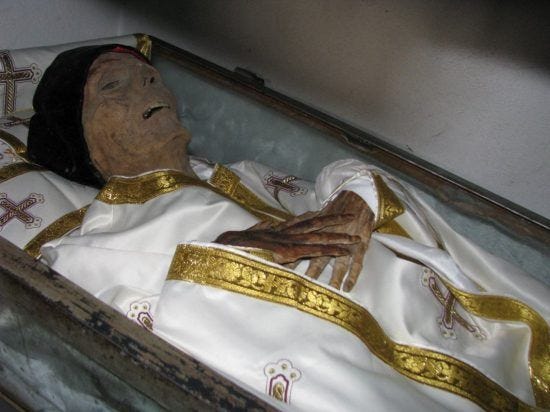
The relic of St. Lăcătușu in its uncorrupted state.
One of the former Legionaries who only disavowed the Legion under communist imprisonment, but not after was Ilie Lăcătușu.
In July 2025, following Legionary-themed manifestations at his relics, it stated that Lăcătușu was canonized for his Christian confession and suffering under communist imprisonment, but not for being part of the Legion.
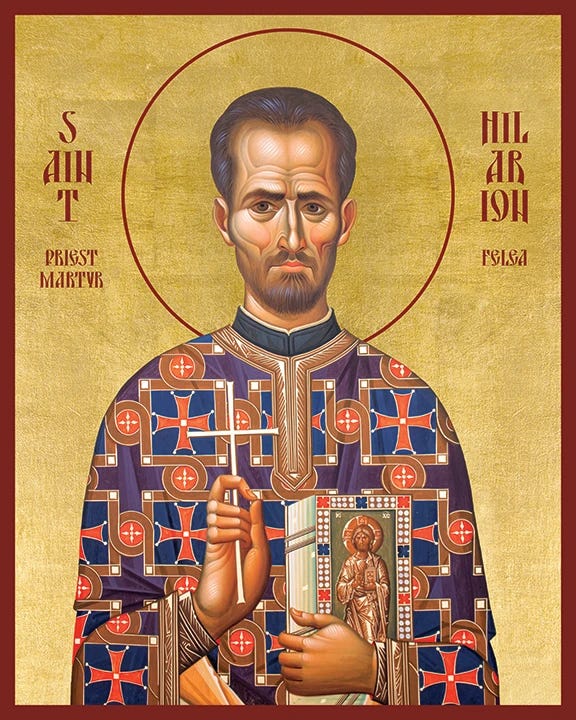
St. Ilarion Felea
Felea had a documented Legionary association in 1940, later said that the January 1941 rebellion caused him to break with the movement, explicitly rejected renewed Legionary activity in 1948, and denied Legionary connections during his 1949 interrogation. Nevertheless, the Communist security apparatus continued to regard him as a Legionary activist and prosecuted him again in 1958–59 in an alleged Legionary-related conspiracy.
Felea was accused in 1958–59 of participation in an anti-Communist conspiracy that the Securitate interpreted in Legionary terms, and he was convicted in 1959. However, the available evidence does not by itself establish that he had actually resumed Legionary activity after his earlier break with the movement. And he died in prison in 1961.
Ignorance or Purposeful Subversion?
Zapadnjak also doesn’t really know much of anything regarding the Iron Guard (Legion of the Archangel Michael). He states incorrectly that Romania was invaded by the Soviet Union in 1939. However, the Soviets annexed Moldavia in June of 1940 while King Carol II was still the leader of Romania.
In fact, it was the annexation of Moldavia and Northern Transylvania to Hungary that ended any remaining support for him. On September 6th, 1940, he abdicated in favor of his son, King Michael I, and left Romania. General Ion Antonescu, who was the Prime Minister, became the country’s de facto leader by leveraging the Iron Guard for support.
Both Antonescu and the Iron Guard opposed the old political establishment and both advocated for Romanian nationalism and antisemitic policies. Both wanted a close relationship with Germany, but German officials were divided over which Romanian faction to back.
The National Legionary State was proclaimed in September of 1940 with Antonescu as the head of government and Codreanu’s successor, Horia Sima, becoming the deputy prime minister.
By late 1940, the two sides increasingly clashed over control of the police, state institutions, economic policy, and the direction of the regime. The Iron Guard seized jewish-owned property, which intensified tensions.
The National Socialists saw the Iron Guard as more ideologically compatible to them, but Antonescu was more predictable and had more control over the military. On January 14th, 1941, Antonescu secured the support of Adolf Hitler as the more reliable partner for maintaining order and cooperating with Germany. Antonescu then began moving against the Iron Guard.
Historians are conflicted on who caused the 1941 Rebellion, but on January 20th, the killing of German military mission officer Major Helmuth Döring became a flashpoint, resulting in Antonescu and the Romanian military removing the Legion from the government by the 23rd.
Altogether, the Iron Guard was only in power for 4 months. Clearly not enough time to fight the Soviet Union.
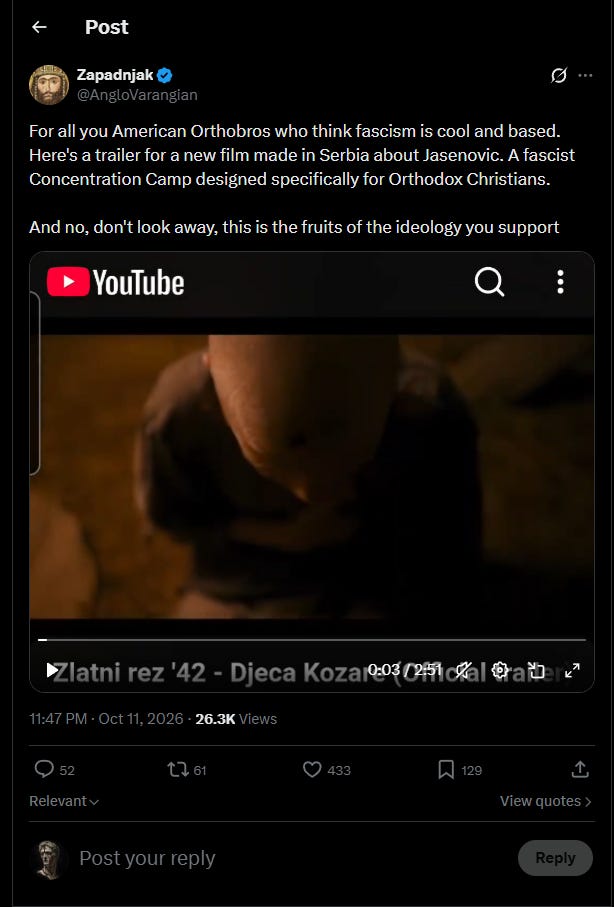
Zapadnjak, also never uses any sources for his arguments. What he relies on is pop culture dramatized fiction. It’s like appealing to Schindler's List, which itself is based on the fictionalized book, Schindler’s Ark. Not to mention, Jasenovac was a concentration camp that was set up to house Serbs, Roma, jews, and communists. It was not a camp specifically set up for Orthodox Christians.
Also, what Zapadnjak isn’t mentioning is the fact that there were Serbian fascists during World War II, including an explicitly fascist movement, ZBOR, led by Dimitrije Ljotić, an Orthodox Christian.
Playing Both Sides
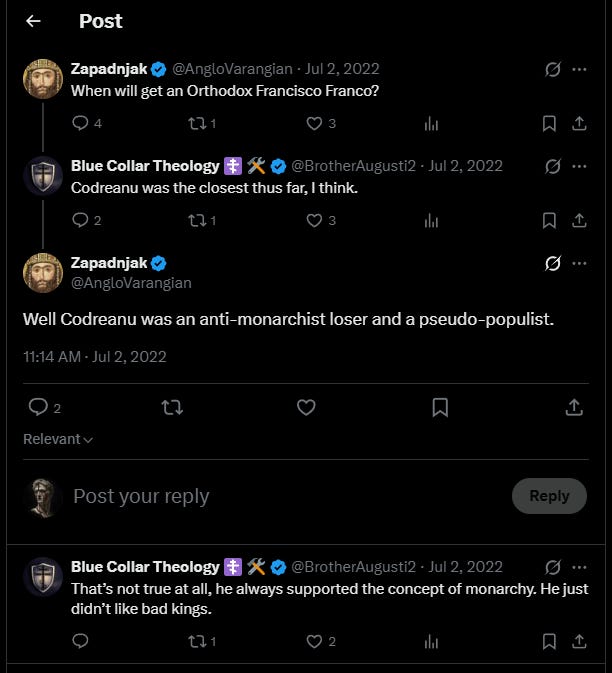
Famously, jews love to play both sides. Often taking controversial stances publicly to virtue signal and gain influence, then later subverting the audience to keep them pacified. Back in 2022, Zapadnjak was calling for an Orthodox Francisco Franco while trying to keep people from learning more about Corneliu Zelea Codreanu and the Legion of the Archangel Michael, by claiming he was an anti-monarchist and pseudo-populist. Both of which claims are untrue.
With the canonization of some of Codreanu’s fellow Legionaries in 2024, Zapadnjak shifted tune to try and audience capture more Orthodox Christians. This is a tactic that jews will employ in order to latch on to the narrative and later take control of it.
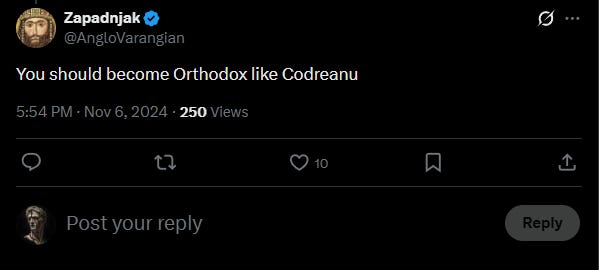
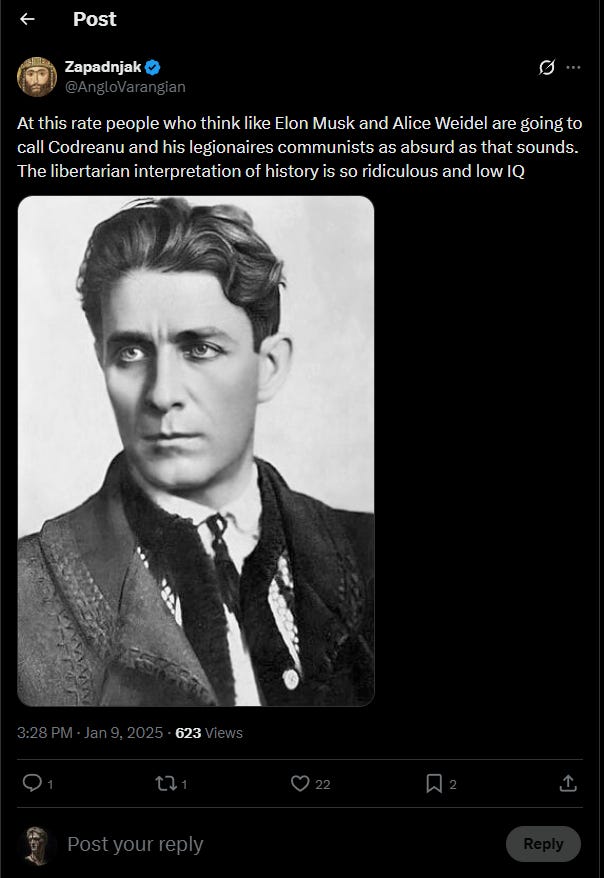
By November of that year, he was already instructing people to become Orthodox like Codreanu. Later defending them from accusations of being communists.
And the thing is, Zapadnjak is purposely doing this. He is well aware that there isn’t a dogmatic view on fascism from the Orthodox Church.
In Conclusion
Zapadnjak must have realized not that long ago that the narrative couldn’t be controlled. So instead of keeping up the charade, he decided to drop the act altogether.
In the Nationalist movement, the two proponents of Legionarism are myself and the Orthodox apologist, Benjamin Michael. Both of us having been unashamedly vocal about the direction the country needs to go in. However, while Benjamin mostly focuses on propaganda, I am the leader of a Legionary organization called, The New Way. My primary goal is to organize men in the same way that Codreanu did.
We are one of the most organized grassroots organizations in the country and we have been able to bring not only Orthodox Christians, but Protestants, and Catholics into the organization with the goal of renewing in real Americans the national consciousness and faith in God. Not only have we successfully organized these men, but many have also converted to Orthodoxy.
As time goes on, you will see us become more and more influential, and the likes of Zapadnjak become more and more subversive. But none of that will save them from what is to come.
Ionuț Biliuță, The Romanian Orthodox Church and the Iron Guard: The Politicization of the Romanian Orthodox Church in the Interwar Period (PhD diss., Central European University, 2014), 179.
Oliver Jens Schmitt, “Approaching the Social History of Romanian Fascism: The Legionaries of Vâlcea County in the Interwar Period,” Fascism: Journal of Comparative Fascist Studies 3, no. 2 (2014): 132.
Ionuț Biliuță, The Romanian Orthodox Church and the Iron Guard: The Politicization of the Romanian Orthodox Church in the Interwar Period (PhD diss., Central European University, 2014), 179. Biliuță notes that Metropolitan Gurie Grosu of Bessarabia participated in religious ceremonies at the Susai Mountain Legionary work camp. In 1935, Grosu publicly praised the Legionary work-camp movement, declaring that he was “deeply impressed by the organization of legionary youth, students, intellectuals, and common people for constructive work” and giving his blessing to the movement’s “purely Christian character.” The statement was subsequently reproduced in the Legionary press.
Ciprian-Viorel Pleșea, “Bishop Visarion Puiu: The Years of Exile,” Research and Science Today Supplement (2023), 22. Pleșea notes that in a letter concerning the organization of Romanian Orthodox communities in the United States, Puiu wrote, “I am the author of the draft law for the foundation of the diocese in the USA, thus its founder.”
Francisco Veiga, The Legionary Movement in Romania, 1927–1941: A Fascist Organization, trans. Mircea Dan Duță (Bucharest: Editura Humanitas, 1993), as cited in Roland Clark, Holy Legionary Youth: Fascist Activism in Interwar Romania (Ithaca, NY: Cornell University Press, 2015).
Roger Griffin, The Nature of Fascism (London: Routledge, 1991), 123. Griffin notes that in the 1937 Romanian elections, of the 103 candidates put forward under the banner of the Legionary Movement’s Everything for the Country organization, 33 were Orthodox priests—approximately one-third of the candidates.
Lavinia Stan, “Gheorghe Calciu-Dumitreasa, the Forgotten Anticommunist Dissident,” in Liberals, Conservatives, and Mavericks, ed. Frank Cibulka and Zachary T. Irwin (Budapest: Central European University Press, 2024), 206–9; Viața Părintelui Gheorghe Calciu după mărturiile sale și ale altora (Bucharest: Editura Christiana, 2007), 29–34.