


In 1991, Seymour Hersh, a jew, advanced the claim in his book, The Samson Option: that Israel possessed not only nuclear weapons, but an implicit doctrine of massive retaliatory use in the face of existential defeat.1
Although never officially acknowledged, the “Samson Option”—named after the biblical figure Samson—has endured in strategic discourse. Increasingly, it is treated not merely as metaphor, but as a plausible extrapolation from Israel’s capabilities, posture, and strategic culture.
While the Samson Option is not formally declared, the convergence of material evidence, doctrinal behavior, and historical context lends it substantial credibility as a real contingency framework.
From Metaphor to Strategic Inference
Hersh’s original formulation was considered controversial at the time, but it did not emerge in a vacuum. By the late 20th-century, mounting evidence suggested that Israel had developed a sophisticated nuclear arsenal centered around facilities such as the Negev Nuclear Research Center.2
Subsequent scholarship by Avner Cohen, another jew, confirmed that Israel had pursued nuclear capability deliberately and systematically, even while maintaining official silence.3
Crucially, the absence of explicit doctrine does not imply the absence of strategy. As Cohen argues, Israel’s nuclear posture is defined by deliberate ambiguity paired with implicit signaling.4 Within such a framework, extreme contingencies are unlikely to be codified publicly, but they may still exist as understood strategic endpoints.
Material Capability and the Logic of Use
The strongest evidence supporting the plausibility of the Samson Option lies not in rhetoric, but in capability.
Analysts such as Hans M. Kristensen and Robert S. Norris have documented that Israel maintains a diversified nuclear arsenal, including:
Land-based ballistic missiles
Air-delivered nuclear systems
Sea-based deterrence platforms
This triad-like structure strongly implies an emphasis on second-strike capability—the ability to retaliate after absorbing a catastrophic attack.5
As Joseph Cirincione notes, second-strike capability is inherently tied to doctrines of assured retaliation, not limited warfighting.6 States do not invest in survivable nuclear forces merely for symbolic purposes; they do so to guarantee that retaliation remains possible under worst-case conditions.
In this light, the Samson Option appears far less speculative. It becomes the logical extreme of an already established deterrent structure.

Strategic Culture and Existential Risk
Israel’s strategic environment further reinforces this interpretation. Since its founding, the state has gotten itself into repeated conflicts widely claimed as “existential threats.”
Cohen and other scholars emphasize that Israeli nuclear policy cannot be understood apart from this context.7 The core principle is not escalation dominance, but survival under conditions of extreme vulnerability caused by their own superiority complex and pride.
This context gives the Samson Option a distinct strategic logic:
If defeat risks national destruction,
and if nuclear capability exists,
then a last-resort retaliatory doctrine becomes not only plausible, but rational.
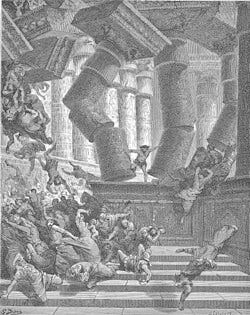
The invocation of the biblical figure Samson is therefore more than symbolic. It encodes a strategic commitment to avoiding annihilation at any cost, even if that cost includes catastrophic escalation. Essentially, “If I can’t win, nobody does.”
Silence as a Signal
One of the most important—and often misunderstood—aspects of the Samson Option is that its credibility depends on not being declared.
Israel’s policy of nuclear opacity allows it to communicate deterrent intent without specifying thresholds. This creates what might be called structured uncertainty: adversaries know the consequences could be extreme, but cannot predict when or how escalation would occur.
In such a system, the Samson Option functions as a background assumption rather than an operational plan. Its power lies precisely in the fact that it is never fully articulated.
Counterarguments and Limits
Skeptics argue that the Samson Option is overstated, pointing out the absence of official confirmation and the risks of escalation inherent in such a doctrine. But since we’re dealing with the Synagogue of Satan, we can assume Israel wouldn’t care about escalation.
As George H. Quester observes, the most consequential nuclear doctrines are often those that remain implicit rather than declared, precisely because ambiguity enhances deterrence.8
Thus, the lack of formalization does not undermine the Samson Option; it may, in fact, be integral to its function.
Conclusion
The Samson Option remains, in formal terms, an unofficial and unacknowledged concept. Yet the convergence of evidence—material capability, second-strike infrastructure, strategic culture, and deliberate ambiguity—suggests that it is more than a journalistic invention.
Rather, it is best understood as a credible inferred doctrine:
Not written, but embedded
Not declared, but signaled
Not hypothetical, but structurally implied
In the final analysis, the Samson Option persists because it reflects a fundamental reality of nuclear strategy:
When survival is at stake, deterrence does not end at proportionality. It extends to the assurance that no adversary can achieve victory through annihilation.

Seymour Hersh, The Samson Option: Israel’s Nuclear Arsenal and American Foreign Policy (New York: Random House, 1991).
Avner Cohen, Israel and the Bomb (New York: Columbia University Press, 1998).
ibidem
Avner Cohen, The Worst-Kept Secret: Israel’s Bargain with the Bomb (New York: Columbia University Press, 2010).
Robert S. Norris and Hans M. Kristensen, “Israeli Nuclear Forces, 2022,” Bulletin of the Atomic Scientists 78, no. 2 (2022): 113–121.
Joseph Cirincione, Bomb Scare: The History and Future of Nuclear Weapons (New York: Columbia University Press, 2007).
Avner Cohen, The Worst-Kept Secret: Israel’s Bargain with the Bomb (New York: Columbia University Press, 2010).
George H. Quester, Nuclear First Strike: Consequences of a Broken Taboo (Baltimore: Johns Hopkins University Press, 2006).


